Monthly Job-Seeking Benefit Surpasses Minimum Wage After Tax
There have been concerns raised that the current unemployment benefit system, which provides higher payments than the minimum wage, is actually undermining the motivation to work and threatening the financial soundness of employment insurance.
According to the report "Problems and Improvement Measures of the Employment Insurance System" released by the Korea Employers Federation on the 25th, as of 2024, the minimum amount of unemployment benefits in South Korea is 41.9% of the average wage, the highest among OECD countries.
Under current law, job-seeking benefits (the core component of unemployment benefits, paid in cash in cases of involuntary unemployment) are set at a minimum of 80% of the minimum wage. Due to the sharp increase in the minimum wage over the past few years, the lower limit for unemployment benefits has also risen significantly.
The monthly job-seeking benefit for the unemployed is approximately 1.93 million won, which is 92% of the monthly minimum wage. In terms of after-tax actual receipt (1.88 million won), there is even a reversal where the unemployment benefit exceeds the minimum wage.
Additionally, in South Korea, both the reference period (18 months) and the contribution period (180 days) required to qualify for job-seeking benefits are shorter than those in major OECD countries. As a result, if the minimum requirements are met, it is possible to receive unemployment benefits for four months after working for about seven months (180 days), making it easy to repeatedly alternate between employment and unemployment and rely on unemployment benefits.
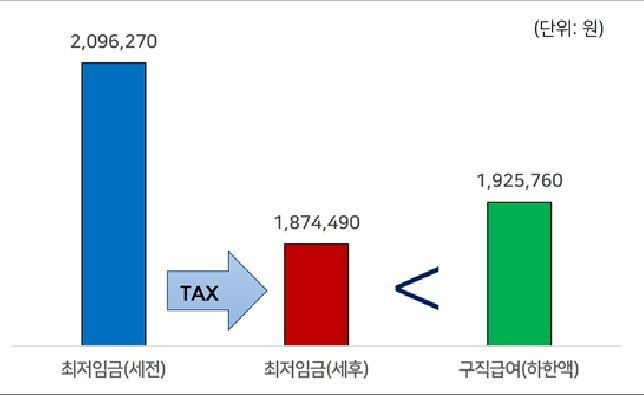 Comparison of Monthly Unemployment Benefits and Minimum Wage Monthly Amount (2025). Provided by Korea Employers Federation
According to the Ministry of Employment and Labor, the number of people who received job-seeking benefits three or more times over the past five years reached 113,000 in 2024, and this number has been steadily increasing each year. The approval rate for job-seeking benefit applications is also as high as 99.7%, meaning that virtually everyone who applies receives the benefits.
The Korea Employers Federation also pointed out that, in South Korea, the funds for parental leave benefits are drawn from the unemployment benefit account. This has become a serious burden on the financial soundness of the employment insurance fund.
To address these issues, the Korea Employers Federation proposed measures such as: restructuring the minimum amount and qualification requirements for job-seeking benefits; strengthening penalties for fraudulent claims of unemployment benefits; and expanding government funding for maternity protection and childcare support programs.
The Korea Employers Federation emphasized, "To establish a sustainable employment insurance system, it is necessary to reform the excessively high minimum amount of job-seeking benefits and introduce a rational incentive structure, such as reducing payments for repeat recipients. Maternity protection benefits that do not align with the purpose of unemployment benefits should be shifted to a state responsibility by expanding government funding."
© The Asia Business Daily(www.asiae.co.kr). All rights reserved.
![Clutching a Stolen Dior Bag, Saying "I Hate Being Poor but Real"... The Grotesque Con of a "Human Knockoff" [Slate]](https://cwcontent.asiae.co.kr/asiaresize/183/2026021902243444107_1771435474.jpg)















