President Lee Meets Treasury Secretary Besant in New York
Reiterates Call for Currency Swap
Kim Minseok's Bloomberg Interview: "Visa Issue Must Be Resolved for Negotiation Progress"
President Lee Jaemyung, who is visiting New York, United States, to attend the United Nations (UN) General Assembly, met with U.S. Treasury Secretary Scott Besant at the Permanent Mission of the Republic of Korea to the UN on the 24th (local time). President Lee stated that Korea-U.S. tariff negotiations should be discussed based on commercial rationality. Secretary Besant acknowledged that there may be short-term difficulties regarding the stalled Korea-U.S. tariff negotiations, but expressed confidence that these challenges can be overcome.
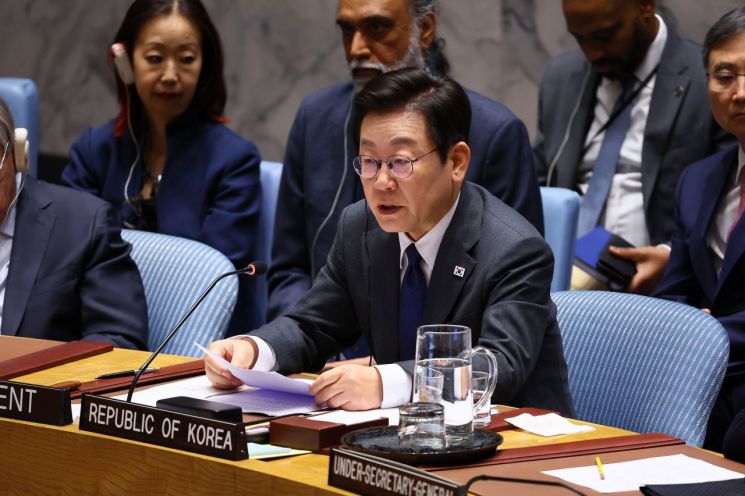
Kim Yongbum, Chief Presidential Policy Secretary, explained that President Lee said, "Cooperation in the area of security is progressing well, and it is also necessary to have productive consultations in the field of trade." This meeting between President Lee and Secretary Besant took place about a month after their previous encounter during the Korea-U.S. summit in Washington, D.C. in August. The meeting was also attended by Deputy Prime Minister and Minister of Economy and Finance Koo Yooncheol, National Security Advisor Wi Seongrak, and Secretary Kim.
Regarding the 350 billion dollar investment fund for the United States, President Lee expressed his hope that discussions would progress in a way that aligns with the interests of both countries, based on commercial rationality, and explained that Korea's circumstances differ from those of Japan. Secretary Besant responded by emphasizing that Korea's cooperation is extremely important in the shipbuilding sector, which the United States considers a core industry, and expressed gratitude for Korea's active support. He also noted that there has been progress in trade negotiations between Korea and the United States.
The Korean government maintains that, since operating a 350 billion dollar investment fund in the United States could cause significant instability in the foreign exchange market, it is necessary to establish safeguards such as an unlimited currency swap agreement. A currency swap is considered the minimum safety measure. Secretary Kim explained, "It must be within the scope allowed by our current laws, and if necessary, we may need to revise the Export-Import Bank Act or, if it is a significant burden, obtain parliamentary approval for a guarantee." He added, "The foreign exchange market issue has been raised as a very important matter in the discussions between the two countries."
Secretary Kim explained the background for requesting a currency swap from the United States, stating that there were significant differences in the memorandum of understanding (MOU) sent by the U.S. after the tariff agreement on July 31. He said, "The United States used the term 'cash flow.' This was essentially an argument very close to 'equity.' We were concerned about the potential impact on the foreign exchange market and pointed this out to the United States." Secretary Kim continued, "We proposed to define cash flow according to our own standards, such as loans, guarantees, and investments, but the United States has not agreed." He emphasized, "We are negotiating on the principle that the outcome should be commercially rational, feasible for us, and mutually beneficial to our national interests. We will not sacrifice principles due to deadlines." He added, "We made it clear that items such as rice and beef are not open for discussion."
Meanwhile, Prime Minister Kim Minseok said in an interview with Bloomberg, released on the 25th, "If a solution to the U.S. visa issue is not found, it will be difficult to invest in the United States or carry out various joint projects currently planned between Korea and the United States." He added, "The detention incidents were a major blow not only to our citizens but also to the workers who were detained. It is natural that they are now reluctant to return to the United States."
© The Asia Business Daily(www.asiae.co.kr). All rights reserved.
![Clutching a Stolen Dior Bag, Saying "I Hate Being Poor but Real"... The Grotesque Con of a "Human Knockoff" [Slate]](https://cwcontent.asiae.co.kr/asiaresize/183/2026021902243444107_1771435474.jpg)















