National Tax Service Launches Tax Audits on Sectors Closely Tied to Daily Living Expenses
55 Companies Targeted, Including Processed Food Manufacturers and Franchise Headquarters
Distribution company A, which sells agricultural products to large supermarkets and consumers, significantly raised its product prices, citing the rise in agricultural product prices. However, according to a National Tax Service investigation, company A was found to have fabricated purchases of agricultural products it had not actually bought, overstating its costs and thereby understating its income to evade taxes.
On September 25, the National Tax Service announced that it will conduct intensive tax audits on tax evaders in sectors closely tied to everyday living expenses, who use the excuse of rising raw material prices to inflate their costs through irregular methods, reduce their reported income, and yet excessively raise prices.
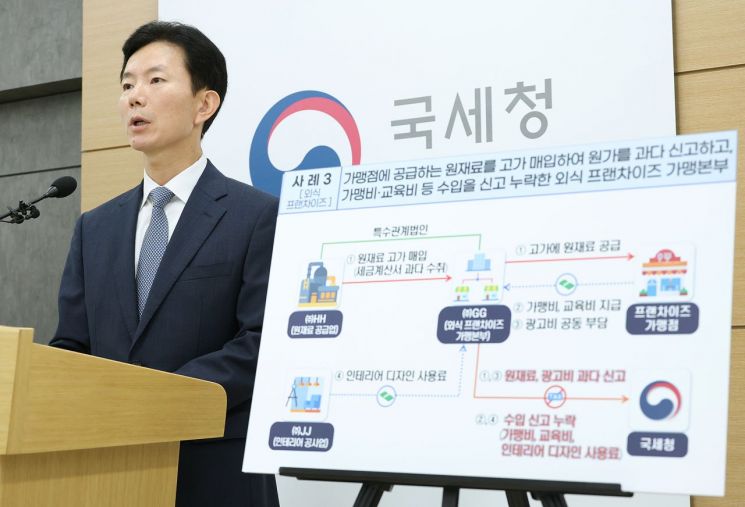 Min Ju-won, Director of the National Tax Service Investigation Bureau, is giving a briefing at the Government Sejong Complex on the 25th.
This tax investigation targets a total of 55 companies, including 12 processed food manufacturing and sales companies, 12 agricultural, livestock, and fisheries product supply and distribution companies, 14 food service franchise headquarters, and 17 event companies such as wedding and funeral service providers.
Min Juwon, Director of the National Tax Service Investigation Bureau, explained, "According to consumer price trends published by Statistics Korea, prices for processed foods, agricultural, livestock, and fisheries products, and dining out-items that people encounter in daily life-have generally risen compared to the previous year. The National Tax Service has conducted a detailed analysis of cost reporting and distribution processes for companies closely related to daily life, such as processed food, agricultural, livestock, and fisheries product companies, as well as wedding and funeral service companies."
The National Tax Service's analysis found that some companies claimed they had no choice but to raise prices due to increased costs from higher raw material prices, logistics, and labor costs. However, it was confirmed that these companies excessively raised product prices, shifting the burden onto consumers by taking advantage of the cost increases. They inflated their costs by falsely reporting purchases of raw materials from business partners or by declaring fabricated labor costs paid to the owners' families, thereby reducing their actual company income and evading taxes.
Additionally, among agricultural, livestock, and fisheries product distribution companies, numerous cases were identified where tax laws were violated, such as issuing false invoices and conducting unrecorded transactions to evade taxes. These companies also purchased luxury apartments, high-end sports cars, and yachts with corporate funds, which the owners' families then used for personal purposes.
Through this tax investigation, the National Tax Service plans to thoroughly verify tax evaders in sectors closely tied to living expenses who reduce their income by inflating costs and evade taxes through opaque distribution processes while still excessively raising prices. In particular, for owners' families who accumulate wealth by diverting corporate funds or paying fabricated labor costs, the agency will examine the sources of funds for all asset acquisitions. Business partners who assisted the investigated companies in inflating their costs will also be subject to investigation.
Director Min stated, "Going forward, the National Tax Service will continue to monitor and audit companies that excessively raise prices under the pretext of rising raw material costs, shifting the burden onto consumers, while underreporting the taxes they owe. We will proactively respond to tax evasion in sectors closely related to people's daily lives, where there is a high risk of harm to the public, and will make greater efforts to eradicate tax evasion that undermines people's livelihoods and to ensure stability in daily life."
© The Asia Business Daily(www.asiae.co.kr). All rights reserved.
![Clutching a Stolen Dior Bag, Saying "I Hate Being Poor but Real"... The Grotesque Con of a "Human Knockoff" [Slate]](https://cwcontent.asiae.co.kr/asiaresize/183/2026021902243444107_1771435474.jpg)















