Trump: "Russia Is a Paper Tiger, Ukraine Can Recover"
Russia Faces Five Consecutive Years of Deepening Fiscal Deficits... Wave of Corporate Bankruptcies
U.S. Support for Ukraine Unchanged... "Merely an Attempt to Provoke Putin"
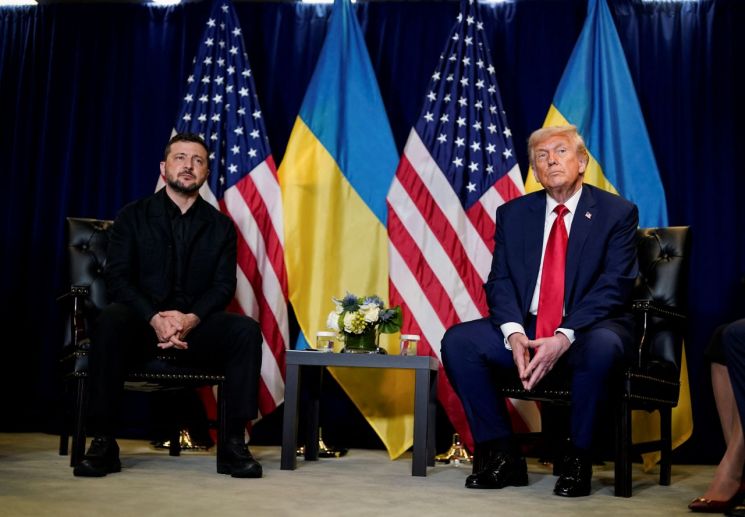 U.S. President Donald Trump (right) is meeting with Ukrainian President Volodymyr Zelensky (left) for a summit at the United Nations General Assembly held on the 23rd (local time). Photo by Reuters Yonhap News
U.S. President Donald Trump has downgraded Russia to a "paper tiger" and mentioned the possibility of Ukraine restoring its territory, drawing attention to the background of this shift. As projections emerge that Russia is suffering from severe economic hardship due to a deepening fiscal deficit and declining oil exports, analysts say President Trump's policy toward Russia has changed dramatically.
Trump Downgrades Russia to 'Paper Tiger'... "Change in Stance Due to Worsening Russian Fiscal Deficit"
On the 23rd (local time), President Trump stated on his social networking service, Truth Social, "If Russia were truly a military powerhouse, it should have won this war in less than a week, but it has dragged on for three and a half years. This makes Russia look like a 'paper tiger.' With time, patience, and financial support from Europe, especially the North Atlantic Treaty Organization (NATO), it is entirely possible for Ukraine to reclaim its original borders."
This marks a complete reversal from President Trump's earlier pro-Russian stance at the start of his administration, when he pressured Ukraine to cede territory. As Russia's fiscal and economic crisis continues and doubts grow about its ability to sustain the war, analysts believe President Trump has also changed his position on the Russia-Ukraine war. CNN reported, "The key factor behind President Trump's change in stance is Russia's economic crisis," adding, "Attacks by Ukraine on Russian oil refineries have disrupted exports, and Russia's ongoing fiscal deficit is raising concerns that it will be difficult to sustain the war for much longer."
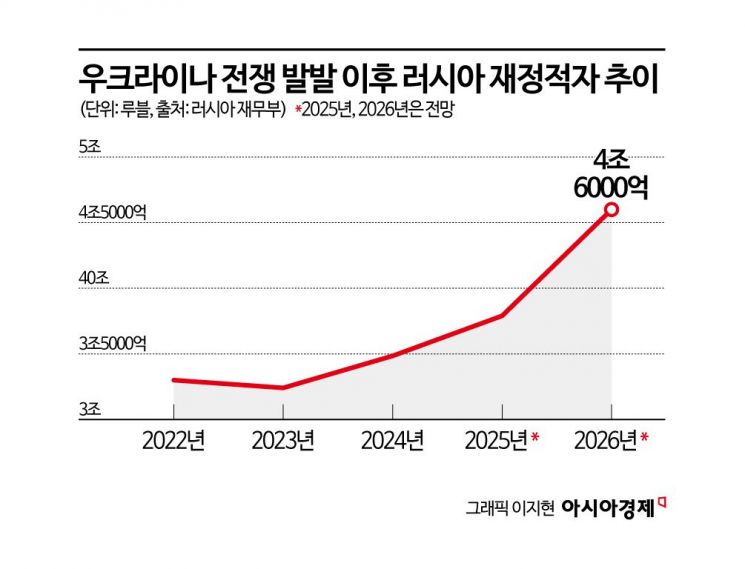
Russia's fiscal deficit has persisted since the outbreak of the war in 2022 and is expected to continue for five consecutive years through next year. On the 24th, Russia's Ministry of Finance announced that this year's fiscal deficit is projected at 3.79 trillion rubles (approximately 63.37 trillion won), and next year's deficit is expected to reach 4.6 trillion rubles (about 76.91 trillion won). If the deficit continues through next year, it will mark five consecutive years of fiscal deficits since the start of the Ukraine war in 2022. The cumulative deficit over the past three years alone, from 2022 to last year, has reached 10.026 trillion rubles (about 168.236 trillion won).
Recently, Ukrainian airstrikes on Russian oil refineries have reduced refining volumes and led to a decline in exports, further damaging the economy. According to CNBC, Russia's oil refining volume this month was about 5.5 million tons, down by more than 900,000 tons from last month's 6.4 million tons. Since Russia relies on oil exports by state-owned enterprises to support its fiscal and economic stability, the impact is inevitable.
With prolonged sanctions against Russia, the number of Russian companies continues to decrease. According to the Ukrainian Foreign Intelligence Service (SZRU), as of the first of this month, there were 3.19 million companies in Russia, but 486,000 companies have closed since 2022.
Has the Perspective on the Russia-Ukraine War Shifted?... No Increase in Military Support Yet

However, some analysts point out that President Trump's change in attitude may be a strategy to bring Russia to the negotiating table, and it is too early to conclude that the U.S. perspective on the Russia-Ukraine war has fundamentally changed.
The BBC, citing sources, reported, "The Trump administration's support for Ukraine still only involves executing the arms aid packages approved by former President Joe Biden, and stronger sanctions against Russia have only been discussed, not implemented. Even if support increases, it is likely to take the form of indirect assistance by selling weapons to NATO rather than providing direct support to Ukraine."
In fact, since the Trump administration took office, military support for Ukraine has shifted to being led by Europe rather than the United States. Since the outbreak of the war in 2022, European countries have provided $95 billion (about 133 trillion won) in military support to Ukraine, already surpassing the $75 billion (about 105 trillion won) provided by the United States. After announcing in March that he would consider suspending additional military support to Ukraine, President Trump has only executed the support budgets planned during the Biden administration, with no additional new aid packages for Ukraine.
Politico, a U.S. political news outlet, also cited European Union diplomats as saying, "There is skepticism that Trump's change in attitude toward Russia is merely an attempt to provoke Putin to come to the negotiating table," adding, "No matter how encouraging his statements may sound, trust in President Trump, who has repeatedly changed his words, remains extremely low."
© The Asia Business Daily(www.asiae.co.kr). All rights reserved.
![Clutching a Stolen Dior Bag, Saying "I Hate Being Poor but Real"... The Grotesque Con of a "Human Knockoff" [Slate]](https://cwcontent.asiae.co.kr/asiaresize/183/2026021902243444107_1771435474.jpg)

















