Essential Drug Citizens' Network Survey on System Improvement
85.4% of Respondents Say "Expansion of Drug List Needed"
Pharmacist Associations Refuse Discussion Citing Misuse and Side Effect Concerns
Consumer Responses Highlight "Safety as Prerequisite for Expansion"
"Pharmacist Groups Should Participate in Expansion Discussions"
With the upcoming Chuseok holiday and an extended break of up to 10 days next month, there has been renewed demand to expand the range of essential over-the-counter drugs sold at convenience stores. The argument is that consumers who need emergency medication during public holidays or late-night hours, when pharmacies are closed, should have more options available at nearby convenience stores. However, pharmacist associations have opposed this move, citing concerns over the potential misuse or abuse of medications closely related to public health without expert guidance. This issue has seen little progress for over a decade, but attention is now focused on whether discussions will resume.
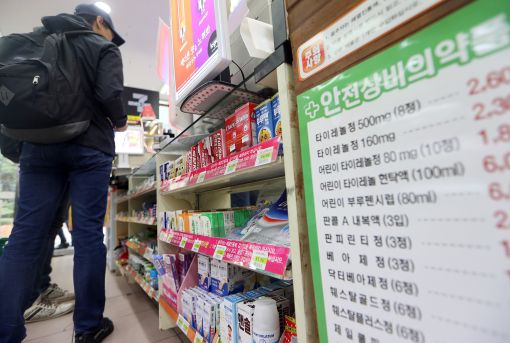 Cold medicines and other essential drugs are stocked at a convenience store in Seoul. Photo by Yonhap News Agency
According to the results of a consumer perception survey on improving the convenience store essential drug system, conducted by the Essential Drug Citizens' Network on September 24 among 1,087 Koreans aged 14 to 79 nationwide, 85.4% responded that there is a need to expand the range of essential drugs available at convenience stores. When including those who believe that the two discontinued essential drugs should be replaced with other products, the agreement rate rises to 94.7%.
The Essential Drug Citizens' Network is an organization established in 2023 to improve access to essential over-the-counter medications. This survey was conducted from August 18 to 25. Two years ago, 62.1% of respondents said expansion was necessary, but this figure has now risen by more than 20 percentage points. Since 2016, similar surveys have been conducted every two years, but this is the first time that support has exceeded 90%.
Under the current Pharmaceutical Affairs Act enforcement regulations, convenience stores in Korea can sell up to 20 designated essential drugs. This system was introduced in 2012 to address the inconvenience of purchasing medications during late-night hours or public holidays. Based on this, 13 products such as cold medicines, antipyretics, pain relievers, digestive aids, and anti-inflammatory drugs have been sold at convenience stores. The list of designated products was originally intended to be reviewed every three years, but there has been no expansion in the past 13 years. Furthermore, after the discontinuation of Tylenol 80mg and 160mg, only 11 out of 4,813 types of over-the-counter drugs in Korea are now available at convenience stores. In contrast, countries like Japan and the United Kingdom allow the sale of at least 120 and up to 300,000 types of over-the-counter drugs outside of pharmacies.
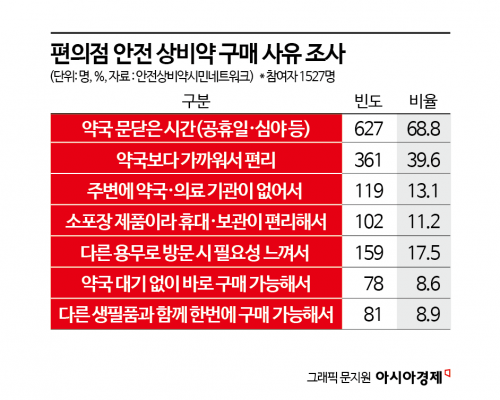
The convenience store industry argues that even if all 20 items stipulated by the Pharmaceutical Affairs Act are not filled, at least some commonly used products with fewer side effect concerns, such as antacids, antidiarrheal agents, and burn ointments, should be added. They claim that consumers who urgently need essential drugs during late-night hours or holidays, when pharmacies are closed, can conveniently purchase them at one of the 50,000 convenience stores nationwide. The industry has consistently conveyed these demands to policymakers and relevant government departments.
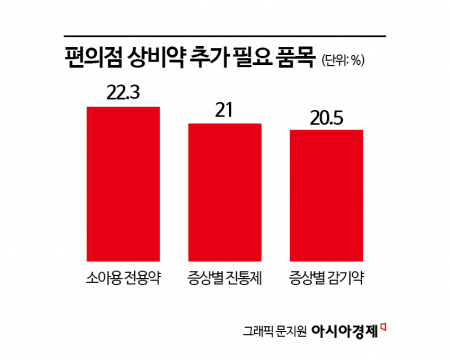
In fact, the latest survey showed that 83.8% of respondents had experience purchasing essential drugs at convenience stores, up more than 12 percentage points from 71.5% two years ago. Among those who supported expansion, the most requested additions were pediatric-specific medications (22.3%), symptom-specific pain relievers (21.0%), and symptom-specific cold medicines (20.5%).
On the other hand, pharmacist organizations such as the Korean Pharmaceutical Association oppose expanding the range of products, citing concerns about potential harm to public health due to misuse or abuse. Although the Fair Trade Commission selected the issue of adjusting the list of essential drugs as a "regulatory improvement task to enhance competition" in 2019 and decided to form an Essential Drug Designation Review Committee in 2023, the committee has yet to be established.
Kim Yeonhwa, chairperson of the Essential Drug Citizens' Network, stated, "We have repeatedly submitted petitions to the Ministry of Health and Welfare and the National Assembly to convene the Essential Drug Designation Review Committee and have even attempted direct dialogue with the Korean Pharmaceutical Association, but there has been no progress." She emphasized, "Although the association opposes expansion citing 'safety concerns,' the essential drugs sold at convenience stores are strictly selected from over-the-counter drugs that have undergone safety monitoring." According to the survey, 64.3% of respondents cited "products with few side effects and high safety" as a prerequisite for expansion, while 51.7% pointed to "products with low risk of misuse or abuse."
Lee Jooyeol, professor of Health Administration at Namseoul University, said, "There are still frequent cases where mothers are unable to obtain emergency medication during public holidays or late-night hours," and added, "The pharmaceutical association should agree to expand access to essential drugs at convenience stores and actively participate in discussions as experts to help resolve public inconvenience."
© The Asia Business Daily(www.asiae.co.kr). All rights reserved.
![Clutching a Stolen Dior Bag, Saying "I Hate Being Poor but Real"... The Grotesque Con of a "Human Knockoff" [Slate]](https://cwcontent.asiae.co.kr/asiaresize/183/2026021902243444107_1771435474.jpg)
















