Chuseok Fruit Purchases Hesitate Due to Price Concerns
Increased Apple and Pear Shipments Expected to Ease Prices
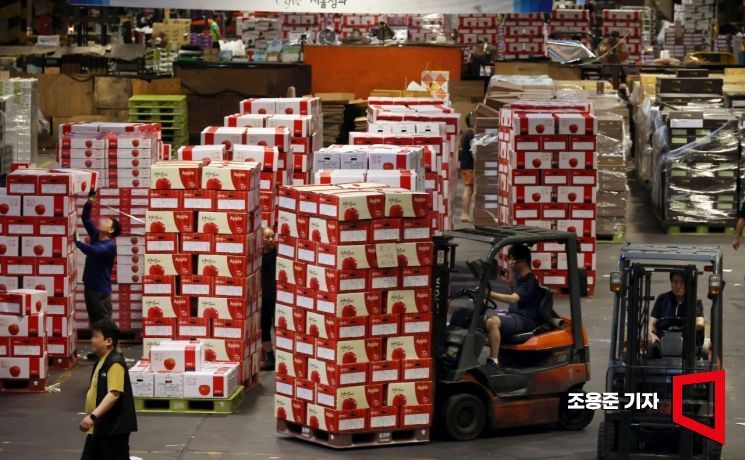
It has been found that consumers are hesitating to purchase fruit for this year's Chuseok holiday due to concerns over high prices. However, there are expectations that the actual perceived prices will remain stable, as the supply of major items such as apples and pears has increased thanks to the later date of Chuseok this year.
According to a survey conducted by the Korea Rural Economic Institute and market research agency Embrain Research on September 24, among 1,000 consumers, 54.8% responded that their intention to purchase fruit for household consumption during the Chuseok peak season would be 'about the same as last year,' which was the highest proportion. The intention to 'decrease' purchases compared to last year was 35.7%, higher than the intention to 'increase' purchases, which stood at 9.5%.
Among major fruits, the intention to reduce purchases of tangerines (44.0%) and peaches (41.3%) exceeded 40%, which is relatively higher than for apples, pears, persimmons, and grapes. This is believed to be because these two items are either past their main shipping season or have not yet reached it by the time of Chuseok, meaning they fall outside the period consumers perceive as their peak season.
The main reason cited for the decrease in fruit purchase intentions compared to last year was 'price burden' (62.1%), which accounted for the largest share. Apples were the item for which consumers most strongly felt the price burden, at 83.3%, followed by 'pears' (77.6%), 'tangerines' (61.6%), 'peaches' (57.6%), 'grapes' (53.3%), and 'persimmons' (51.4%). This is interpreted as a reflection of the relatively high price levels last year in consumer perceptions. Other reasons included 'family members dislike it' (11.9%), 'number of family members has decreased' (8.8%), and 'poor quality (taste, freshness)' (8.8%).
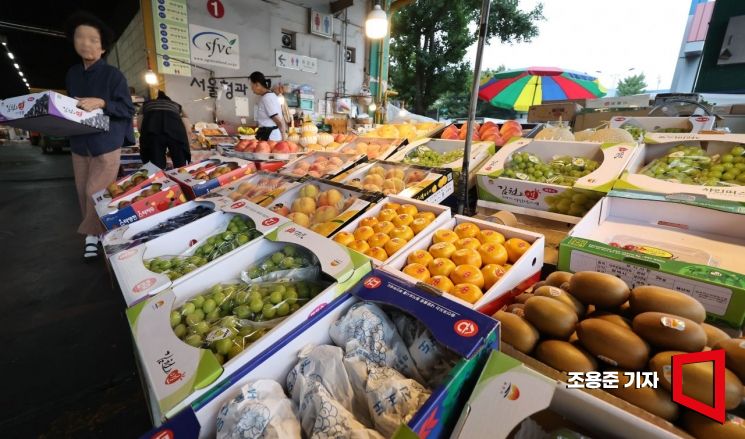
Although price burden emerged as the main reason for the decline in purchase intentions, it is expected that the actual price burden felt by consumers will be less than last year, as the overall supply of fruit during the Chuseok peak season will be greater than last year. This is because the supply of major fruits such as apples, pears, and persimmons is expected to increase from mid- to late September, and a variety of fruits, including imported ones, are expected to be shipped. In fact, retail prices for major fruits have been declining since mid-September.
For apples, the representative item, the shipment volume during the two weeks before Chuseok and the peak season (September 22 to October 5) is expected to increase by 6.5% compared to last year. The shipment volume of Hongro apples, whose growth had been delayed due to prolonged high temperatures and insufficient rainfall, is increasing, and the later date of Chuseok is expected to lead to earlier shipments of other varieties as well. As a result, the shipment volume of apples during the Chuseok peak season is forecast to increase compared to last year. For pears, the shipment volume during the peak season is expected to be around 43,000 tons, a 7.2% increase over last year's peak season. Due to the continued high temperatures in July and August, the harvest period for all varieties has been delayed, and shipments are predicted to be concentrated during the Chuseok peak season.
As for the main purchasing channels for household fruit during the Chuseok peak season, 'large retailers' accounted for the highest proportion at 47.4%. The share of large retailers has increased because there are more discount events compared to the summer, and they offer a wider variety of fruit than other channels. Traditional markets were the second most common purchasing channel at 12.1%. This is believed to reflect the seasonal characteristics of the holiday period, and is also linked to government and local government policy support, such as Onnuri gift certificate programs and discount events, as well as consumption coupons for economic recovery that are implemented before and after the holiday.
© The Asia Business Daily(www.asiae.co.kr). All rights reserved.


















