Korea's First "Book Village"
Experimenting with "Simple and Appropriate Living"
1980s Activist Generation Returns Home
Choosing "the Path of Living" Over Politics
"Seeking a Different Life After Retirement"
A New Model for Regional Cultural Movements
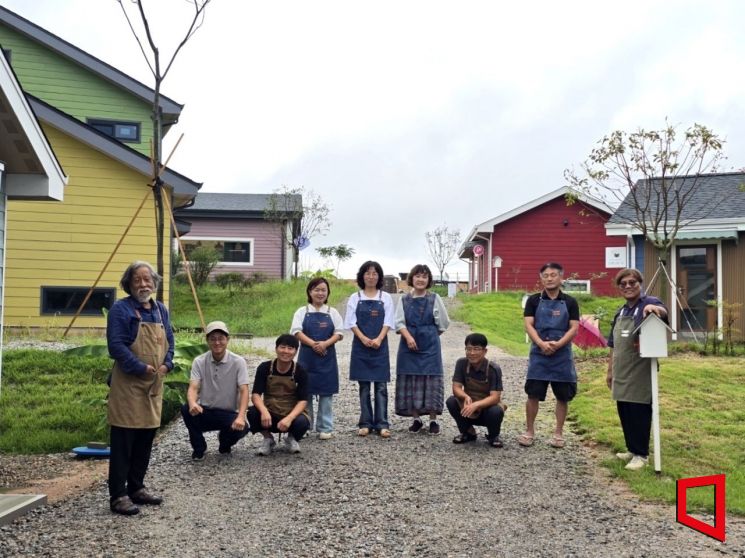 In the bookstore village perched on a hill in Daesan-myeon, Gochang-gun, Jeollabuk-do, six small bookstores specializing in philosophy, graphic novels, ecology, travel, and picture books come together to rebuild life through books, living a retirement life centered on community and sharing. Photo by Park Changwon.
There are two unique villages in Gochang, Jeollabuk-do: "Gochang Bookstore Village" in Daesan-myeon and "Chaekmaeul Haeri" in Haeri-myeon. As their names suggest, these two villages, which have come together around books, are attracting attention as new models for regional cultural movements in South Korea.
Gochang Bookstore Village is the first "bookstore village" in Korea, formed by six independent bookstores. Chaekmaeul Haeri, on the other hand, is a space that transformed a closed school into a "village that makes books." Both places are experimenting with community-based living centered on books, sending a powerful message to Korean society.
◇ Korea's First Bookstore Village... Experimenting with "Simple and Appropriate Living"
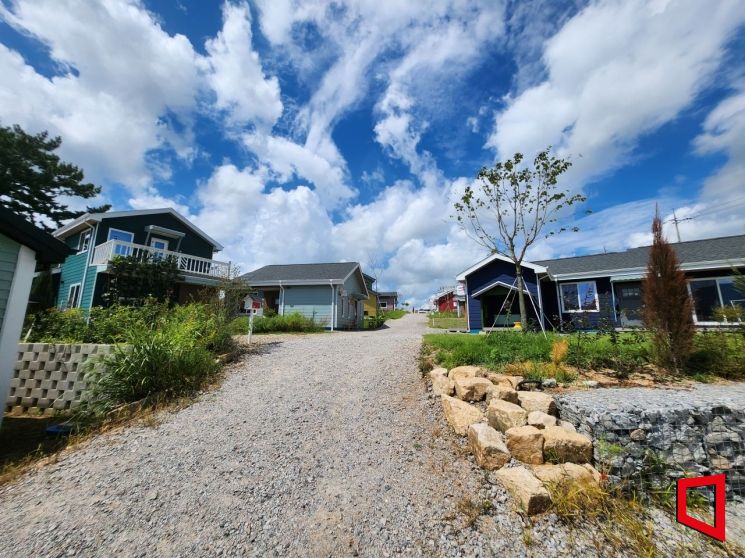
Perched on a hill in Daesan-myeon, Gochang-gun, the bookstore village brings together six small bookstores specializing in philosophy, graphic novels, ecology, travel, and picture books. Village chief Lee Yunho (age 63) is a former cultural critic who published the magazines "Yegam" and "Review" in the 1990s. Although he once ran a humanities academy in Seoul, he lost his space due to gentrification, which inspired him to create a "Korean version of Hay-on-Wye," the famous UK book town.
In an interview with this publication, Lee explained, "I wanted to escape the hurried life of the city and try living simply and appropriately. I wanted to experiment in the bookstore space with what is an appropriate amount to earn and spend, and what kinds of relationships are appropriate within a community."
Those who shared this vision included Kang Junseok and Hwang Kyungseon, a couple he met through humanities lectures, as well as fashion planner Lee Junho. They agreed to "build a life around books," secured a 4,000-pyeong plot of land, built homes and bookstores on 2,000 pyeong, and used the remaining 2,000 pyeong for communal farming. Each opened a bookstore reflecting their own expertise and taste, but all shared the principle of "running a bookstore as a way of life, not just as a business."
The residents of the bookstore village also established a set of rules: ▲ For three years, do not sell the bookstore and keep it open every day without holidays ▲ Do not proceed with anything unless everyone agrees ▲ The bookstore must not become an annex to a lodging facility. Beyond jointly operating the bookstores, they also established a used bookstore called "Rebook" and a village enterprise for processing local specialties.
◇ From a Closed School to a Village of Books: Chaekmaeul Haeri
About a 30-minute drive from Daesan-myeon Bookstore Village, Haeri-myeon is home to Chaekmaeul Haeri, which already has a history of nearly 20 years. Village chief Lee Daegun (age 55) acquired the site of an old school established by his great-grandfather, which had been closed in 2006, and transformed it into a "village that makes books." Having edited over 1,000 books over 30 years, he wanted to create a magical space where people become authors, not just consumers of books.
Through publishing camps, village schools, and book film festivals, Chaekmaeul Haeri has produced more than 5,000 "authors." From the elderly to teenagers, people write and publish their own books, making this place not just a reading space but a true publishing community.
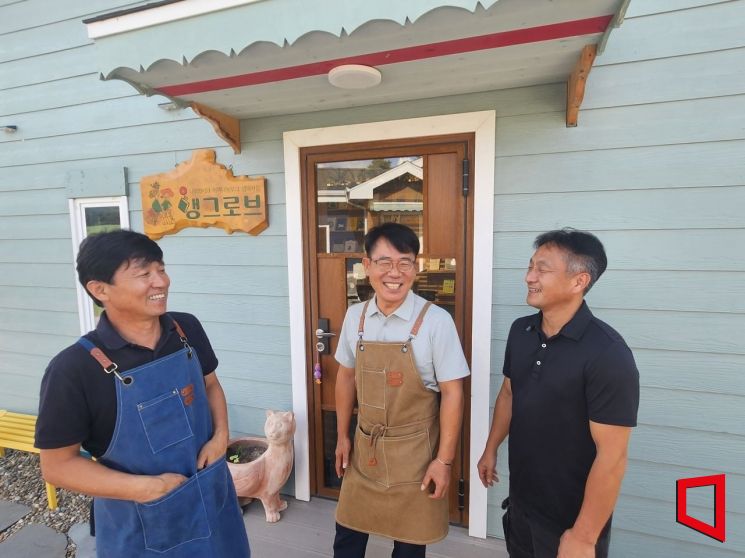 In the 1980s, Kang Junseok, Kim Cheolhong, and Kim Seongyeol (from left in the photo) were student activists in the Chinese Language Department at Chosun University. The three have worked in firefighting, meat sales, and food distribution while engaging in social activities. After retirement, they are challenging themselves to change their way of life through bookstores and community villages. Photo by Park Changwon
◇ "The Path of Living," Not the Path of Power
Half of the six members of Gochang Bookstore Village are from the PD (People's Democracy) faction of student activists in the Chinese Language Department at Chosun University during the 1980s: Kang Junseok, Kim Cheolhong, and Kim Seongyeol.
In particular, Kang Junseok was a candidate for student body president at Chosun University and was deeply involved in the movement at the time. In the late 1980s, the student movement split into the NL (National Liberation) and PD (People's Democracy) factions. While the NL faction shifted toward nationalism and political power, the PD faction sought alternatives in labor, grassroots, and culture.
Kang said, "For our generation, the movement is over, but the questions remain. There was a path to politics and compromise with vested interests, but I didn't think that was right for me. In the end, what remains is daily life, and perhaps the way to live is to form relationships with people within a community."
This difference in choices became clear in the trajectories of their lives. While many from the NL faction entered political parties and secured institutional power, many from the PD faction dispersed into local communities or the fields of culture and education. The creators of Gochang Bookstore Village are part of this trend.
Kang and his colleagues worked in firefighting, food distribution, and meat sales, then reunited as they approached retirement. What they chose was "a way of living through books." Rather than changing social structures through political power, they sought to change their way of life itself through bookstores and village communities. This is significant in that the activist generation continues to experiment with "alternative ways of living" even after retirement.
They define themselves as "a generation not seeking to become heroes now, but living with a willingness to embrace modesty." Choosing "the path of living" over "the path of power," their return to the countryside sends a new message from the activist generation of the 1980s to society.
◇ A Message to Generations and Society
The experiment of Gochang Bookstore Village is not simply about creating a local cultural space. It is an answer to the question of what values the democratization generation will live by after retirement. Rebuilding life with books in spaces pushed out by capital, and centering community and sharing, offers a quiet yet profound resonance in Korean society.
As the residents of the bookstore village declare, "This is not a tourist destination, but a place to fully enjoy books." Their experiment may not be flashy, but it is steadily and firmly reshaping the cultural landscape of Korean society.
© The Asia Business Daily(www.asiae.co.kr). All rights reserved.