Establishing an Integrated Management System Covering "Prevention, Response, and Recovery"
The government has announced a comprehensive injury management plan to address the issue of "injury," which ranks as the fourth leading cause of death in Korea. The vision of this plan is to create a "healthy society free from injury concerns," with the goal of reducing the injury mortality rate by 30% by 2030.
The Korea Disease Control and Prevention Agency stated on the 24th that it has finalized the "First Comprehensive Injury Management Plan" after review and approval by the National Injury Management Committee. "Injury" is a broad concept encompassing all health problems caused by external factors such as accidents, disasters, and poisoning, excluding diseases.
According to the agency, in 2023 alone, approximately 3.55 million people experienced injuries, with 1.23 million hospitalized and around 28,000 deaths. The socioeconomic cost of injuries is estimated at 21 trillion won annually, making it the largest among all diseases. Notably, for those aged 0 to 44, injury was the leading cause of death.
Until now, policies related to injury have been fragmented across ministries-transportation (Ministry of Land, Infrastructure and Transport), industry (Ministry of Employment and Labor), and school safety (Ministry of Education)-and have focused solely on "prevention." As a result, there have been criticisms about the lack of integrated management covering the entire process from on-site response to treatment, rehabilitation, and social reintegration after an incident occurs.
This first comprehensive plan aims to overcome these limitations by establishing an integrated management system encompassing the entire cycle of "prevention-response-recovery." "Prevention" refers to blocking risks before they occur, "response" means immediate action when an incident happens, and "recovery" involves preventing the worsening of disabilities and supporting recovery. To achieve this, 14 government ministries and agencies-including the Ministry of Health and Welfare, Ministry of Education, Ministry of Land, Infrastructure and Transport, Ministry of Employment and Labor, National Police Agency, and National Fire Agency-will collaborate on this whole-of-government initiative.
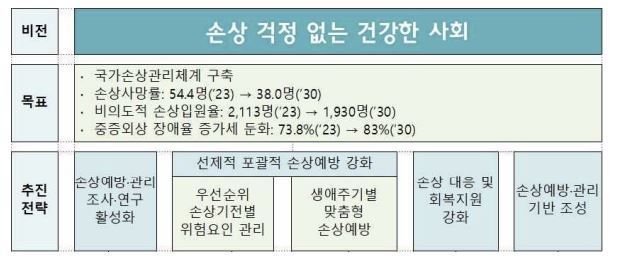
The government plans to reduce the injury mortality rate, which was 54.4 per 100,000 people in 2023, to 38.0 per 100,000 by 2030-a decrease of about 30%. The goal is also to lower the unintentional injury hospitalization rate from 2,113 per 100,000 people to 1,930. Additionally, the government aims to slow the increase in the rate of severe trauma-related disabilities, keeping it at 83% by 2030, up from 73.8% in 2023.
To achieve these goals, the government has established 44 detailed tasks under five key strategies. The first is to promote research, investigation, and management of injury prevention. A "Comprehensive Injury Information Management System" will be established to link and analyze scattered injury statistics, providing a scientific basis for policy. The second strategy focuses on managing risk factors by injury mechanism. To address the most serious issue-suicide-monitoring of illegal online distribution of suicide-related materials will be strengthened. To reduce severe injuries from traffic accidents, pedestrian-centered road environments will be created, and safety management of personal mobility devices will be reinforced.
The third strategy is tailored injury prevention across the life cycle. In infancy and early childhood, dietary management in daycare centers will be strengthened to prevent choking accidents, and the role of specialized medical institutions for child abuse will be expanded. In childhood and adolescence, peer life guardians will be trained to detect suicide risks early, and AI-based predictive models will be used to anticipate accident risks in schools. For adults, consulting support will be provided to establish occupational safety and health management systems in small businesses with fewer than 50 employees. For the elderly, fall risk factors in the home will be checked through integrated care services, and management to prevent poisoning accidents due to polypharmacy will be enhanced.
The fourth strategy is to strengthen support for injury response and recovery. Public CPR education will be expanded, and a pilot project for dedicated ambulances (Mobile ICU) for inter-hospital transfer of severe patients will be implemented. The fifth strategy is to establish a foundation for injury prevention and management. The functions of the Central Injury Management Center will be strengthened, and by 2030, the government will support the establishment of regional injury management centers in all 17 provinces and metropolitan cities.
Im Seungkwan, Commissioner of the Korea Disease Control and Prevention Agency, stated, "Injury is no longer a matter of chance but a preventable health issue. Through close cooperation among relevant agencies, we will establish a management system covering the entire process from before to after injury occurs, and we will also seek designation as a World Health Organization (WHO) Collaborating Center to secure global leadership in injury prevention and management."
© The Asia Business Daily(www.asiae.co.kr). All rights reserved.
![Clutching a Stolen Dior Bag, Saying "I Hate Being Poor but Real"... The Grotesque Con of a "Human Knockoff" [Slate]](https://cwcontent.asiae.co.kr/asiaresize/183/2026021902243444107_1771435474.jpg)















