Issues Raised During Gyeongbuk Provincial Council's Policy Inquiry
Calls for Developing Gyeongsan's "Balhae Village" as a Tourism Resource
On September 23, Lee Cheolsik, a member of the Gyeongbuk Provincial Council (People Power Party, Gyeongsan 4th District), raised questions to Gyeongbuk Province and the provincial Office of Education during the first plenary session of the 358th extraordinary session. His inquiries focused on expanding transportation infrastructure, support measures for Gyeongbuk's auto parts companies, systematic promotion of the Educational Development Special Zone, and the 'Balhae Village,' a community of Balhae Dae Joyeong's descendants.
Lee Cheolsik emphasized the need for the 'Gyeongsan-Ulsan Expressway Construction' project to be included in the '3rd Expressway Construction Plan' for prompt implementation. He argued that this would maximize logistical efficiency between Gyeongsan's auto parts industry and Ulsan's finished car sector, thereby establishing a new metropolitan economic zone. He stressed that the Ministry of Land, Infrastructure and Transport must include this project in the '3rd Expressway Construction Plan.'
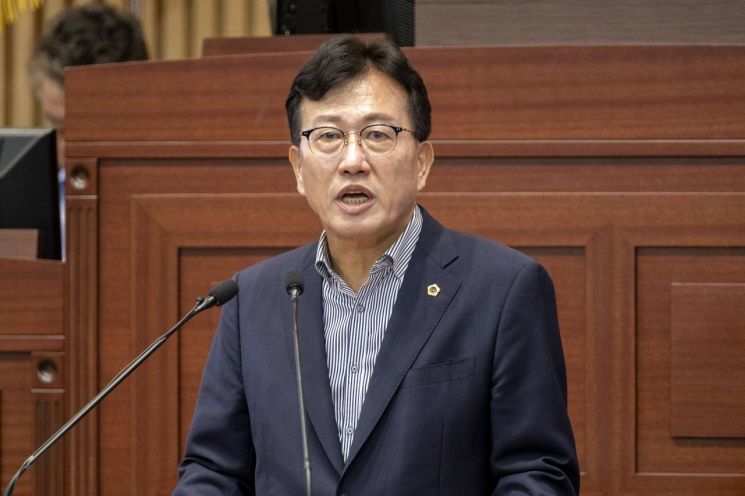
Lee also highlighted the importance of the 'Namcheon-Namsan National Road Bypass' project, the final remaining section of the arterial expressway in Gyeongsan, and called for Gyeongbuk Province to take an active role so that the 'Daegu Urban Railway Lines 1 and 2 Circular Line Construction' project can be included in national plans and implemented on schedule. These projects are essential to respond quickly to the needs of businesses and universities between Yeungnam University and the Gyeongsan Knowledge Industry Complex, as well as to improve accessibility to tourism resources and the metropolitan transportation system.
Lee pointed out that the southeastern region of Gyeongbuk, including Pohang, Gyeongju, and Gyeongsan, is a key hub of the domestic auto industry, with over 1,800 auto parts companies concentrated there. However, due to the impact of high U.S. tariffs, exports to the United States have fallen by 16% compared to the previous year, putting the industry in a serious crisis. Despite significant budget allocations to support these companies, their small-scale structure has become entrenched, making their survival increasingly precarious.
Gyeongsan is a strategic hub, with 302 companies accounting for 16.7% of the total in the region. Lee highlighted that the city is taking proactive measures, such as a 20 billion won project to advance electronic control components for future vehicles and autonomous vehicle demonstration projects. He called for urgent, practical measures at the provincial level to overcome the tariff crisis, including transitioning to smart factories, diversifying export strategies, and supporting the retention of young talent through industry-academia cooperation.
Regarding the Educational Development Special Zone, Lee stressed, "As an alternative to overcoming regional extinction, the Educational Development Special Zone must serve as a practical model for regional education innovation and talent cultivation. Gyeongbuk Province and the Office of Education must prepare effective implementation plans."
He further pointed out, "Fifteen cities and counties in the province have been designated as pilot zones, and over 120 billion won in budget is expected to be invested this year alone. However, there is no dedicated workforce, and a proper cooperation system has yet to be established." He urged, "Gyeongbuk Province and the Office of Education must develop new strategies tailored to local realities and take a more active role in creating a virtuous ecosystem where universities, businesses, and youth startups are organically connected."
Regarding the 'Balhae Village,' a community of Balhae Dae Joyeong's descendants in Namcheon-myeon, Gyeongsan, Lee emphasized the need to develop it as a historical symbol and tourism resource. He stated, "Balhae Village in Gyeongsan, the only community of Balhae descendants in Korea, is a space that preserves the proud history and identity of Balhae." He called on Gyeongbuk Province to take the lead in establishing a Balhae History Museum and promoting Balhae history as tourism resources, so that the grand spirit of Balhae, which once boasted the largest territory in Korean history, can be inherited as a new spirit of the times and utilized to revitalize the local economy.
© The Asia Business Daily(www.asiae.co.kr). All rights reserved.

















