Condensing Decades of Work into a Single Volume
Separate Edition Published for Foreign Readers
Far Less Known Than Chinese and Japanese Art
"Korean Art Has Been Extensively Studied...
Now Is the Time to Share It with the World"
On September 23, Yoo Hongjun, director of the National Museum of Korea, shared these thoughts upon publishing "A History of Korean Art for Everyone" (Nulwa) and "A History of Korean Art for Foreigners" (Nulwa). Although he has published over 40 books to date, he considers himself to have written just four main series ("My Exploration of Cultural Heritage," "Lives of Great Artists," "Pilgrimage to National Treasures and Masterpieces," and "Lectures on Korean Art History"). He explained, "This new book condenses all my previous works into a single volume." While "A History of Korean Art for Everyone" covers Korean art history chronologically, "A History of Korean Art for Foreigners" enhances understanding by organizing the content by major genres.
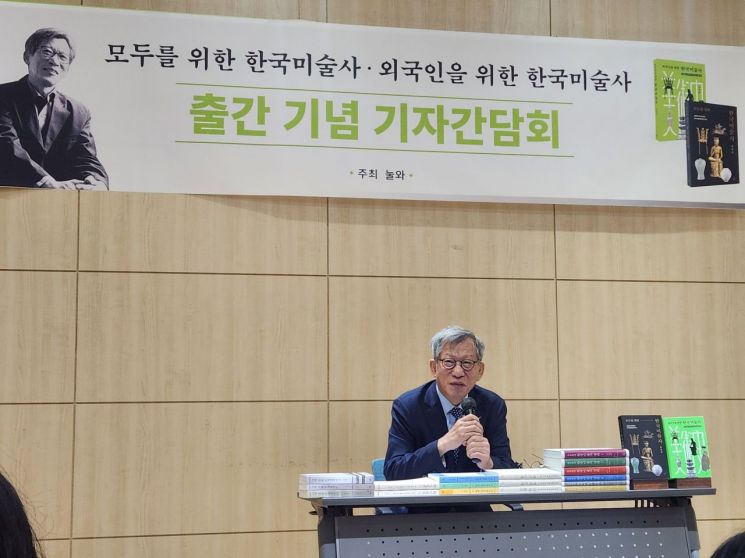 On the morning of the 23rd, Yoo Hongjun, director of the National Museum of Korea, is speaking at a publication press conference held in Mangwon-dong, Seoul. Photo by Seo Mideum
The origin of this book dates back to his "Korean Art History" lectures at Sungsim Women's University (now the Catholic University of Korea) in 1981. The public lectures titled "Korean Art History for Young People," which began in Sinchon in 1985, gained significant popularity and drew public attention. Director Yoo said, "Attendance grew from 40 to 80, then 100, and eventually 400 people per session," adding, "This book is the result of my deep contemplation, since then, on how best to convey our culture."
The book focuses on the journey of art's emergence and its role as a tool for historical evidence, spanning from eras with no written records up to the modern period. It provides an overview of the historical context for each era-from prehistoric times through the Three Kingdoms, Goryeo, and Joseon periods-accurately highlighting the distinctive features and unique characteristics that represent each period's culture.
One of the book's defining features is the exquisite harmony between text and images. After completing the draft, Director Yoo spent over a year refining the balance between the writing and the illustrations. He stated, "What I can proudly say about my book is that the text and images flow together. I sat beside the editor, adding and moving text, adjusting the size and placement of the images," and emphasized, "I never separate the images from the text. The coexistence of content, style, utility, and beauty is the hallmark of this book's editing."
Director Yoo chose to publish the book during his tenure because he believes the publication can elevate the museum's international standing and enhance global understanding of Korean art. Citing the examples of Kenneth Clark, director of the National Gallery in the UK (1934-1945), and Takashina Shuji, director of the National Museum of Western Art in Japan (1992-2000), who published art-related books while in office, he said, "Books authored by directors and curators reflect the authority and dignity of their museums." He further explained, "Among the criteria for evaluating a museum-its building, artifacts, and people-the people are represented not only by visitor numbers but also by the scholarly abilities of the curators."
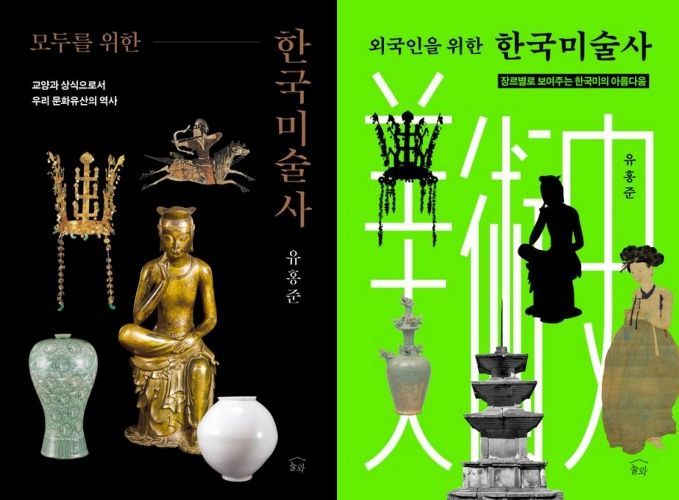
Regarding the separate publication for foreigners, Director Yoo pointed out, "There are almost no books on Korean art history published in foreign languages. Even in the prominent 'World of Art' series (about 200 volumes), there is hardly any content on Korean art history," adding, "Compared to the sections dedicated to Japan and China, the representation is severely lacking." He continued, "A Korean art history book published in a foreign language must be different from one for Koreans. For foreigners unfamiliar with Korea's history and geography, it is more effective to introduce the subject by genre rather than by historical period."
On the limited international reach of Korean art, Director Yoo explained, "It was not until 2002 that Myongji University established the first independent undergraduate department of art history. Before that, it was included under archaeology or as a graduate program called archaeology and art history." He added, "However, things have changed significantly now. The level of museum curators has advanced to the point where I seek their advice. There is a real need to properly introduce Korean art to the world."
© The Asia Business Daily(www.asiae.co.kr). All rights reserved.


















