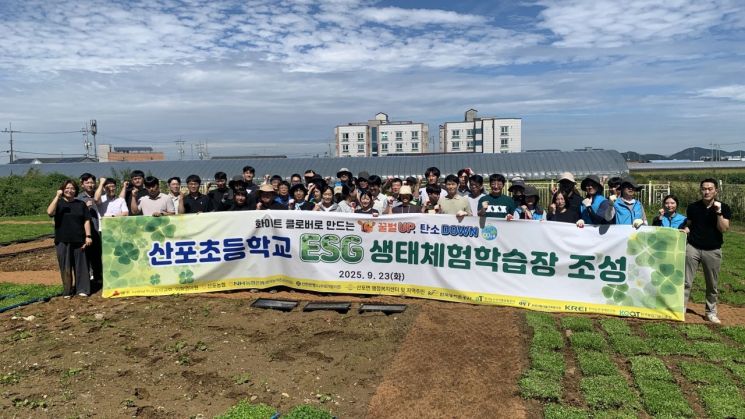
 The Gwangju Community Chest of Korea held an event to create an ESG ecological experience learning center as part of the "Honeybee UP, Carbon DOWN Project Made with White Clover." Photo by Gwangju Community Chest of Korea
The Gwangju Community Chest of Korea (hereafter referred to as Gwangju Sarangui Yeolmae) announced on September 23 that it held an event to create an ESG ecological experience learning center as part of the "Honeybee UP, Carbon DOWN Project with White Clover."
The event, held at Sanpo Elementary School in Sanpo-myeon, Naju, was attended by more than 100 people, including representatives from Korea Rural Community Corporation, Korea Agro-Fisheries & Food Trade Corporation, Korea Institute of Planning and Evaluation for Technology in Food, Agriculture and Forestry, Korea Rural Economic Institute, Korea Agricultural Technology Promotion Agency, Sanpo Agricultural Cooperative, NongHyup Bank (Korea Rural Community Corporation Branch), Shinhan Bank (Naju Bitgaram Branch), the Sanpo-myeon Administrative Welfare Center, and local residents.
The project was made possible with a total of 10.3 million won, including 5 million won in donations raised by Gwangju Sarangui Yeolmae from institutions in Naju Innovation City and 5.3 million won in project funds from Korea Rural Community Corporation. Participants contributed to the creation of the ecological experience learning center by transplanting 2,000 trays of white clover seedlings grown at the Sanpo Agricultural Cooperative nursery.
This initiative expands the "Ecological Weed Control Project through White Clover Sward Cultivation," led by Bangcho Sonyeondan, an in-house venture at Korea Rural Community Corporation, into a social contribution activity. It is expected to generate various social values, including weed control, reduction of carbon emissions, provision of nectar sources for honeybees, and landscape enhancement, while also serving as an ecological education center for students.
A representative from Korea Rural Community Corporation stated, "We hope that this ecological experience learning center, created collaboratively by local residents and institutions, will become a valuable environmental education space for children and a model for sustainable sharing and ESG practices in the community."
Meanwhile, the ecological experience learning center established at Sanpo Elementary School is expected to be expanded to various locations in the future, including reservoir embankments, solar power plants, and office flower beds.
© The Asia Business Daily(www.asiae.co.kr). All rights reserved.

















