A key technology to accelerate the commercialization of all-solid-state batteries has been developed in South Korea.
The Electronics and Telecommunications Research Institute (ETRI) announced on September 23 that it has successfully created a solid electrolyte membrane that combines a highly ion-conductive sulfide-based solid electrolyte with a laser-processed scaffold, resulting in a thin, flexible, and large-area manufacturable solid electrolyte membrane.
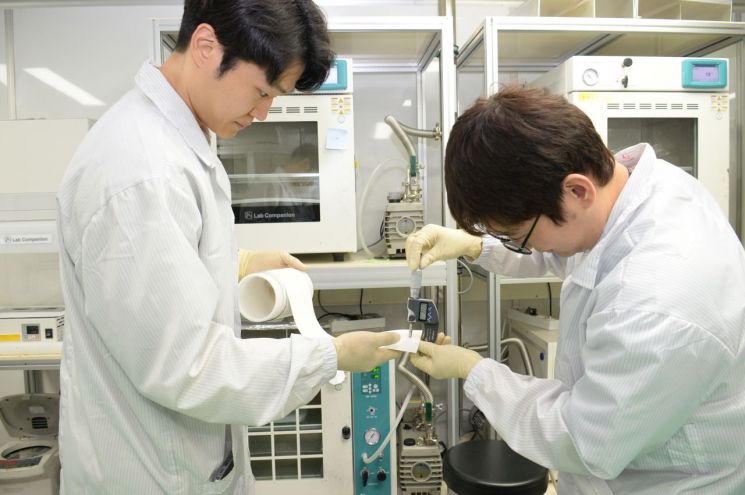 ETRI researchers are precisely measuring the thickness of a large-area solid electrolyte membrane manufactured in a roll form. Photo by Korea Electronics and Telecommunications Research Institute
All-solid-state batteries are next-generation batteries that replace the liquid electrolyte of lithium-ion batteries with a nonflammable solid, making them safer and less prone to ignition. They also offer the advantage of storing larger amounts of energy by using high-energy-density lithium metal anodes.
However, previous studies have revealed that using thick, pellet-type solid electrolytes with thicknesses of several hundred micrometers (μm) reduces the energy density of the battery. Conversely, when the thickness of the solid electrolyte is reduced, its mechanical strength drops sharply, making large-area manufacturing difficult.
To address this, ETRI developed a method of coating a solid electrolyte slurry onto a scaffold surface with laser-formed micro-pores, successfully producing a thin solid electrolyte membrane with a thickness of 27 μm.
In particular, this solid electrolyte membrane demonstrated more than 13 times higher tensile strength than conventional freestanding membranes, and by using polymer films or metal foils as the scaffold, it achieved both mechanical durability and ion conductivity.
ETRI also succeeded in manufacturing roll-type solid electrolyte membranes using a comma coater, a device commonly employed in commercial lithium-ion battery manufacturing processes. This demonstrated compatibility with roll-to-roll processing, confirming the potential for actual mass production.
Experimental results showed that when the solid electrolyte membrane developed by ETRI was applied, the all-solid-state battery achieved an energy density six times higher than that of conventional pellet-type electrolytes, and exhibited stable charge-discharge cycling performance even at room temperature.
Additionally, computer simulations were used to analyze how the pore arrangement, shape, and uniformity of the scaffold affect mechanical strength and electrochemical performance, providing directions for further optimization.
Senior Researcher Kang Seokhoon explained, "ETRI has enabled the large-area production of thin, flexible solid electrolyte membranes at the level of separators by securing both mechanical durability and ion conductivity, addressing a key challenge in the commercialization of all-solid-state batteries."
Lee Youngki, head of the Smart Materials Research Division, commented, "This research is significant in that it lays the groundwork for applying the technology to actual battery mass production processes. We expect to further expand its application to electrode interface stabilization and bipolar structure batteries in the future."
This research was conducted by corresponding authors Lee Youngki of ETRI and Professor Lee Yongmin of Yonsei University, with Senior Researcher Kang Seokhoon of ETRI as the first author.
The research results were recently published online in the materials science journal "Small."
© The Asia Business Daily(www.asiae.co.kr). All rights reserved.
![Clutching a Stolen Dior Bag, Saying "I Hate Being Poor but Real"... The Grotesque Con of a "Human Knockoff" [Slate]](https://cwcontent.asiae.co.kr/asiaresize/183/2026021902243444107_1771435474.jpg)















