Used Batteries Removed from Electric Vehicles Released After 2021
Business Agreement Signed by Ministry of Environment, Korea Environment Corporation, and Korea Automobile Dismantling & Recycling Business Association
Going forward, used batteries from electric vehicles released after 2021 can also be managed at the government-operated Future Waste Resource Hub Collection Centers, instead of at scrapyards.
On September 23, the Ministry of Environment announced that it would sign a "Business Agreement to Support the Circulation of Non-Returnable Used Batteries" at the Capital Region Future Waste Resource Hub Collection Center in Siheung, Gyeonggi Province, together with the Korea Environment Corporation and the Korea Automobile Dismantling & Recycling Business Association.
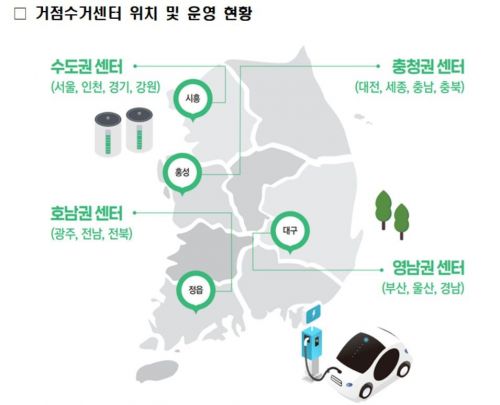
Under this agreement, four Future Waste Resource Hub Collection Centers-located in the Capital Region, Yeongnam Region (Dalseo District, Daegu), Honam Region (Jeongeup, North Jeolla Province), and Chungcheong Region (Hongseong, South Chungcheong Province)-will handle the receipt, performance evaluation, storage, and sale of non-returnable used batteries.
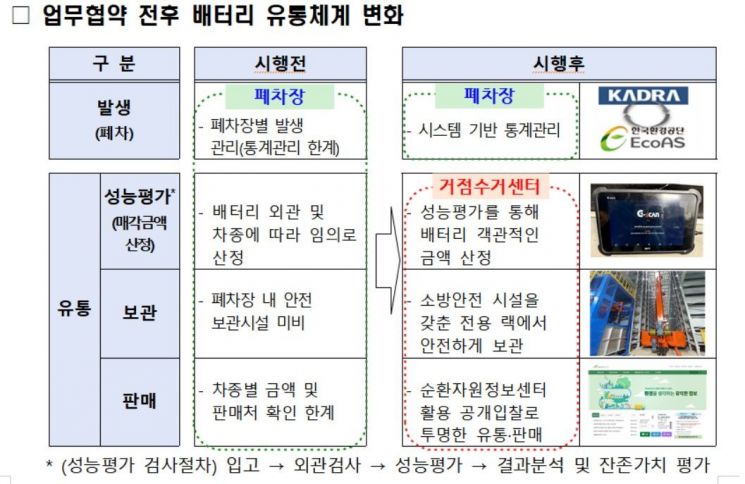
Currently, the obligation to return batteries and the procedures for handling them at the end of an electric vehicle's life differ depending on when the vehicle was purchased.
For electric vehicles that received purchase subsidies before 2021, the batteries must be returned to the national or local government after use. Returned batteries are evaluated for performance at the Future Waste Resource Hub Collection Centers and are then sold for reuse or recycling purposes.
For vehicles that received purchase subsidies after 2021, there is no obligation to return the batteries, so after removal at scrapyards, they are freely traded in the private market.
However, most scrapyards lack the infrastructure for storing used electric vehicle batteries, performance evaluation equipment, and sales systems. As a result, removed batteries are often left unattended for long periods, or their residual value cannot be properly assessed, preventing them from being utilized as high value-added resources through reuse or other means.
The Ministry of Environment will launch a pilot project to ensure the safe circulation of non-returnable electric vehicle batteries until a self-regulating private distribution system for used batteries is established.
The Ministry of Environment and the Korea Environment Corporation will provide administrative and institutional support for the pilot project and will use the four Future Waste Resource Hub Collection Centers nationwide to handle the receipt, performance evaluation, storage, and sale of batteries on behalf of the industry.
The Korea Automobile Dismantling & Recycling Business Association will operate a cooperation platform to provide information on the generation and collection of used batteries between scrapyards and the Korea Environment Corporation. For this year's pilot project, the Ministry of Environment and the Korea Environment Corporation will waive the service fee that scrapyards would otherwise have to pay to the Hub Collection Centers.
This agreement is a follow-up measure to the "Plan to Promote Battery Circulation and Utilization" announced by the government on May 14 of this year. The government expects that this will help establish a foundation for the recycling of key minerals such as lithium and nickel.
The Future Waste Resource Hub Collection Centers are facilities established and operated by the Ministry of Environment and the Korea Environment Corporation to support a full-cycle resource circulation system for future waste resources, such as electric vehicle batteries and solar panels, including their collection, storage, and sale.
© The Asia Business Daily(www.asiae.co.kr). All rights reserved.
![Clutching a Stolen Dior Bag, Saying "I Hate Being Poor but Real"... The Grotesque Con of a "Human Knockoff" [Slate]](https://cwcontent.asiae.co.kr/asiaresize/183/2026021902243444107_1771435474.jpg)
















