Applications Surpass Last Year's Total in Just 7 Months
Average Closure Cost Reaches 21.88 Million Won... Debts Pile Up After Starting a Business
Government Responds by Increasing Next Year's Budget by 25%
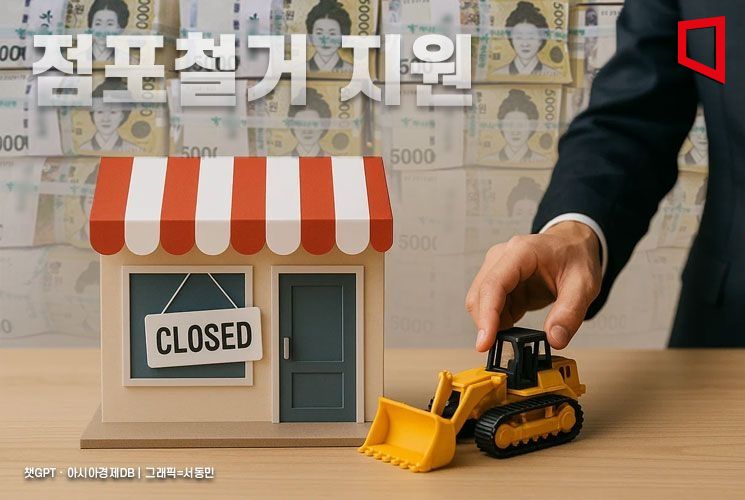
Requests for business closure support funds from small business owners have surged significantly this year. This trend reflects the vicious cycle of involuntary entrepreneurship among those who cannot access or have been pushed out of the job market, followed by a wave of consecutive business closures. Last year, the number of businesses reporting closure surpassed 1 million for the first time in history, and with forecasts suggesting that the scale of closures could be even larger this year, market conditions are expected to deteriorate further, intensifying this trend.
According to the Ministry of SMEs and Startups on September 23, the number of applications for store demolition cost support under the Hope Return Package's one-stop closure assistance program for small business owners reached 54,518 as of September 9. The number of applications has increased each year, from 30,247 in 2023 to 42,042 in 2024, and this year, the total surpassed last year's figure in just about seven months since the program was announced in February. When calculated as a simple monthly average, the number of applications nearly doubled from 3,500 per month last year to 6,800 per month this year.
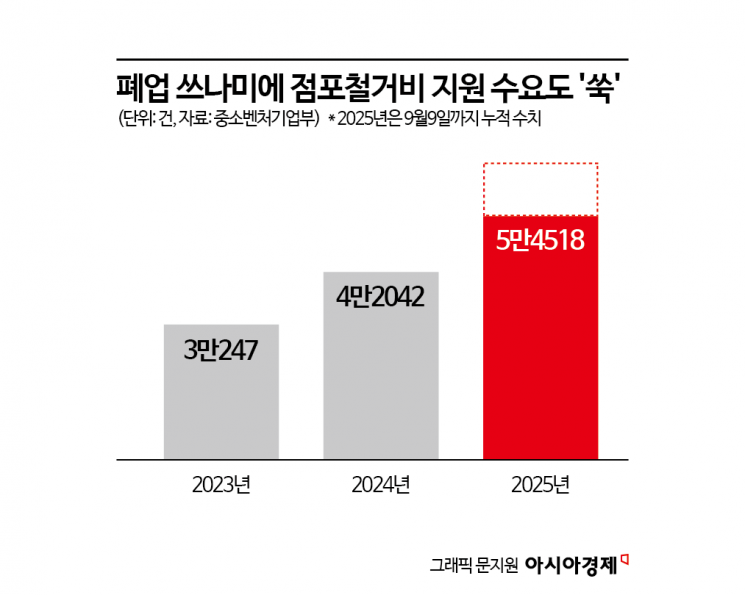
The store demolition cost support program subsidizes expenses incurred by small business owners who have closed or are planning to close their stores during the demolition and restoration process. As applications surged following the announcement, the Ministry of SMEs and Startups expanded the number of eligible recipients from 30,000 to 40,000 through the first supplementary budget in May. Nevertheless, before the third quarter even ended, the number of applications had already exceeded this expanded quota. However, not all applications immediately lead to support, so the ministry expects there will be no budget execution issues by the end of the year.
The increased demand for demolition support highlights the severe financial pressure felt by small business owners. According to the Korea Federation of SMEs' "2025 Survey on Closed Small Business Owners," the average cost incurred by small business owners during the closure process was 21.88 million won. Of this, demolition costs accounted for 5.18 million won, second only to employee severance pay, which averaged 5.62 million won.
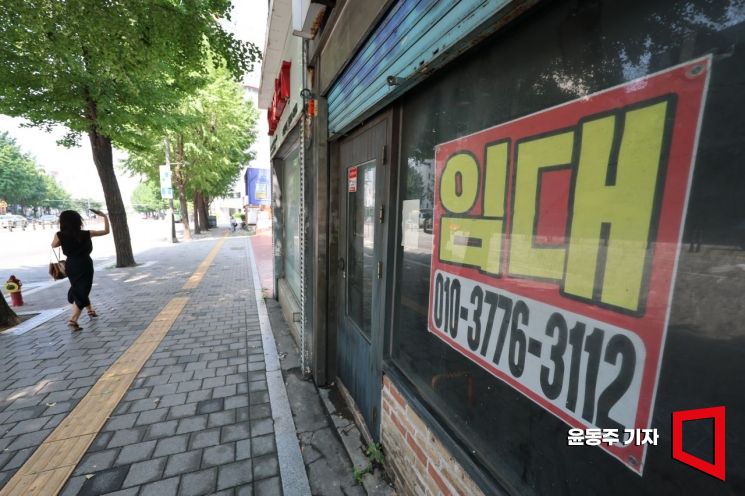 A rental banner is displayed on the first-floor commercial space in the representative shopping district of Sinchon. Photo by Yoon Dongjoo
The problem is that there are no signs of improvement in the on-site business environment. Last year, the number of businesses reporting closure reached 1,008,282, surpassing 1 million for the first time since statistics began in 1995. This figure increased by more than 10,000 compared to 986,487 in 2023, and the closure rate also rose from 9.02% to 9.04% during the same period. By industry, retail and restaurant businesses accounted for nearly half of all closures, indicating that sectors dependent on domestic demand were hit particularly hard. Many businesses did not even survive three years after opening. Among those who closed, 34.3% had operated for more than one year but less than three years before shutting down.
According to a survey by the Korea Federation of Micro Enterprises, the average monthly operating profit for small business owners this year is 2.08 million won, which falls far short of last year's average monthly wage for salaried workers of 3.13 million won. Song Chiyoung, president of the Korea Federation of Micro Enterprises, recently stated at a press conference, "While the title 'boss' sounds nice, the reality is that today's small business owners and self-employed people in Korea are not even earning the minimum wage."
The government is expanding support in response to rising demand. Next year's budget for the Hope Return Package has been set at 305.6 billion won, a 25% increase from this year. In addition, the government plans to expand and reorganize the operation of existing "AI Voice Bot" and "Early Warning System" programs to provide tailored support measures in advance for those facing business crises. The plan is to operate not only support for the closure process but also programs for entrepreneurship and reemployment in parallel.
An industry insider said, "There are currently no clear factors that would lead to a reduction in the number of small business closures," adding, "With the economic recovery delayed, it is highly likely that the scale of closures this year will exceed last year's level."
© The Asia Business Daily(www.asiae.co.kr). All rights reserved.
![Clutching a Stolen Dior Bag, Saying "I Hate Being Poor but Real"... The Grotesque Con of a "Human Knockoff" [Slate]](https://cwcontent.asiae.co.kr/asiaresize/183/2026021902243444107_1771435474.jpg)


















