Myron Calls for Aggressive Rate Cuts in First Speech After Taking Office
Musalem and Bostic Urge Caution on Further Easing
Debate Over Future Rate Path Expected to Continue
Stephen Myron, a member of the U.S. Federal Reserve Board often referred to as "Trump's economic advisor," has argued that the benchmark interest rate should be cut by 2 percentage points. In his first public speech just one week after taking office, Myron made a series of bold statements calling for a dramatic rate cut, sparking controversy. In contrast, other Fed officials have indicated a more cautious approach, suggesting that the likelihood of further rate cuts is limited. As a result, Myron's position is expected to remain a significant source of debate in future policy discussions.
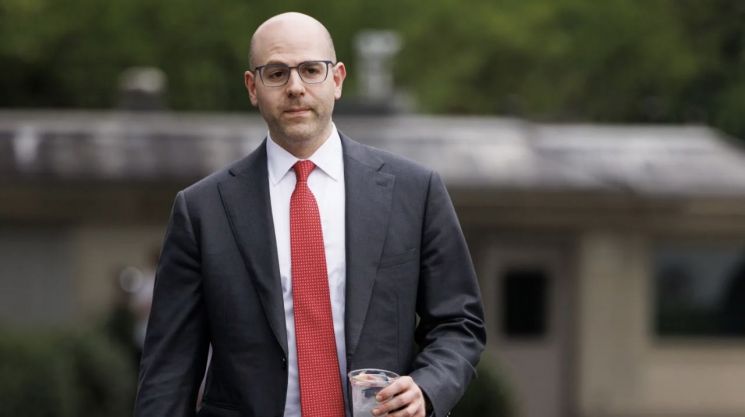
In a speech at the Economic Club of New York on September 22 (local time), Myron stated, "The bottom line is that monetary policy has entered a restrictive territory," and added, "Leaving short-term rates about 2 percentage points too tight compared to the appropriate level creates unnecessary risks of layoffs and higher unemployment."
He argued that tariffs, immigration restrictions, and tax policies have lowered the neutral interest rate, and that it is necessary to cut rates much further to prevent economic harm. The neutral interest rate refers to the theoretical level that neither overheats nor slows down the economy.
Myron emphasized, "The Fed is tasked with the important goal of promoting price stability for the benefit of all American households and businesses, and I am doing my utmost to restore inflation to a sustainable 2%." However, he reiterated, "Keeping policy at an excessively restrictive level poses significant risks to the Fed's employment mandate."
Myron was nominated by President Donald Trump to succeed former Fed Governor Adriana Kugler, who recently resigned unexpectedly. Known as Trump's economic advisor throughout his second term, Myron previously served as chairman of the White House Council of Economic Advisers (CEA). At his first Federal Open Market Committee (FOMC) meeting on September 17, he called for a substantial rate cut. At that meeting, the Fed lowered the benchmark rate by 0.25 percentage points to a range of 4.0% to 4.25%, but Myron was the sole dissenter, advocating for a 0.5 percentage point cut. Regarding year-end rate forecasts, while other members anticipated an additional 0.5 percentage point cut, Myron projected a cut of up to 1.25 percentage points.
In contrast, other Fed officials expressed more cautious views that day. Alberto Musalem, President of the Federal Reserve Bank of St. Louis, explained at an event in Washington that the September 17 rate cut was a "precautionary move to support the labor market at full employment and prevent further weakness," adding, "Rates are now somewhere between mildly restrictive and neutral, and there is limited room for further easing."
Raphael Bostic, President of the Federal Reserve Bank of Atlanta, told The Wall Street Journal in an interview that he expects only one rate cut this year. He said, "I am concerned that inflation has remained excessively high for an extended period. If the decision were today, I would neither support nor move toward an additional cut."
Nevertheless, Myron made it clear that he will continue to advocate for significant rate cuts in the future, signaling that what has been dubbed "Myron's rebellion" over the future path of rates is likely to persist.
He stated, "Until my view changes, I will continue to advocate for it. If that means dissenting, I will continue to dissent. I will not vote for something I do not believe in just to create the illusion of consensus where there is none."
Myron's term runs through January next year, completing the remainder of former Governor Kugler's term. Whether he will be reappointed has not yet been decided. If he serves only the remainder of the term, he will return to his current leave of absence as chairman of the White House CEA. In response, the Democratic Party has criticized the appointment as pandering to President Trump and has raised concerns about the Fed's independence.
© The Asia Business Daily(www.asiae.co.kr). All rights reserved.
![Clutching a Stolen Dior Bag, Saying "I Hate Being Poor but Real"... The Grotesque Con of a "Human Knockoff" [Slate]](https://cwcontent.asiae.co.kr/asiaresize/183/2026021902243444107_1771435474.jpg)















