Essential Drug Citizens' Network Consumer Perception Survey
Over 20 Percentage Point Increase Compared to Two Years Ago
"System Has Been Neglected Since Its Introduction in 2012"
"Government and Pharmaceutical Association Must No Longer Avoid Their Responsibilities"
A recent survey found that more than 9 out of 10 people in South Korea agree with expanding the range of essential over-the-counter drugs available at convenience stores.
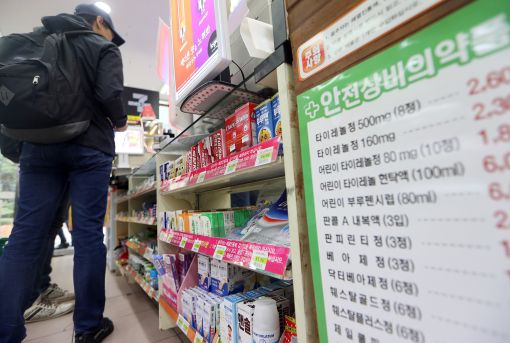 Cold medicines and other essential drugs are stocked at a convenience store in Seoul. Photo by Yonhap News Agency
According to the results of a "Consumer Perception Survey on Improving the Convenience Store Essential Drug System," released on September 22 by the Essential Drug Citizens' Network-which was launched in 2023 to enhance access to essential over-the-counter medicines-the proportion of respondents who agreed on the need to expand the list of such drugs at convenience stores increased from 62.1% two years ago to 85.4% this year. When including those who believe that two discontinued domestically produced items should be replaced, 94.7% of respondents called for either an expansion or replacement of the items available.
This survey was conducted from August 18 to 25, targeting 1,087 people nationwide. The goal is to more clearly communicate the public's demands for improvements to the current convenience store essential drug system to President Lee Jaemyung and the Ministry of Health and Welfare. While the first survey focused on gauging public awareness and evaluating the effectiveness of the system, the second survey aimed to clarify public concerns about how the system is being managed by the government and to specify demands for expanding the range of available items.
Currently, there are 4,813 types of over-the-counter medicines available in South Korea, but only 11 types across four categories-antipyretics and analgesics, digestive aids, cold medicines, and pain relief patches-can be purchased at convenience stores. In contrast, countries such as Japan and the United Kingdom allow the sale of at least 120 and up to 300,000 types of over-the-counter drugs outside of pharmacies.
As in the 2023 survey, respondents who agreed on the need for expansion cited "adding new categories" (46.7%) and "further subdividing by symptoms" (44.0%) as the top priorities for improvement. Specifically, there was strong demand for the following: medicines exclusively for children (22.3%), pain relievers tailored to specific symptoms (21.0%), and cold medicines tailored to specific symptoms (20.5%).
An Hyeri, Secretary-General of the Consumer Public Interest Network, which conducted the survey, stated, "According to the survey, 39.7% of respondents said that the number of essential drugs available at convenience stores should be increased to more than 20, even if it requires amending the law." She added, "Consumers clearly recognize that 'safety' is a prerequisite for expanding the list of essential drugs at convenience stores, and the results confirm that they are capable of making safe, self-directed choices for their health."
In fact, 64.3% of respondents cited "items with fewer side effects and higher safety" as a prerequisite for expansion, while 51.7% pointed to "items with a low risk of misuse," making it clear that ensuring safety is fundamental to any expansion. Additionally, more than 75% of consumers responded that they could safely take these medicines on their own based on the provided usage instructions, ingredients, and efficacy information.
Kim Yeonhwa, Chairperson of the Essential Drug Citizens' Network, said, "It has been two years since our organization was launched. During that time, we have repeatedly submitted petitions to the Ministry of Health and Welfare and the National Assembly for the convening of a committee to review the designation of essential drugs, and we have even attempted direct talks with the Korean Pharmaceutical Association, but there has been no progress." She continued, "Although the association opposes expansion on the grounds of 'safety concerns,' the essential drugs sold at convenience stores are selected from among over-the-counter medicines that have undergone safety monitoring and strict screening. I hope that this survey will serve as an opportunity for the government and experts to actively discuss ways to improve the system in line with the public's needs."
The Essential Drug Citizens' Network plans to use the results of this survey to carry out policy advocacy activities with the Ministry of Health and Welfare, the National Assembly, and other relevant bodies.
© The Asia Business Daily(www.asiae.co.kr). All rights reserved.
![Clutching a Stolen Dior Bag, Saying "I Hate Being Poor but Real"... The Grotesque Con of a "Human Knockoff" [Slate]](https://cwcontent.asiae.co.kr/asiaresize/183/2026021902243444107_1771435474.jpg)














