Office for Government Policy Coordination Announces “People’s Sovereignty Government Youth Policy”
Comprehensive Government Support Measures Introduced for Youth Week
Creating Workplaces Young People Want and Expanding Daily Life Support
Youth Representation on Government Committees to Exceed 10%
The government will expand the target group of youth policies, which were previously focused on low-income and vulnerable groups, to include all young people. Support will be provided not only for their entry into society but also for establishing a foundation for independence and encouraging social participation in a comprehensive manner.The “Second Basic Youth Policy Plan,” to be announced at the end of this year, will incorporate new initiatives that reflect the voices of young people and address their most pressing needs and demands.
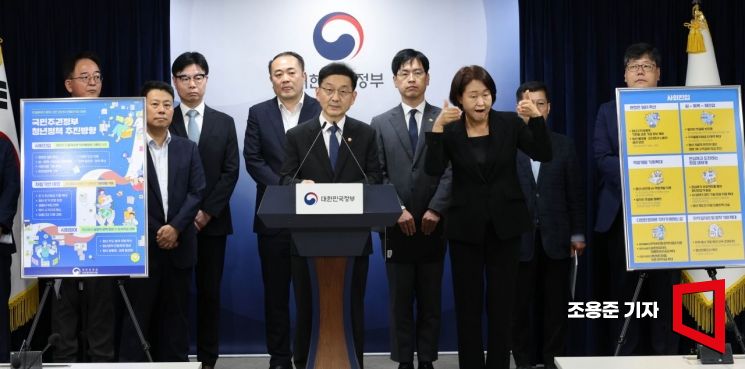 Yoon Changryul, Director of the Office for Government Policy Coordination, is conducting a joint ministry briefing on the direction of youth policy implementation under the People’s Sovereignty Government at the Government Complex Seoul in Jongno-gu, Seoul, on the 22nd.
The Office for Government Policy Coordination, together with the Ministry of Economy and Finance, the Ministry of Education, the Ministry of Science and ICT, the Ministry of Health and Welfare, the Ministry of Employment and Labor, and other relevant ministries, announced the “Direction of Youth Policy Promotion under the People’s Sovereignty Government” at the Government Complex Seoul on the 22nd. In celebration of Youth Week, which runs from the 20th to the 26th, the new measures include expanding the policy targets and scope to provide opportunities and support for basic living standards to all young people.
The People’s Sovereignty Government’s youth policies aim to enhance the sense of policy effectiveness among young people by including: ▲guaranteeing opportunities for jobs and asset building, ▲supporting basic living throughout the life cycle, and ▲expanding meaningful participation in policymaking. Notably, these policies are designed to offer opportunities and initial steps for future planning, such as jobs and asset formation, not only to low-income and vulnerable youth but also to the general youth population.
Yoon Changryul, Director of the Office for Government Policy Coordination, stated, “We will strengthen support for basic living throughout the entire life cycle of young people,” adding, “We aim to guarantee a minimum standard of living for youth while establishing a safety net and stepping stones for stable independence and new challenges.” He also said, “We will significantly expand the practical participation and rights of young people across society,” and, “We plan to reinforce the entire system so that young people can voice their opinions and exert influence on social issues and policies that are directly linked to their lives and futures.”
Creating Workplaces Where Common Sense Prevails... Improving the Quality of Job Training and Work Experience
First, to facilitate young people’s entry into society, the government will promote the spread of decent workplaces that adhere to basic principles and common sense. As many young people who are currently “taking a break” do so due to the lack of desirable jobs, the government aims to create workplaces that meet their expectations. Measures include enabling job seekers to verify companies’ compliance with labor laws on recruitment platforms and providing 24-hour AI-based labor law consultations. To protect platform and freelance workers, who make up a significant portion of the youth workforce, the government will pursue the enactment of the “Basic Law on Guaranteeing Workplace Rights.”
Opportunities and conditions will also be created for young people who have taken a break to re-enter society. Through the “First Step to Employment Guarantee Program,” the government will proactively identify young people who have been unemployed for extended periods or face difficulties in finding jobs and provide tailored support. The job search activity support fund under the National Employment Support System will be increased from 500,000 won this year to 600,000 won next year, easing the financial burden on young job seekers during their search period. The government also plans to allow one-time unemployment benefits for voluntary resignations during a lifetime.
Efforts will be made to improve the quality of vocational training, work experience, and various educational programs to help young people transition smoothly into the labor market. All 470,000 military personnel will be offered AI-based online education to help them develop skills during their service. In building a startup ecosystem where young people can take risks with confidence, the government will focus on expanding support for startups utilizing advanced technologies such as AI and deep tech. Tax incentives, including expanded income and corporate tax reductions, will be provided to youth-led startups in new industries such as AI.
To expand regional job and settlement opportunities for young people, the government will provide retention incentives for 50,000 young employees working at small and medium-sized enterprises outside the Seoul metropolitan area if they remain employed for two years. In particular, in regions experiencing population decline, the maximum incentive will be increased to 7.2 million won over two years.
Youth Future Savings Account to Be Introduced Next Year... Enhanced Support for National Scholarships and Income-Contingent Loans
To help young people build a foundation for independence, the government will guarantee opportunities for basic asset formation. In June next year, the “Youth Future Savings Account” will be introduced to expand opportunities for young people to accumulate initial assets. Compared to existing similar programs, the contribution period for the Youth Future Savings Account will be shortened from five years to three years, and the government’s matching contribution will be increased from 3-6% to 6-12%. The government will also expand the current “Tomorrow Preparation Savings” program, which is currently limited to enlisted soldiers, to include junior military officers, thereby strengthening asset-building support for young professionals starting their careers.
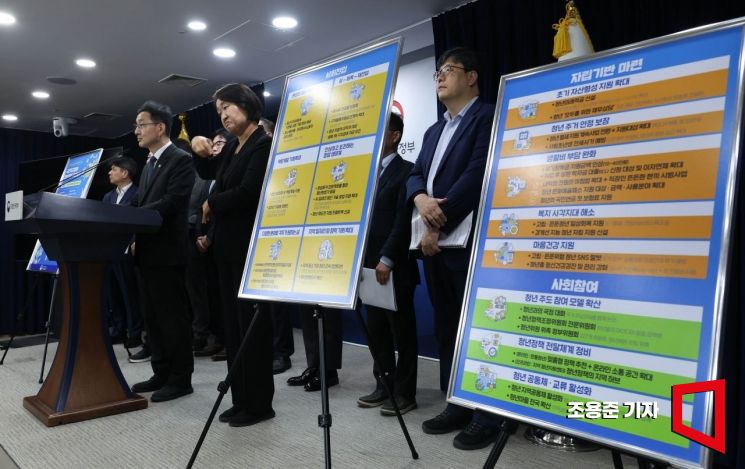 Yoon Changryul, Director of the Office for Government Policy Coordination, is conducting a joint ministry briefing on the direction of youth policy promotion under the government of popular sovereignty at the Government Seoul Office in Jongno-gu, Seoul, on the 22nd.
In terms of housing support, the government will continue to increase the supply of youth housing and alleviate the burden of monthly rent and lease costs for young people. The “Youth Monthly Rent Support Program,” which provides up to 200,000 won per month for rent to young people who are either homeless or low-income, was originally a temporary program but will now become a permanent measure. The government will also actively supply public housing units that are affordable for young people and focus on preventing rental fraud, which often affects young people new to the workforce, to ensure sustainable housing stability.
To support young people’s living expenses, the government will strengthen support for national scholarships and income-contingent student loans (ICL). The “1,000-Won Breakfast” program for university students will be expanded from 4.5 million recipients this year to 5.4 million next year. In addition, a new “Public Transportation Flat-Rate Pass” will be introduced, allowing young people with high transportation expenses to use subways and buses up to 200,000 won per month for a flat fee of 55,000 won.
Government Committees to Aim for at Least 10% Youth Representation
The government will strengthen the operation of national dialogue and communication platforms so that young people can discuss not only youth-related policies but also major national issues with responsible decision-makers. The government will also expand and continuously strengthen various mechanisms for youth participation in policymaking. Six specialized subcommittees will be established under the Youth Policy Coordination Committee, chaired by the Prime Minister, so that policies can be identified, proposed, and developed from the perspective of young people.
Youth representation on government committees will be expanded so that the voices of young people, as the generation leading the future, are included throughout the government’s policy-making process. A total of 227 government committees will be required to appoint youth representatives, and the government aims to ensure that at least 10% of members on these committees are young people. The government also plans to enhance the “Ontong Youth” platform, which integrates and delivers youth policies promoted by various ministries and local governments.
Director Yoon stated, “Going forward, the government will, with the Office for Government Policy Coordination at the center, supplement and establish detailed plans for the direction of youth policy promotion under the People’s Sovereignty Government through communication and consultation with a diverse range of young people.” He added, “When formulating the ‘Second Basic Youth Policy Plan (2026-2030),’ a comprehensive five-year plan to be announced at the end of this year, we will actively reflect the voices of young people and incorporate new initiatives that are highly relevant to their needs and experiences.”
© The Asia Business Daily(www.asiae.co.kr). All rights reserved.


















