Ministry of Health and Welfare Holds Public Hearing on Caregiving Benefit Reform
Patient Share to Be Reduced to 30% by 2030
6.5 Trillion Won to Be Invested Over 5 Years for Nursing Care and Payment Adjustments
The government will begin gradually applying health insurance to nursing care costs starting in the second half of next year. Currently, nursing care expenses are classified as non-covered items under health insurance, meaning patients must pay 100% out of pocket. The new policy will significantly reduce the patient's share to around 30%.
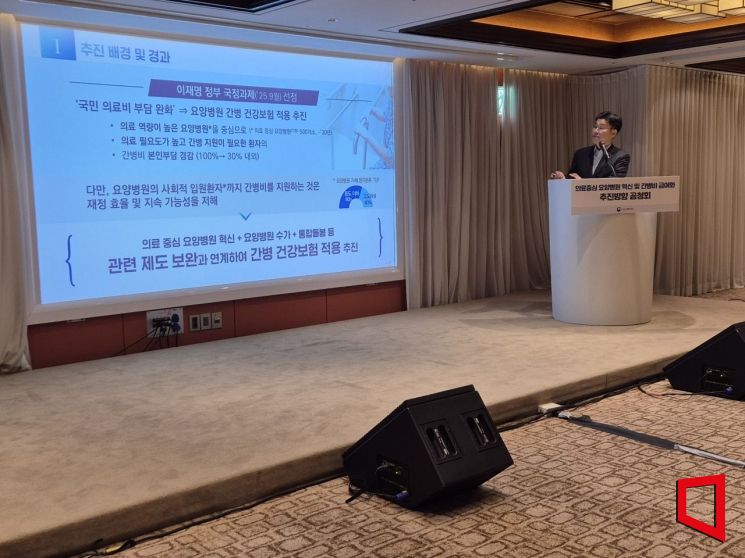 On the 22nd, at the Royal Hotel in Jung-gu, Seoul, Lee Jungkyu, Director of the Health Insurance Policy Bureau at the Ministry of Health and Welfare, explained the plan to cover part of the nursing care fees for long-term care hospitals through health insurance at the public hearing on "Innovation in Medical-Centered Long-Term Care Hospitals and Promotion Direction for Nursing Care Benefit Coverage."
On the 22nd, the Ministry of Health and Welfare announced this plan at the "Public Hearing on Innovation in Medical-Centered Nursing Hospitals and the Promotion Direction of Caregiving Benefit Coverage" held at the Royal Hotel Seoul in Jung-gu, Seoul. Minister of Health and Welfare Chung Eun-kyung delivered a video congratulatory address, stating, "As the population ages rapidly, the demand for both medical care and caregiving is increasing. We will gradually expand the coverage of nursing care costs, focusing on patients with high medical needs and nursing hospitals capable of providing sufficient treatment."
The core of the government's plan is the selective and phased expansion of health insurance coverage for nursing care costs. To ensure fiscal efficiency, the policy will first be applied to "medical-centered nursing hospitals" that meet the criteria set by the government.
The expansion will proceed in three stages. First, by 2026, 200 nursing hospitals will be selected to provide nursing care coverage to approximately 20,000 patients. By 2028, the program will be expanded to 350 hospitals, supporting about 40,000 patients. Ultimately, by 2030, the goal is to support around 60,000 patients at 500 nursing hospitals.
The Ministry of Health and Welfare estimates that approximately 6.5 trillion won will be invested over five years for payment adjustments, including support for nursing care costs and increases in reimbursement rates.
Lee Jungkyu, Director of the Health Insurance Policy Bureau at the Ministry of Health and Welfare, who delivered the keynote presentation, stated, "One of the greatest burdens patients feel when hospitalized is the cost of nursing care. Considering the increasing elderly population, our goal is to secure about 100,000 beds in around 500 hospitals."
One of the main reasons for the gradual expansion of health insurance coverage is the issue of securing enough nursing staff. Lee explained, "The aim of this coverage is to create conditions where caregivers can work in three shifts like nurses in hospitals, rather than the current poor system where one caregiver works 24 hours straight. To achieve this, a much larger workforce is needed, so we have no choice but to expand gradually while monitoring staffing levels."
The criteria for designating "medical-centered nursing hospitals" are expected to be stringent. Since health insurance funds will be allocated, the government believes strict standards are necessary. The main points of the Ministry's draft selection criteria include: accepting patients with high medical needs, providing high-quality nursing care services, and operating hospitals without unnecessary non-covered services. However, these criteria may change. Lee added, "The selection criteria have not been finalized yet and are being developed in collaboration with experts."
Supplementary measures have also been prepared to address regional disparities in medical care. If there are no hospitals in a specific region that meet the criteria, a "preliminary designation" system is being considered, which would allow hospitals to be designated on the condition that they meet the standards within a set period, such as one year.
To prevent "social admissions" that exploit loopholes in the system, a robust monitoring system centered on external evaluations will be established. "Social admission" refers to hospitalization driven by social needs, such as a lack of caregivers, rather than medical necessity.
All new and existing patients will be required to undergo evaluation by external assessors. If the hospital's internal assessment and the external assessment differ, support for nursing care costs will be suspended. Lee emphasized, "Hospitals with a high rate of disagreement between internal and external assessments will face disadvantages in future evaluations."
Measures to curb unnecessary long-term hospitalizations will also be implemented. If the length of stay exceeds 180 days, the reimbursement rate for nursing care will be reduced by 10% and the patient's share will be increased by 10%. If the stay exceeds 360 days, both figures will be adjusted by 20%.
Based on these details, the Ministry of Health and Welfare plans to seek final approval from the Health Insurance Policy Deliberation Committee by the end of this year or early next year, and to begin the selection process for eligible hospitals early next year.
However, some concerns were raised regarding the implementation of the system. Ahn Byungtae, Vice President of the Korea Association of Nursing Hospitals, stated during a panel discussion, "If we follow the government roadmap and convert six-bed rooms to four-bed rooms, more than 30% of total beds will be lost, resulting in monthly losses of several hundred million won. In contrast, government support is limited to 66 million won per hospital, and there are no measures in place for the approximately 800 nursing hospitals that are not selected."
The Emergency Committee of Small and Medium Nursing Hospitals also issued a statement before the hearing, saying, "Why are only 500 nursing hospitals selected to receive benefits? The nursing care benefit policy could become a policy of elimination for the remaining 814 nursing hospitals. Concrete measures to ensure the survival of unselected nursing hospitals must be prepared first."
© The Asia Business Daily(www.asiae.co.kr). All rights reserved.
![Clutching a Stolen Dior Bag, Saying "I Hate Being Poor but Real"... The Grotesque Con of a "Human Knockoff" [Slate]](https://cwcontent.asiae.co.kr/asiaresize/183/2026021902243444107_1771435474.jpg)















