Keynote Speech at Korea Energy Economics Institute Policy Seminar
"Phasing Out Specific Energy Sources Is Not a Solution to Climate Change"
"'Historical Emissions' Should Be the Most Important Criterion for NDC"
"Impossible to Set Carbon Budgets by Country"
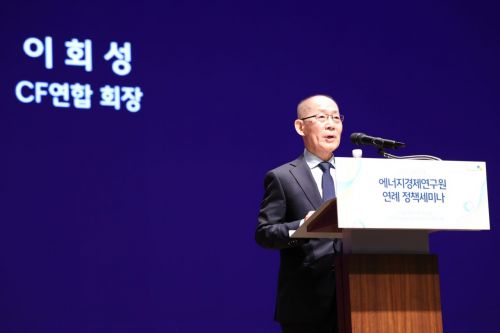 Lee Hoeseong, chairman of the CF Federation, is delivering a keynote speech at the annual policy seminar of the Korea Energy Economics Institute held at the Korea Chamber of Commerce and Industry on the 22nd. Korea Energy Economics Institute
"Calling for the elimination of a specific energy source cannot be the solution to climate change."
Lee Hoeseong, chairman of the CF Federation and the first Korean to serve as chair of the Intergovernmental Panel on Climate Change (IPCC), delivered a keynote speech at the Korea Energy Economics Institute's 39th Annual Policy Seminar held at the International Conference Hall of the Korea Chamber of Commerce and Industry on the 22nd. He stated, "There is a significant difference between viewing energy from a climate perspective and viewing climate from an energy perspective."
Chairman Lee pointed out that while environmental activists have continuously called for the elimination of fossil fuels, the share of fossil fuels has kept rising. He said, "Despite persistent pressure to phase out fossil energy, fossil energy consumption has continued to increase and now accounts for 78% of the world's total energy supply."
He also noted that, over the past 13 years, wind and solar power accounted for 43% of the increase in electricity consumption, while coal and natural gas accounted for a similar 44%. "During this period, China came to dominate 90% of the global renewable energy ecosystem," he added.
The reason fossil fuel use is not declining is because demand from sectors such as petrochemicals, steel, and cement remains strong. Chairman Lee argued that it is misguided to call for the elimination of supply sources while leaving this demand unaddressed. He said, "If we view the climate change issue solely from the perspective of elimination, not only heavy and chemical industries, but also other sectors such as industry, transportation, buildings, military weapons, and even methane-emitting cattle would all have to be eliminated."
Chairman Lee emphasized that too much time has been wasted since the 2015 Paris Agreement in unnecessary debates over whether to eliminate energy sources, and that it is now time to approach the issue from the perspective of energy. He argued that the strategy should be to add renewables while reducing greenhouse gas emissions.
He stressed, "We must add a new function-achieving zero greenhouse gas emissions-to the existing core functions of energy systems, which are economic growth and energy security."
Regarding South Korea's 2035 Nationally Determined Contribution (NDC) target, which is currently under discussion, Chairman Lee said that 'historical emissions' should be the most important criterion. Since the International Court of Justice (ICJ) recommended in July that each country should set the highest possible level of NDC, environmental groups have continued to demand that the government raise its 2035 NDC target.
In response, Chairman Lee explained that the International Court of Justice presented three evaluation factors for NDCs: historical emissions, level of economic development, and national circumstances. "South Korea accounted for 0.7% of the world's total cumulative greenhouse gas emissions up to 2019, while Europe accounted for 15%, which is 21 times higher than Korea," he explained. In other words, for every ton of greenhouse gases Korea reduces, Europe would need to reduce 21 tons to achieve relative fairness.
He pointed out, "Recently, Europe has been increasing its defense budget while cutting its climate budget," and added, "In this situation, no European country can strongly urge South Korea to take the lead on the climate crisis."
Chairman Lee further stated that the level of economic development, as presented by the International Court of Justice as a criterion for evaluating NDCs, should be compared with countries with a high share of manufacturing, like Korea, and that national circumstances should be judged by each country individually.
Chairman Lee also expressed a negative view regarding the carbon budget legislation currently being pursued in the National Assembly.
He pointed out, "The carbon budget refers to the total amount that the entire planet can afford to emit to prevent global warming, and no one talks about a carbon budget for each country." In order to set a national carbon budget, all countries in the world would have to come together and negotiate, which is virtually impossible.
He added, "The term 'carbon budget' has never been mentioned at any Conference of the Parties so far, and even discussing it implies interference with a country's economic and energy sovereignty." Chairman Lee also said, "If Korea were to pursue a carbon budget for the sake of the planet, it should be able to demand that Europe reduce its carbon emissions by 21 times more than Korea."
Chairman Lee also predicted that artificial intelligence (AI) could help reduce carbon emissions. He said, "The spread of AI will make it possible to track the flow of carbon in real time and provide information so that consumers can use carbon-saving products."
Lee Hoeseong, who served as the first president of the Korea Energy Economics Institute, became the first Korean to be elected chair of the IPCC in 2015 and served until 2022. During his tenure, the IPCC's Sixth Assessment Synthesis Report was released.
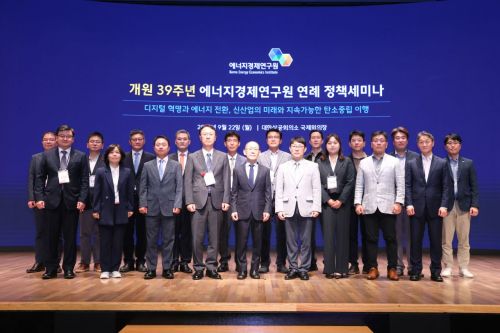 At the annual policy seminar held on the 22nd at the International Conference Hall of the Korea Chamber of Commerce and Industry, key attendees are taking a commemorative photo. Energy Economics Institute
Meanwhile, the event was held under the theme of "Digital Revolution and Energy Transition: The Future of New Industries and Sustainable Carbon Neutrality Implementation." The program included opening remarks by Kim Hyeonje, president of the Korea Energy Economics Institute, and a keynote speech by Lee Hoeseong, chairman of the CF Federation, followed by two tracks: "The Digital Revolution and the Future of Energy in the AI Era" and "Strategies for Building a Clean Energy Ecosystem for Carbon Neutrality in the Digital Transition Era."
© The Asia Business Daily(www.asiae.co.kr). All rights reserved.
![Clutching a Stolen Dior Bag, Saying "I Hate Being Poor but Real"... The Grotesque Con of a "Human Knockoff" [Slate]](https://cwcontent.asiae.co.kr/asiaresize/183/2026021902243444107_1771435474.jpg)
















