Dissatisfaction with Cross-Strait Policy Rises from 43% to 63%
Trust in the U.S. Drops Compared to Last Year
It has been found that 6 out of 10 Taiwanese people harbor negative feelings toward President Lai Ching-te's hardline cross-strait (China and Taiwan) policy, which is characterized by a pro-U.S., anti-China stance.
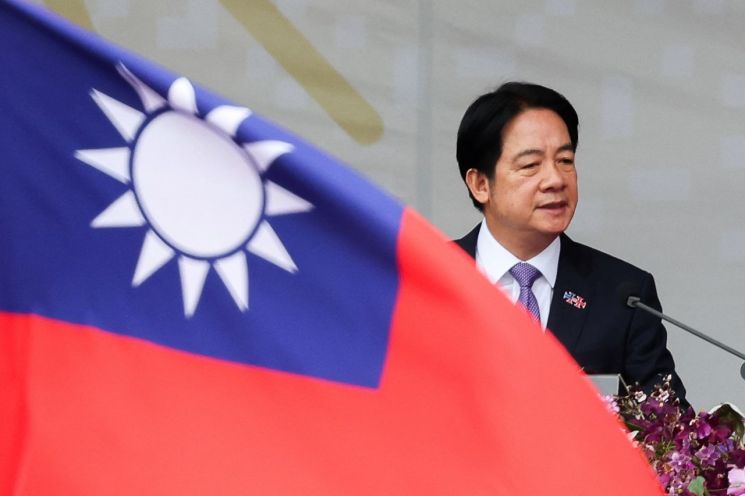
According to the "Annual Cross-Strait Relations Survey" released by the United Daily News of Taiwan on the 22nd, the level of dissatisfaction among Taiwanese people regarding President Lai's cross-strait policy, after just over a year in office, rose from 43% last year to 63% this year, while the proportion of respondents who gave a positive evaluation dropped from 44% to 26%. The survey was conducted via telephone interviews with 1,012 Taiwanese adults aged 20 and older from September 10 to 15.
Although President Lai, who has been classified as having a strong pro-independence stance, emphasized "neither being servile nor arrogant, and maintaining the status quo" in his inaugural address in May last year, he also stated that "the Republic of China (Taiwan) and the People's Republic of China (China) do not subordinate to each other."
China does not recognize President Lai and is pressuring Taiwan through military and economic means. In response, President Lai announced a security enhancement strategy in March this year, defining China as an external hostile force, citing Chinese infiltration into Taiwan's military and society, and focusing on controlling cross-strait exchanges and strengthening internal surveillance in Taiwan. According to the United Daily News survey, 63% of Taiwanese believe that President Lai's hardline remarks have had a negative impact on cross-strait relations, while only 18% felt that the positive impact was greater.
In addition, the proportion of respondents who said that Taiwan and China should strengthen economic and trade cooperation increased from 41% last year to 46% this year, while those who said such cooperation should be reduced fell from 19% to 13%. The response rate for "maintaining the status quo" has remained around 35% over the past four years.
Following the launch of the second Donald Trump administration in the United States, trust in the U.S. among Taiwanese people has declined. The proportion of respondents who believe that the United States would send troops to defend Taiwan in the event of a military conflict between Taiwan and China dropped from 49% last year to 41%, while those who believe the U.S. would not intervene rose from 42% to 49%.
Regarding President Trump's demand that Taiwan pay for its own defense, 71% of respondents expressed opposition. Additionally, 46% opposed President Lai's plan to raise defense spending to 5% of gross domestic product (GDP), which was higher than the 44% who supported it.
Sixty-six percent of respondents said that Taiwan should not lean toward either the United States or China. Compared to last year, the proportion advocating for maintaining a balance remained at around 66%, while those favoring a tilt toward the United States decreased from 21% to 18%. Those favoring a tilt toward China increased from 8% to 12%.
The United Daily News explained that even among supporters of the Democratic Progressive Party (DPP), which is President Lai's support base and is known for its pro-independence stance, 51% said Taiwan should maintain a neutral distance between the U.S. and China. Among opposition party supporters and independents, support for a balanced approach exceeded 70%.
© The Asia Business Daily(www.asiae.co.kr). All rights reserved.
![Clutching a Stolen Dior Bag, Saying "I Hate Being Poor but Real"... The Grotesque Con of a "Human Knockoff" [Slate]](https://cwcontent.asiae.co.kr/asiaresize/183/2026021902243444107_1771435474.jpg)















