Commemorating the 60th Anniversary of Korea-Japan Diplomatic Normalization
Jeonju University announced on September 22 that the 'Korea-Japan Traditional Arts Festa: Sound, Story, Dance,' held over two days from September 19 to 20 in celebration of the 60th anniversary of the normalization of diplomatic relations between Korea and Japan, concluded successfully.
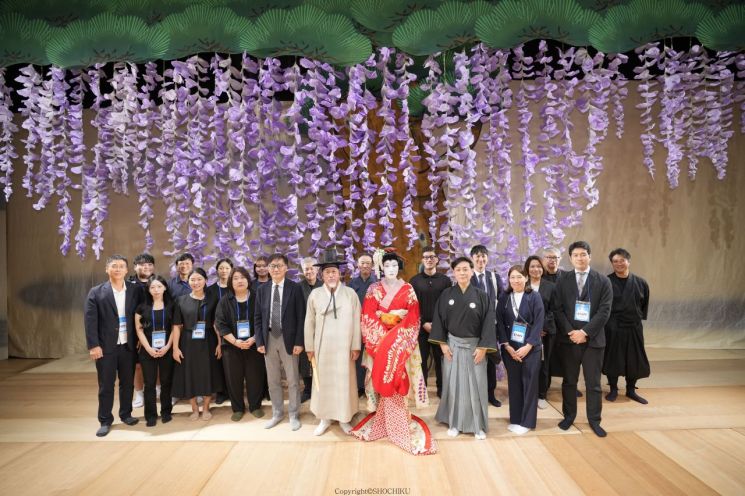 Jeonju University HUSS Project Group, in collaboration with Japanese traditional arts company Shochiku, successfully concluded the 'Korea-Japan Traditional Arts Festa'. Copyright SHOCHIKU·Provided by Jeonju University
The event drew participation from more than 400 students and citizens and was jointly hosted and organized by the Jeonju University Humanities and Social Sciences Convergence Talent Development Project Group (hereafter HUSS Project Group), RISE Project Group, Local Content-Focused University, Tune Co., the Korean Association for Japanese Culture, and Japanese traditional arts company Shochiku Co., Ltd.
On the first day, lectures and performances were held at Jeonju University’s JJ Art Hall. Professor Pyun Yongwoo (Department of Japanese Language and Culture) and Kabuki actor Nakamura Umeno each compared and explained the characteristics and significance of Pansori and Kabuki, receiving an enthusiastic response from the audience.
Following this, Nakamura Umeno demonstrated the process of stage makeup and performed her representative work, 'Fujimusume.' Master singer Wang Kisuk delivered a moving performance with the short song 'Sacheolga' and the famous 'Eye Scene' from 'Simcheongga,' one of the five core Pansori repertoires.
On the second day, a talk concert was held at Jeonju University’s Jinri Hall, where Korean and Japanese traditional arts experts shared vivid experiences from behind the scenes and discussed future visions for the traditional arts of both countries. On the same day, the Korean Association for Japanese Culture hosted an academic presentation session, shedding scholarly light on the value of traditional arts and the possibilities for their modern succession.
Lee Yonguk, head of the HUSS Project Group, stated, "This festival went beyond a simple performance; it was a meaningful occasion that internationally expanded Jeonju’s traditional cultural identity and opened new possibilities for cultural exchange between Korea and Japan. It provided students with an unforgettable cultural experience and deeply resonated with citizens, making it even more significant."
Meanwhile, building on the success of this event, the Jeonju University HUSS Project Group signed a memorandum of understanding (MOU) with Shochiku Co., Ltd., a leading company in Japanese traditional arts, further strengthening international communication and cooperation.
The two organizations plan to establish a sustainable cooperation model through the joint development of traditional arts content and operation of exchange programs. Through these efforts, the HUSS Project Group aims to provide students with opportunities to enhance their global competencies and to spread local cultural content worldwide, positioning itself as a central hub for international cultural exchange.
© The Asia Business Daily(www.asiae.co.kr). All rights reserved.

















