Yeo Han-koo Briefs Industry Leaders After U.S. Follow-up Talks
Companies Urge "Tariff Exemptions for Strategic Industries, Separate Visas Needed"
"Local Workforce Management" Emerges as a New Challenge
Yeo Han-koo Stresses "Public-Private Teamwor
Korean companies have requested that the government prioritize resolving visa issues for strategic industries such as shipbuilding, defense, semiconductors, and batteries. With companies investing in the United States still facing persistent visa challenges, and the Trump administration announcing an additional plan to drastically raise the new issuance fee for H-1B professional visas to $100,000, both the public and private sectors have agreed on the need to address visa issues in urgent sectors first.
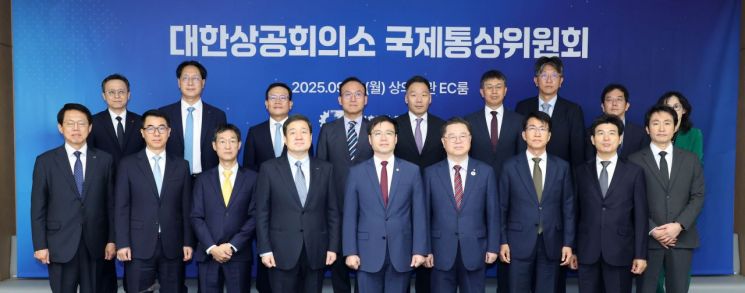 The Korea Chamber of Commerce and Industry held an International Trade Committee meeting on the 22nd at the Sangyohui Building in Jung-gu, Seoul, inviting Yeo Hangoo, the Director General of Trade Negotiations at the Ministry of Trade, Industry and Energy. The meeting mainly addressed unresolved issues regarding tariffs and visas. Korea Chamber of Commerce and Industry
The Korea Chamber of Commerce and Industry held an International Trade Committee meeting on the 22nd at the Sangyohui Building in Jung-gu, Seoul, inviting Yeo Hangoo, Director General for Trade Negotiations at the Ministry of Trade, Industry and Energy, to review current trade issues with the United States. This was the first gathering of government officials and major companies after the U.S. government announced its plan to increase H-1B visa issuance fees by 100 times, and the meeting focused on unresolved issues regarding tariffs and visas. Director General Yeo, who had just returned from follow-up negotiations in the U.S. on the 19th, explained the progress of the talks. The business community urged a swift response to the growing uncertainties surrounding tariff negotiations and visa issues.
Director General Yeo emphasized that the negotiation environment is challenging, highlighting the importance of public-private cooperation in overcoming obstacles. He also cited Japan's case, where tariffs on automobiles were quickly reduced through negotiations with the United States, and explained that he would do his utmost to ensure that tariffs on Korean automobiles are also lowered.
During the meeting, there was a strong call to "put out the most urgent fires first," focusing on strategic industries. For smooth implementation of U.S. investments, such as the MASGA (Make American Shipbuilding Great Again) project, it was stressed that tariff exemptions for strategic sectors like shipbuilding and defense, as well as minimizing the impact of item-specific tariffs on semiconductors and other products, are urgent priorities. A corporate representative at the meeting stated, "For strategic industries whose supply chains in the United States are not yet fully established, the domestic supply chain must fill the gap, making tariff deferrals or exemptions urgent. If item-specific tariffs are expanded, increases in manufacturing costs and weakened price competitiveness will be unavoidable."
Labor and visa issues were also raised. After the "Georgia Korean Detention Incident" brought visa issues to the forefront, the U.S. government announced it would raise the new issuance fee for the H-1B professional visa from the current $1,000 to $100,000 (about 140 million won), a hundredfold increase. An industry representative commented, "To establish new factories or production lines, essential personnel from Korea must be dispatched, but it is unacceptable to require us to pay tens of millions of won per application. Revitalizing manufacturing is the goal of the United States, but it is unreasonable for our companies to bear the burden during this process."
Another company representative added, "When entering the United States, a large number of initial operating personnel are required, but fast-track options like the Electronic System for Travel Authorization (ESTA) or B-1 visas do not allow local employment. For projects like MASGA, which require specialized personnel, it is urgent to introduce new visa categories, expand quotas, and streamline issuance procedures."
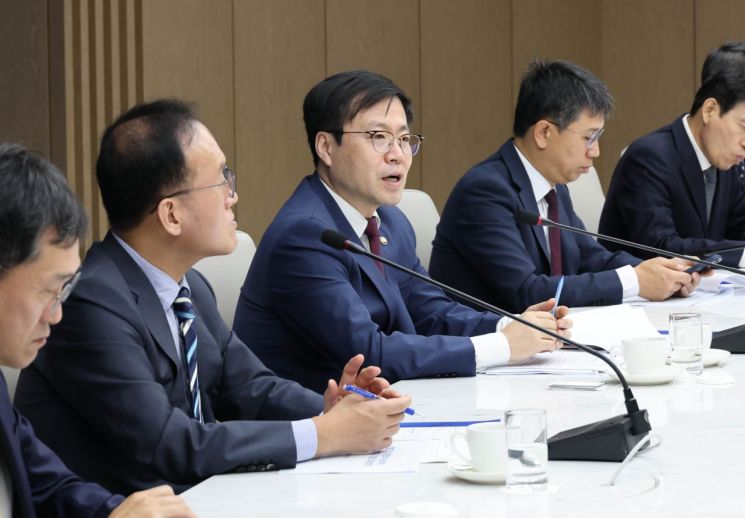 Yeo Hangoo, Director General for Trade Negotiations at the Ministry of Trade, Industry and Energy, is speaking at the Korea Chamber of Commerce and Industry International Trade Committee held on the 22nd. Korea Chamber of Commerce and Industry
The government plans to continue negotiations with the United States while also pursuing mid- to long-term policies to achieve the goal of 'economic security,' such as diversifying export markets. As visa issues have introduced new challenges in managing local personnel, it is reported that the government and business community will also work together to determine how to manage Korean employees stationed in the United States going forward.
Lee Gaein, Chairman of the International Trade Committee at the Korea Chamber of Commerce and Industry (and CEO of POSCO International), stated, "Unexpected situations like the recent visa issues faced by Korean workers in the United States can arise at any time, so companies cannot afford to let their guard down. The ability to turn risks into opportunities comes from strong government support, so please listen closely to the voices of businesses."
The meeting was attended by Park Iljun, Executive Vice Chairman of the Korea Chamber of Commerce and Industry; Kim Dongwook, Vice President of Samsung Electronics; Yeom Sungjin, Vice President of SK SUPEX; Kim Dongwook, Vice President of Hyundai Motor Company; Ha Taeseok, Executive Director of LG; Shin Sungju, Executive Director of Lotte; Kim Sun, Vice President of Hanwha; Choi Nuri, Vice President of GS; Ryu Geunchan, Vice President of HD Hyundai; Eom Jaedong, Vice President of Korean Air; Cho Youngseok, Vice President of CJ; and Kim Sungtae, President of Doosan Management Research Institute, among others.
© The Asia Business Daily(www.asiae.co.kr). All rights reserved.
![Clutching a Stolen Dior Bag, Saying "I Hate Being Poor but Real"... The Grotesque Con of a "Human Knockoff" [Slate]](https://cwcontent.asiae.co.kr/asiaresize/183/2026021902243444107_1771435474.jpg)
















