Keytruda SC Formulation Receives FDA Approval
Alteogen Technology Applied... Milestone and Royalties Expected to Exceed 1 Trillion Won
The subcutaneous (SC) injection formulation technology developed by Korean biotech company Alteogen will be applied to Keytruda, the world’s top-selling cancer drug. It is expected that Alteogen could secure up to 1 trillion won in annual royalty revenue-a record-breaking achievement in the history of the Korean bio industry.
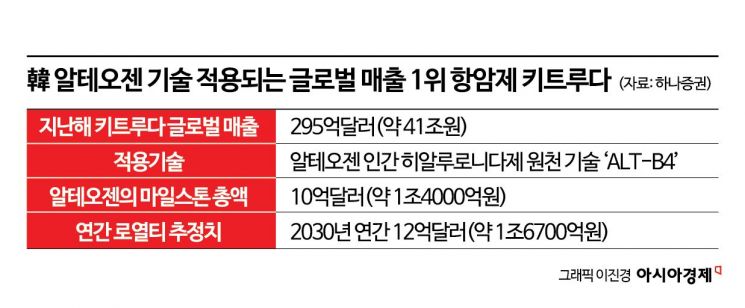
According to industry sources on September 22, the SC formulation of Keytruda received product approval from the United States Food and Drug Administration (FDA) the previous day. Keytruda is a blockbuster drug that generated approximately $29.5 billion (about 41 trillion won) in sales last year. Alteogen signed a contract with Merck in 2020, and the deal was converted into an exclusive agreement last year, bringing the total contract value to about $1 billion (approximately 1.4 trillion won). Upon FDA approval, Alteogen will receive the remaining milestone payments. While some Korean biotech firms have signed technology transfer contracts worth several trillion won with global pharmaceutical companies, there has been no precedent for actually receiving technology transfer fees following product approval from major authorities such as the US FDA. An Alteogen representative stated, “If the first product incorporating our SC formulation conversion technology is commercialized, we expect to generate stable revenue,” adding, “As a proven case for our platform technology, this will also help future technology exports.”
Keytruda SC offers a faster administration compared to the existing intravenous (IV) formulation, which requires a 30-minute infusion. It provides two dosing options: a one-minute subcutaneous injection every three weeks, or a two-minute subcutaneous injection every six weeks. Alteogen’s proprietary human hyaluronidase technology, ‘ALT-B4,’ is a recombinant enzyme protein that breaks down hyaluronic acid, which impedes drug penetration in subcutaneous tissue. By creating channels in the skin, it enables the drug to pass through the subcutaneous tissue. Lee Seungkyu, Vice Chairman of the Korea Biotechnology Industry Organization, commented, “There is a significant difference between having to stay in the hospital for a long time and simply receiving a subcutaneous injection,” and added, “The transition to SC formulations is one of the areas of greatest interest for global big pharma.”
Due to its convenience, the royalties Alteogen will receive from Keytruda are expected to continue increasing. According to Merck’s research, 30-40% of patients currently receiving Keytruda by IV would prefer to switch to the SC formulation if available. There are also analyses indicating that patients who have experienced the SC formulation do not return to IV. Kim Seona, a research analyst at Hana Securities, projected in a recent report, “Alteogen could earn up to $1.2 billion (about 1.67 trillion won) annually in royalties alone by 2030, five years after the launch of Keytruda SC.”
Alteogen’s achievement goes beyond the success of a single company. The adoption of Korean biotech technology in a flagship product of a major pharmaceutical company has solidified Korea’s position on the global stage, invigorating the entire industry ecosystem. In particular, Alteogen has presented a new business paradigm that moves beyond the traditional domestic model focused on licensing out or contract development and manufacturing (CDMO), by generating stable cash flow through proprietary technology. While the value of Korean biotech firms has often depended on the uncertainties of clinical development, this case demonstrates that long-term accumulation of technological capabilities can also enhance corporate value, not just short-term results.
Jung Yuntaek, Director of the Pharmaceutical Industry Strategy Research Institute, said, “Platform technologies can be linked to existing products, giving them greater impact than other new drugs or enabling the continuous expansion of pipelines,” and added, “This success story will serve as a foundation for domestic companies to expand various pipelines, not only for new drug development but also for platform technologies that can minimize risk.”
Alteogen’s platform technology is highly scalable, with potential applications not only for antibody drugs but also for ADCs (antibody-drug conjugates) and mRNA (messenger ribonucleic acid) therapies. In particular, for ADCs-which are gaining attention as next-generation cancer treatments-subcutaneous administration can help mitigate toxicity issues associated with intravenous injection, raising expectations for the technology’s application. In November last year, Alteogen signed the world’s first ADC SC development agreement with Daiichi Sankyo, the leading ADC company, and in March this year, entered into a technology transfer deal worth 2 trillion won with AstraZeneca of the United Kingdom.
© The Asia Business Daily(www.asiae.co.kr). All rights reserved.
![Clutching a Stolen Dior Bag, Saying "I Hate Being Poor but Real"... The Grotesque Con of a "Human Knockoff" [Slate]](https://cwcontent.asiae.co.kr/asiaresize/183/2026021902243444107_1771435474.jpg)












