A team of Korean researchers has proposed a new method for early diagnosis and treatment of Parkinson's disease using a fusion of artificial intelligence (AI) and optogenetics technology. This approach is significant because it can sensitively detect early-stage changes that are difficult to identify with conventional diagnostic methods and can enhance clinical efficacy.
KAIST announced on September 22 that a joint research team-comprising the group led by Distinguished Professor Heo Wondo from the Department of Biological Sciences, the team led by Professor Kim Daesu from the Department of Brain and Cognitive Sciences, and the group led by Director Lee Changjun from the Institute for Basic Science (IBS)-has demonstrated the potential for both early and precise diagnosis and treatment in animal models of Parkinson's disease by combining AI analysis with optogenetics.
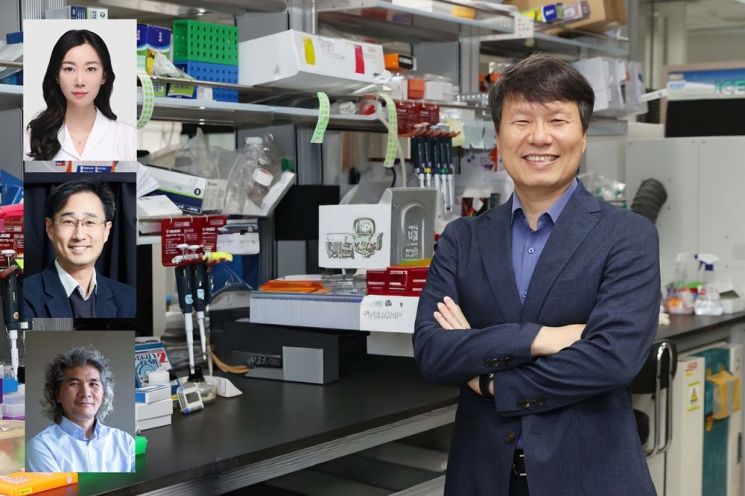 (From the top left) Dr. Hyun Bobae, Professor Kim Daesu, Director Lee Changjun, (right) Distinguished Professor Heo Wondo. Provided by KAIST
First, the joint research team applied an AI-based 3D posture estimation technology to analyze the behavior of a Parkinson's disease mouse model with stage 2 severity. The Parkinson's disease mouse model is a standard experimental model used for diagnosis and treatment research, created by inducing Parkinson's disease in male laboratory mice through abnormal alpha-synuclein protein expression, thereby mimicking the human condition.
The behavioral analysis involved using AI to evaluate over 340 behavioral signals-such as gait, limb movements, and tremors-in the Parkinson's disease mice, and expressing the results as a single score called the Parkinson's Behavior Index.
As a result, the Parkinson's Behavior Index showed a significant difference from the control group as early as two weeks after disease induction, enabling more sensitive detection of disease progression compared to conventional motor function tests.
Based on these findings, the joint research team identified that abnormal behaviors-such as changes in stride length, asymmetry in limb movements, and chest tremors-are key factors in diagnosing Parkinson's disease. The top 20 behavioral markers included limb asymmetry, changes in stride and posture, and increased high-frequency chest components.
To determine whether these behavioral markers simply reflected reduced motor function or were specific to Parkinson's disease, the team applied the same analysis to an amyotrophic lateral sclerosis (ALS) mouse model. Since both Parkinson's disease and ALS involve motor function impairment, the premise was that if the markers merely indicated reduced motor function, both diseases would show high Parkinson's Behavior Index scores.
However, the analysis revealed that the ALS animal model did not exhibit a high Parkinson's Behavior Index even when motor function was impaired. The behavioral changes were also clearly different from those seen in Parkinson's disease. This demonstrates that the Parkinson's Behavior Index developed by the team is not just a tool for identifying general motor impairment, but can detect changes unique to Parkinson's disease.
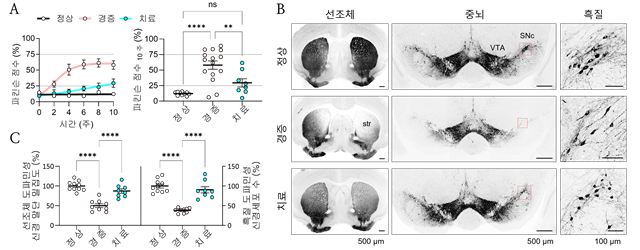 Disease progression alleviation and cell death inhibition effects in a Parkinson's disease mouse model using optogenetics. Provided by KAIST
Furthermore, the joint research team confirmed that using the optogenetic technology 'optoRET'-which precisely controls brain nerve cell function with light-for Parkinson's disease treatment improved gait and limb movement and reduced tremor symptoms in animal models.
They also found that administering light every other day (an alternate-day cycle) was the most effective treatment regimen for Parkinson's disease, and that this approach tended to protect dopamine neurons in the brain.
Distinguished Professor Heo stated, "This study is significant as it is the first in the world to implement a preclinical framework that integrates AI-based behavioral analysis and optogenetics for early diagnosis, treatment evaluation, and mechanism verification of Parkinson's disease. We expect that these results will contribute to the development of patient-tailored therapies and the realization of precision medicine in the future."
Meanwhile, Dr. Hyun Bobae, a postdoctoral researcher at the KAIST Institute of Biological Sciences, participated as the first author in this study. The results were recently published online in the international journal Nature Communications.
© The Asia Business Daily(www.asiae.co.kr). All rights reserved.
![Clutching a Stolen Dior Bag, Saying "I Hate Being Poor but Real"... The Grotesque Con of a "Human Knockoff" [Slate]](https://cwcontent.asiae.co.kr/asiaresize/183/2026021902243444107_1771435474.jpg)
















