Fruit Is the Most Expensive Item
Livestock Products Considered for Imported Alternatives
Allowances for Parents Are the Greatest Financial Burden
This year, the Chuseok holiday will last for seven days, from October 3 to October 9, and a recent survey found that holiday spending burdens are expected to rise significantly compared to previous years. This increase is attributed not only to the longer holiday period, but also to a combination of factors such as rising prices and higher "filial duty expenses."
According to a consumer group survey of 1,000 people nationwide on their "2025 Chuseok Spending Plans," the average expected expenditure this year is 712,300 won. This is an increase of approximately 148,800 won (26.4%) compared to last year's Chuseok.
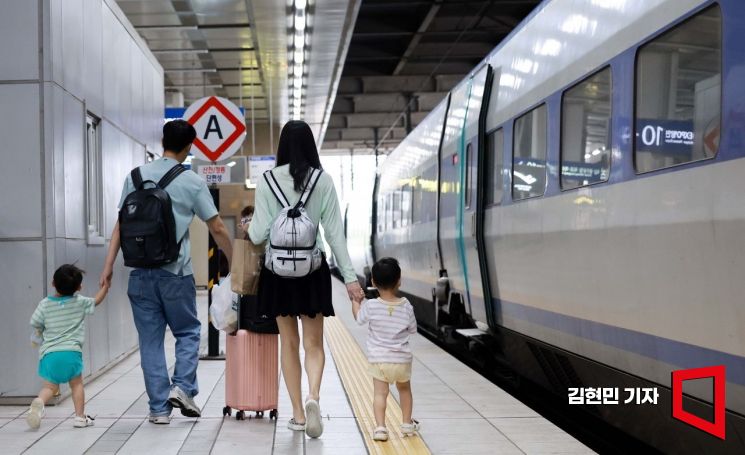 A family heading home for the holidays is boarding a train on the platform at Yongsan Station in Seoul.
Although the average daily spending has actually decreased slightly compared to last year, the total expenditure has risen sharply due to the extended holiday period. Among respondents, 62.4% said they plan to increase their budget compared to last year, and 8.2% said they intend to spend more than twice as much as before.
The largest portion of spending is allocated to allowances and gifts for parents, averaging 386,100 won, which accounts for more than half (54.2%) of the total. This is followed by expenses for Charye table offerings, allowances for relatives and nephews, and food costs at home as the main spending categories.
Notably, even as traditional holiday customs are becoming simpler, the financial burden does not appear to be decreasing. The most common response was to spend the holiday with family at home (46.8%), while only 36.4% planned to visit their hometowns. Plans for domestic travel accounted for 23.2%, and overseas travel was limited to 5.7%.
Additionally, 24% of respondents said they plan to take advantage of additional vacation days to create a longer holiday, with nearly half citing "rest" as their primary purpose. This suggests that the need for rest outweighs economic considerations.
The Charye table tradition is also changing. Among respondents, 86.4% said they are considering simplifying or replacing the Charye table, while only 13.3% plan to adhere to traditional formats. The reasons for simplification were a combination of housework burden, financial strain, and lack of time.
Among Chuseok food ingredients, fruit was cited as the most burdensome item, followed by livestock products and seafood. Willingness to purchase imported goods was highest for livestock products, while there was still a strong preference for domestic fruit.
Overall, 86% of respondents said they feel a financial burden due to the long holiday, with those in their 40s reporting the highest level of pressure.
Experts commented, "While Chuseok is gradually shifting from a family-centered tradition to a more individual-oriented culture, spending on the parent generation is actually increasing. It is important to set a budget in advance and practice rational consumption by comparing prices."
© The Asia Business Daily(www.asiae.co.kr). All rights reserved.
![Clutching a Stolen Dior Bag, Saying "I Hate Being Poor but Real"... The Grotesque Con of a "Human Knockoff" [Slate]](https://cwcontent.asiae.co.kr/asiaresize/183/2026021902243444107_1771435474.jpg)















