Suspicions of Anti-Korean Elements in Controversial Dialogue and Artwork
Experts Stress the Need for Vigilance Against Anti-Korean Sentiment
As the Japanese animation "Demon Slayer" continues its box office success in South Korea, surpassing a cumulative audience of 4.5 million, it has once again become embroiled in controversy over "right-wing tendencies" and "anti-Korean" sentiment. Recently, claims have emerged online that a specific line from the work evokes memories of Japan's past massacres of Koreans, causing the controversy to spread further.
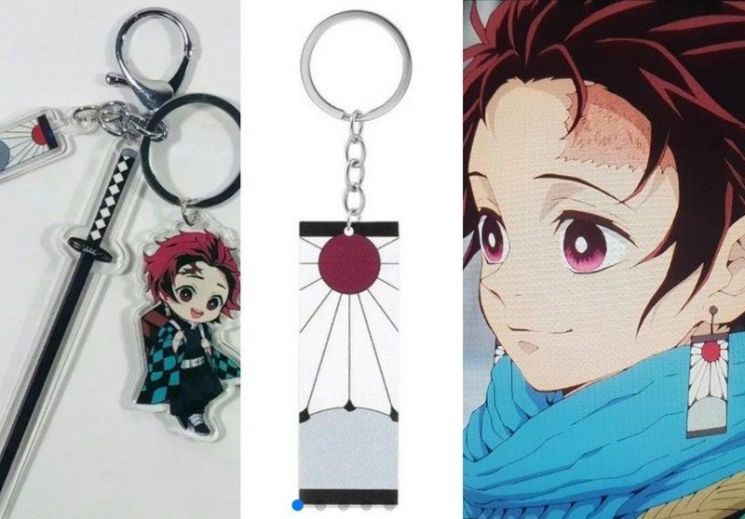 Keychain modeled after the protagonist of "Demon Slayer" wearing earrings with the Rising Sun flag pattern. Photo by Seokyeongdeok Professor Facebook
On September 20, a scene from Volume 18 of the original "Demon Slayer" manga became a hot topic on the social networking service X (formerly Twitter). The scene in question features the line, "The weak do not fight fairly and poison the well. It is despicable," against a backdrop resembling the Korean Peninsula. Critics argue that this evokes the massacre of Koreans during the 1923 Great Kanto Earthquake. Related posts have been shared over 17,000 times, generating significant public reaction.
This work has previously sparked controversy because the protagonist Tanjiro’s earrings were seen as reminiscent of the Rising Sun flag. Additionally, there has been criticism that the setting-the Taisho period (1912-1926), when Japan was strengthening its militarism-conveys a right-wing message.
The controversy is spreading beyond the content itself to include merchandise. Seo Kyungduk, a professor at Sungshin Women’s University, recently raised an issue after revealing that a "Demon Slayer" keyring featuring the Rising Sun flag pattern was being sold on a domestic online shopping mall. He criticized, "The fact that a major domestic shopping mall is selling such products without any verification encourages the indiscriminate distribution of far-right Japanese symbols."
Similar controversies have repeatedly arisen across Japanese content. In the past, the creator of "Attack on Titan" sparked debate with remarks that appeared to justify Japan's colonial rule, while "Slam Dunk" was also criticized for featuring a background image similar to the Rising Sun flag.
Nevertheless, attitudes toward Japanese content in South Korea appear to have become more flexible than in the past. Experts analyze that as Korean society has achieved economic growth and greater cultural confidence, reactions to Japanese content have also matured. While there is still awareness of anti-Korean expressions, the extreme rejection seen in the past is less common, especially as young Japanese now look up to Korean culture.
However, some point out that ongoing social vigilance is still necessary regarding recurring controversies over right-wing tendencies. They note that while Germany enforces strict legal sanctions against Nazi symbols, Japan has virtually no regulations on imperialist symbols such as the Rising Sun flag. There is a need for continued international efforts to highlight this issue.
"Demon Slayer: The Infinity Castle Arc" was released in South Korea on August 22 and surpassed 1 million viewers in the shortest time. It has now exceeded 4.5 million viewers, ranking as the third most successful Japanese animation in Korean box office history. Despite the political controversies surrounding the work, the loyalty of its fan base remains strong.
© The Asia Business Daily(www.asiae.co.kr). All rights reserved.
![Clutching a Stolen Dior Bag, Saying "I Hate Being Poor but Real"... The Grotesque Con of a "Human Knockoff" [Slate]](https://cwcontent.asiae.co.kr/asiaresize/183/2026021902243444107_1771435474.jpg)















