Event Hosted by the Ministry of Trade, Industry and Energy and Organized by the Korea Hydrogen Union
Clean Hydrogen Market Shifting to Asia, Led by China
Financial Support Needed to Lower Hydrogen Prices
Need to Address Differing Certification Standards by Country
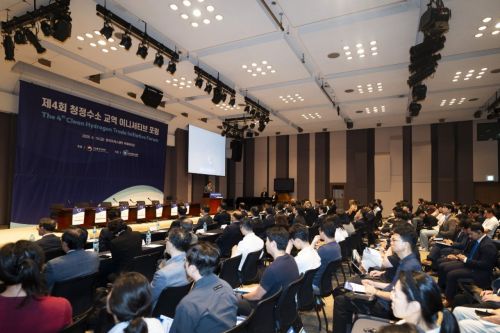 The 4th Clean Hydrogen Trade Initiative event, hosted by the Ministry of Trade, Industry and Energy and organized by the Korea Hydrogen Alliance, is being held on the 19th at the Seoul Press Center. Korea Hydrogen Alliance
As the role of clean hydrogen is being highlighted in response to the climate crisis and for energy security, there have been suggestions that continuous government policy and financial support are necessary to expand the clean hydrogen market.
At the "4th Clean Hydrogen Trade Initiative Forum (CHTI)" held at the Seoul Press Center on the 19th, hosted by the Ministry of Trade, Industry and Energy and organized by the Korea Hydrogen Union, Annie Nakamura, Deputy Director at S&P Global, stated, "The center of the clean hydrogen market is shifting to Asia," and pointed out, "To support this, continuous policy support, the establishment of large-scale supply chains, and regulatory streamlining are needed."
According to S&P Global, as of June 2025, the scale of global water electrolysis hydrogen projects under construction or operation is about 18 gigawatts (GW), roughly double the figure from the same period last year. In particular, Asian countries such as China and India are leading the green hydrogen market. Deputy Director Annie projected, "By 2030, China will account for 55% of the green hydrogen market."
In contrast, the green hydrogen markets in the European Union (EU) and the United States are stagnating. Deputy Director Annie explained, "Decision-making is being delayed in the EU, and in the United States, the number of green hydrogen projects has declined since the implementation of the 'One Big Beautiful Bill (OBBBA).'" She also predicted that the differing clean hydrogen certification standards by country would act as an obstacle to future market expansion.
Moonkyung Lee, Analyst at the Blue Dot Network of the Organisation for Economic Co-operation and Development (OECD), presented various support policies to promote investment in clean hydrogen, such as Contracts for Difference (CfD), hydrogen offtake (long-term purchase agreements) guarantees, and foreign exchange risk guarantees, while emphasizing the need to ensure sustainability and inclusiveness through international certification.
According to an OECD survey, as of 2024, the scale of clean hydrogen projects reached 75 billion dollars (about 104 trillion won), a 90% increase compared to 2020. Analyst Lee stated, "Demand for clean hydrogen will increase to 8 million tons by 2030," and added, "Policies and regulations will play a key role in achieving this."
The OECD projected that with financial support, the levelized cost of hydrogen (LCOH) could be reduced to 3 dollars per kilogram. The largest portion of clean hydrogen production costs was attributed to power grid infrastructure investment (53%), followed by electrolyzer prices (23%) and power operation costs (19%). Analyst Lee emphasized, "Financial support for clean hydrogen production should be used to lower the LCOH and strengthen the price competitiveness of clean hydrogen," and added, "Policy support such as long-term purchase agreements and CfD should be used to reduce risks."
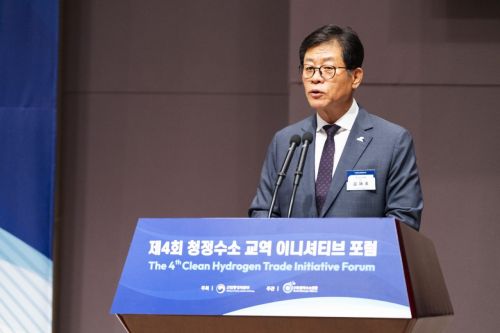 Kim Jaehong, chairman of the Korea Hydrogen Alliance, is delivering the opening remarks at the "4th Clean Hydrogen Trade Initiative Forum" held at the Press Center in Seoul on the 19th. Korea Hydrogen Alliance
Homoo Lee, Director at the Korea Energy Economics Institute, introduced the main criteria and operational plans of Korea's clean hydrogen certification system, stating that the pre-consulting system for companies participating in the Clean Hydrogen Power Bidding Market (CHPS) is helping to mitigate uncertainties in supply chain projects.
He also raised the need to unify the MRV (Measurement, Reporting, and Verification) system through AI-based optimization strategies and strengthened international cooperation to further enhance the certification system.
Director Lee stated, "With President Lee Jaemyung's visit to Japan, hydrogen cooperation has been elevated to a ministerial-level agenda," and added, "We plan to strengthen cooperation with the Japan Organization for Metals and Energy Security (JOGMEC)." The Korea Energy Economics Institute will first discuss clean hydrogen certification standards with Japan.
Kwon Kim, Director at Korea Power Exchange, presented the direction of the system design for the Clean Hydrogen Power Bidding Market, introducing a comprehensive evaluation system that assesses total generation cost, clean hydrogen certification grade, and industrial contribution. Director Kim emphasized the importance of market operation that balances economic efficiency and environmental friendliness.
Japan's JOGMEC announced that the Japanese government will promote a long-term support plan based on CfD over the next 15 years to expand the supply chain for low-carbon fuels. In addition, it emphasized the importance of building supply chains through cooperation with Germany's H2Global and the Korea-Japan dialogue channel.
Germany's H2Global stated that a phased approach to market formation and expansion is important for the spread of clean hydrogen. In particular, it revealed the current status of bid support worth 5.8 billion euros, a two-way bidding structure (Hintco) that connects long-term contracts with operating hydrogen suppliers to short-term sales with buyers, and plans for a second round of bidding worth 2.5 billion euros.
India's GH2India introduced the "National Green Hydrogen Mission," aiming to produce 5 million tons of hydrogen annually, attract 125 billion dollars in investment, and create 600,000 jobs by 2030. It also explained that state government incentives and infrastructure support policies, as well as the Solar Energy Corporation of India's (SECI) green ammonia procurement project, are being used to promote decarbonization of the fertilizer industry.
Kim Jaehong, Chairman of the Korea Hydrogen Union, stated in his opening address, "Our ultimate goal is green hydrogen based on renewable energy, but considering the realities of technology and price, a phased approach is necessary," and added, "Transitioning step by step to green hydrogen with zero greenhouse gas emissions, based on the clean hydrogen production technology and economic feasibility accumulated so far with blue hydrogen, will be a realistic and sustainable path."
Chairman Kim emphasized, "Korea's hydrogen demand is projected to reach about 3.9 million tons by 2030, of which 70% will need to be supplied from overseas," and added, "The demand and supply of clean hydrogen cannot be solved by the efforts of a single country alone, so the international community must work together to design supply chains and expand trade to enable the growth of the clean hydrogen industry."
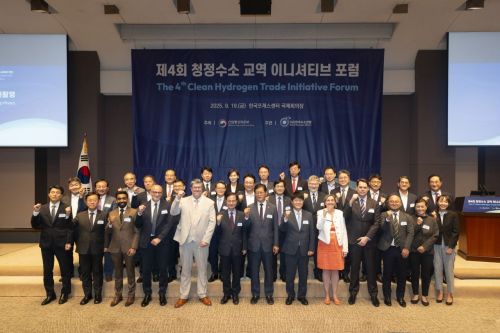 On the 19th, key participants are taking a commemorative photo at the "4th Clean Hydrogen Trade Initiative Forum" held at the Seoul Press Center. Korea Hydrogen Alliance
Dukyeol Park, Director of Hydrogen Economy Policy at the Ministry of Trade, Industry and Energy, stated, "Even under the new administration, Korea views hydrogen as an important means to achieve carbon neutrality and to create growth engines for the future energy industry, and will systematically build a full-cycle clean hydrogen industry ecosystem."
About 250 domestic and international experts and industry officials attended the event. Key figures included Kim Jaehong, Chairman of the Korea Hydrogen Union; Dukyeol Park, Director of Hydrogen Economy Policy at the Ministry of Trade, Industry and Energy; Philippe Lafortune, Ambassador of Canada to Korea; Martin Walker, Deputy Ambassador of the Australian Embassy in Korea; and Onny Jalink, Deputy Ambassador of the Embassy of the Netherlands in Korea.
The Korea Hydrogen Union explained, "While last year's forum focused on the clean hydrogen certification system, this year, by discussing key issues such as investment promotion, supply chain design, and policy support for vitalizing global clean hydrogen trade, the forum served as an opportunity to seek a foundation for practical cooperation and expand international collaboration."
© The Asia Business Daily(www.asiae.co.kr). All rights reserved.



















