Up to One Million Join Protests
309 Arrested Nationwide
Angered by the French government's austerity budget plan, crowds took to the streets for a large-scale protest on the 18th (local time), following the 'National Paralysis' citizen movement on the 10th.
Citizens who joined the protest criticized the government’s budget plan, arguing that daily life is becoming more difficult and that the social safety net-including schools and public hospitals funded by taxes, as well as unemployment benefits-is continuously shrinking. They also pointed out that poverty and inequality are worsening.
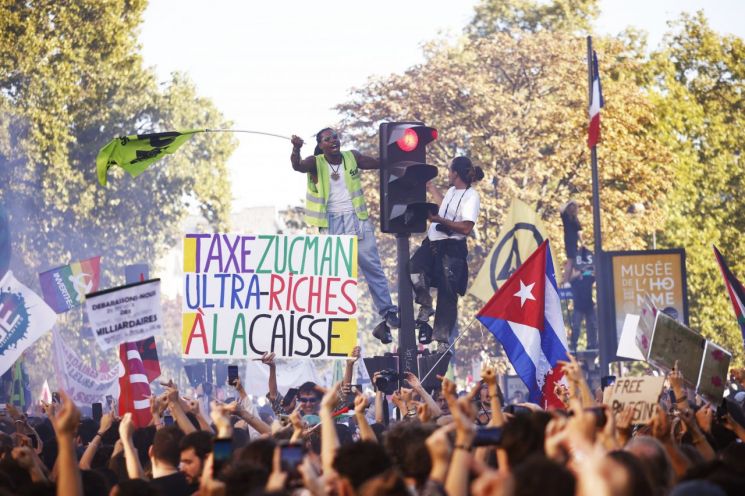 On the 18th (local time), citizens participated in a protest against the government's budget plan in Paris, France. Photo by EPA Yonhap News
Foreign media reported that numerous placards reading "Tax the Rich" were displayed at the protest sites.
Pierre Courroye, a retired civil servant, told the Associated Press, "France’s fiscal deficit is a problem, but cutting public services will not solve it."
Cyril, an IT worker, told the BBC, "I joined the strike because I disagree with President Macron’s economic and social policies, as well as former Prime Minister Francois Bayrou’s budget plan." He added, "If the new government tilts further to the left, it could mark the beginning of a solution."
According to the French Ministry of the Interior, more than 506,000 people participated in protests nationwide, with 55,000 in the capital, Paris. The hardline union General Confederation of Labour (CGT), which led the protest, estimated that over one million people joined across the country. This is a significant increase compared to the 200,000 who gathered during the protest on the 10th.
As a result of the protest, nationwide transportation-which saw relatively little disruption on the 10th-was paralyzed. On the 18th, four major unions at Paris Transport Authority (RATP) declared a strike, and only three automated subway lines operated normally without drivers. French National Railway Company (SNCF) announced that nine out of ten high-speed trains were running, but only about 60% of local train (TER) lines were in operation.
The French Ministry of Public Service stated that approximately 10.95% of civil servants went on strike. About one-third of elementary school teachers nationwide participated in the strike, and 98% of pharmacies joined as well.
The French government deployed 80,000 police officers, along with drones and armored vehicles, to maintain order. According to reports from The Guardian and others, police used tear gas in some areas, and minor clashes broke out between police and protesters in Lyon and Nantes, but the demonstrations were largely peaceful. The Ministry of the Interior reported that 309 people were arrested and 134 were detained nationwide.
This protest was triggered when former Prime Minister Bayrou, who had resigned, announced a 44 billion euro austerity package in July, which included a freeze on government spending and the abolition of two public holidays to reduce public debt. Last year, France’s fiscal deficit reached 5.8% of its gross domestic product (GDP), nearly double the European Union (EU) deficit ceiling of 3%.
Sebastien Lecornu, the new prime minister who took office on the 10th, announced that he would withdraw the plan to abolish public holidays and held talks with opposition parties, taking a step back. However, resistance continues.
The Associated Press reported that the situation has further increased pressure on Prime Minister Lecornu and President Macron.
© The Asia Business Daily(www.asiae.co.kr). All rights reserved.
![Clutching a Stolen Dior Bag, Saying "I Hate Being Poor but Real"... The Grotesque Con of a "Human Knockoff" [Slate]](https://cwcontent.asiae.co.kr/asiaresize/183/2026021902243444107_1771435474.jpg)
















