Government to Support Establishment and Expansion of AI Factories
Up to 10 Trillion Won in Insurance and 200 Billion Won in Loans
"AI Great Transformation Relay On-site Meeting"
The government plans to raise the AI adoption rate among manufacturing companies to 40% by 2030 and expand the number of leading AI factory pilot plants to 500. To achieve this, it will provide dedicated insurance products worth up to 10 trillion won and loans totaling 200 billion won.
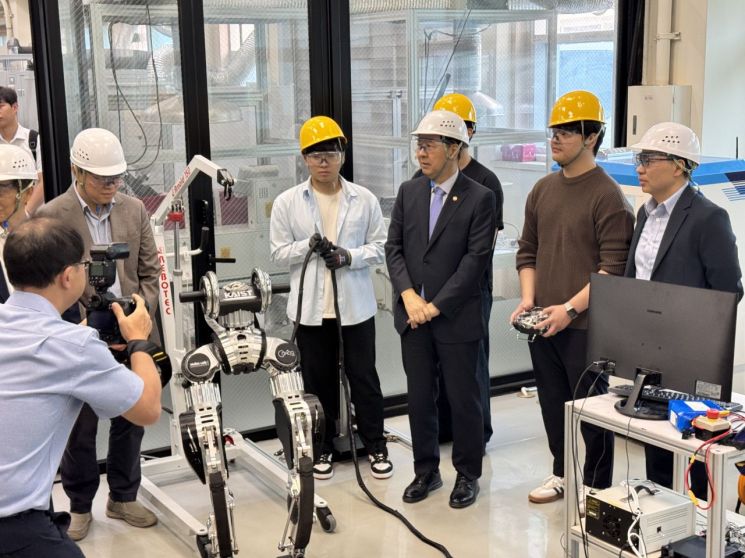 On the 19th, Deputy Prime Minister and Minister of Strategy and Finance Koo Yoonchul held a relay on-site meeting for the AI grand transformation at the AI Factory Lab of KAIST in Yuseong-gu, Daejeon, with leading companies in the AI factory sector, experts, and relevant government ministries.
On September 19, Deputy Prime Minister and Minister of Strategy and Finance Koo Yoonchul held the "AI Great Transformation Relay On-site Meeting" at the AI Factory Lab of KAIST in Daejeon, where he announced these plans, stating, "AI-based innovation in manufacturing processes is an essential strategy for survival." This was the second meeting in the relay series, following the session on "AI Robots and Automobiles" held on September 12.
Industry participants included POSCO, LG Electronics, GS Caltex, Hyundai Motor Company, and Google Cloud. Deputy Prime Minister Koo emphasized, "With the goal of increasing the AI adoption rate among manufacturing companies from less than 5% in 2025 to 40% by 2030, we will support the establishment and expansion of AI factories across the manufacturing sector."
The government will significantly increase the number of leading AI factory pilot plants from 26 in 2024 to 500 by 2030. In cooperation with commercial banks, it will provide dedicated insurance products worth up to 10 trillion won to companies participating in the AI factory initiative, and will also offer loans totaling 200 billion won.
The budget for related support has also been greatly increased in next year's budget proposal. The Ministry of Strategy and Finance announced, "The budget for supporting the establishment and expansion of smart factories has been increased by 84.9%, from 236.1 billion won this year to 436.6 billion won in 2026." By 2026, the government will focus on supporting core "physical AI" technologies, including specialized AI factory models and software platforms (40 billion won), as well as ultra-precise LAM (Large Action Model) technology (40 billion won). Efforts will also be made to establish testbeds and secure global standards. Unlike LLMs (Large Language Models), LAMs are large action models that understand the physical world and perform specific actions.
At the meeting, POSCO shared its case of using AI in the ironmaking process to calculate the optimal raw material input ratio and improve productivity with self-inspecting AI. Participating companies requested government support, noting, "Since there is no global leader yet in the field of AI manufacturing, Korea has an opportunity to take the lead." The government plans to incorporate on-site feedback into policy and continue to hold sector-specific relay meetings, such as those on AI talent (October 1) and AI ships and drones (October 1), to further develop support measures. Deputy Prime Minister Koo stressed, "By combining world-class manufacturing capabilities with AI, we will transform Korean manufacturing from A to Z."
© The Asia Business Daily(www.asiae.co.kr). All rights reserved.
![Clutching a Stolen Dior Bag, Saying "I Hate Being Poor but Real"... The Grotesque Con of a "Human Knockoff" [Slate]](https://cwcontent.asiae.co.kr/asiaresize/183/2026021902243444107_1771435474.jpg)















