Average Seat Occupancy Rate at 80.3%
Distribution of "Waiting Tickets" as Crowds Gather
Restrooms Blocked, Rendering Them Unusable
On September 18, the first official day of operation for the Hangang Bus, every trip was fully booked. The service attracted around 4,000 passengers, highlighting its popularity, but unexpected issues also arose, such as restroom blockages that made them difficult to use.
According to the Seoul Metropolitan Government on September 19, the total number of passengers on the first day of Hangang Bus operations was recorded at 4,361. The average number of passengers per route segment was 152.5, and the average seat occupancy rate was 80.3%.
The first buses departing from both ends of the route, Magok and Jamsil, at 11 a.m. the previous day, were fully booked in both directions. There are 14 round trips per day, with seven in each direction, and most of the remaining Hangang Bus trips also operated at full capacity. By segment, the first Jamsil-bound trip was fully booked from Magok to Apgujeong, and the third trip was fully booked from Yeouido. For Magok-bound trips, the first was fully booked from Jamsil to Ttukseom, and the third from Oksu to Apgujeong.
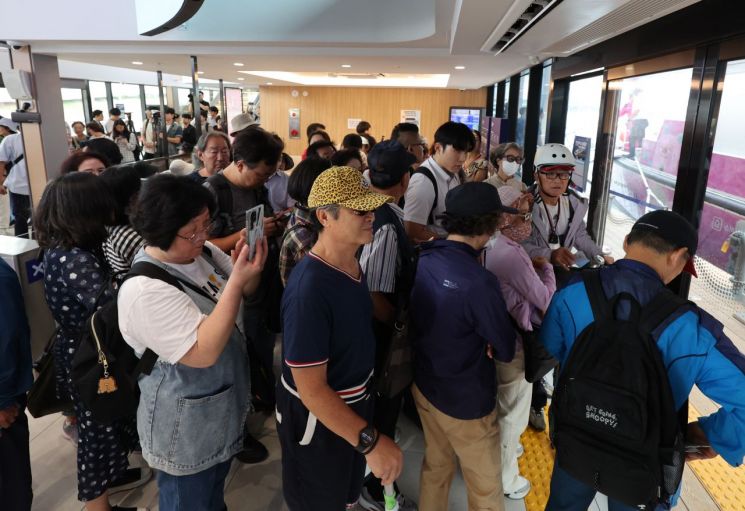
As it was the inaugural day, crowds gathered at the Hangang Bus piers, prompting staff to distribute "waiting tickets." Hangang Bus vessels have 145 or 199 seats, depending on the boat, but more citizens gathered than the available seats. From about 30 minutes before the first departure, people gathered at the pier to issue tickets and look around inside the terminal.
Remaining seats for the Hangang Bus can be checked via "information displays" at subway stations near the piers. They can also be checked by searching "Hangang Bus" on Naver Map or Kakao Map. As of the afternoon of the previous day, online checks showed that most segments had either no remaining seats or fewer than 10. A Seoul city official explained, "The moment a boarding pass is tagged for boarding at the site, the remaining seat information is updated. Once the crew makes a final check and inputs the data, the information is displayed on the display board. You can check this information until the scheduled arrival time."
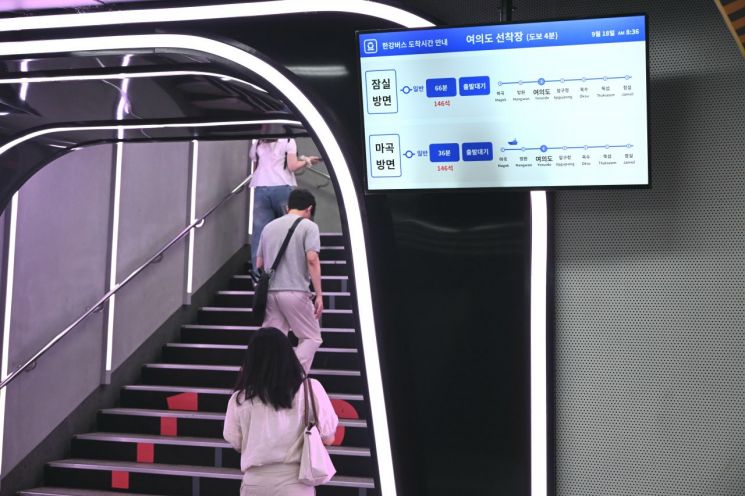 Hangang Bus Information Display Installed at Yeouinaru Station of Seoul Subway. Provided by Seoul City.
Restroom issues arose from the very first day of operation. According to the city, at around 4:30 p.m. the previous day, the restroom inside the Hangang Bus became blocked and unusable. Although only one stall was affected, all the restrooms became unavailable because the wastewater pipes are connected. A city official said, "It appears the blockage was caused by people disposing of wet wipes and similar items. Since the structure of restrooms on a vessel is different from those in regular buildings, it is not something that can be resolved immediately, but we will address it as quickly as possible." The vessel will continue to operate with restroom use restricted for now.
The fare for a single ride on the Hangang Bus is 3,000 won, and unlimited rides are available with the Climate Companion Card for an additional 5,000 won. Passengers tag their transportation cards at the terminal, just like on regular public transportation, and transfer discounts are available for buses and subways. Paper boarding passes can also be issued at kiosks. However, cash payments are not accepted.
© The Asia Business Daily(www.asiae.co.kr). All rights reserved.
![Clutching a Stolen Dior Bag, Saying "I Hate Being Poor but Real"... The Grotesque Con of a "Human Knockoff" [Slate]](https://cwcontent.asiae.co.kr/asiaresize/183/2026021902243444107_1771435474.jpg)
















