Hyundai Holds First Overseas CEO Investor Day in New York
Jose Munoz: "Tariffs Lowered Profit Margin by 1 Percentage Point"
U.S. Sales to Increase... Local Production Share to Rise from 40% to 80%
On September 18 (local time), Jose Munoz, President of Hyundai Motor Company, expressed hope that the U.S. tariff rate on Korean-made automobiles would be reduced from the current 25% to 15%, emphasizing the need for a swift trade agreement between South Korea and the United States. At the same time, he also revealed Hyundai's determination to directly tackle tariff risks by expanding sales in the U.S. and increasing the proportion of local production.
This clearly signals Hyundai's intent to compete in the U.S. market, its largest sales destination, despite adverse factors such as steep tariffs and the elimination of electric vehicle subsidies.
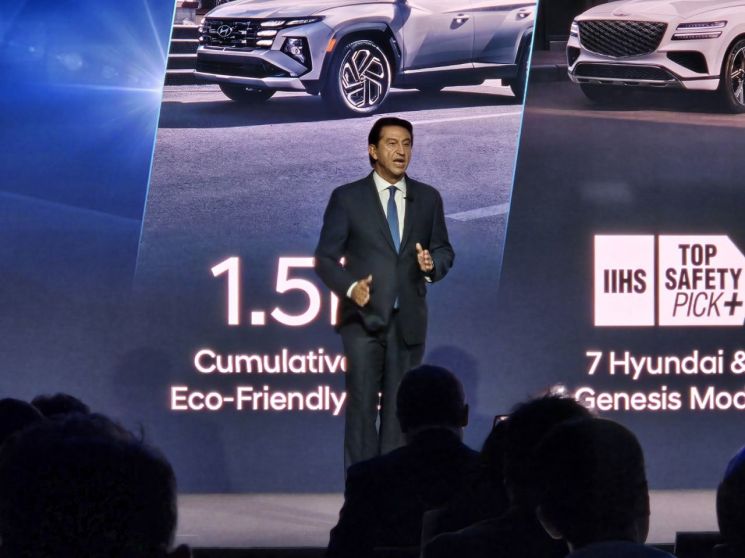
At the “2025 CEO Investor Day” held at The Shed in Manhattan, New York, targeting global investors and others, President Munoz stated, “I hope the governments of Korea and the U.S. will quickly reach an agreement on automobile tariffs,” adding, “We want to set plans for this year and next, and present a vision for strong performance.” This marks the first time Hyundai Motor Company has held a CEO Investor Day overseas.
Since April, the United States has been imposing a 25% itemized tariff on imported automobiles. In the case of Japan, the rate was reduced to 15% through a bilateral agreement, but although South Korea agreed at the end of July to a 15% reduction, subsequent negotiations failed to resolve differences, so the 25% rate still applies. Previously, under the Korea-U.S. Free Trade Agreement (FTA), the tariff rate on Korean automobile exports to the U.S. was 0%.
Regarding the downward revision of this year’s operating margin target, President Munoz explained, “The (lowered) earnings guidance provided today is based on a 25% tariff rate,” and added, “If the tariff were reduced to 15%, we could have met the previously presented outlook.”
Reflecting the impact of tariffs, Hyundai Motor Company lowered its target for this year’s consolidated operating margin to 6.0-7.0%, down by 1.0 percentage point from the previous 7.0-8.0%. However, the target for consolidated revenue growth was raised from the initial 3.0-4.0% to 5.0-6.0%. The strategy is to offset profit declines as much as possible by expanding sales.
President Munoz stressed, “The focus of our business operations is always on our customers and shareholders,” and added, “We will continue to grow despite tariffs by expanding sales, improving our product mix, and increasing net revenue.”
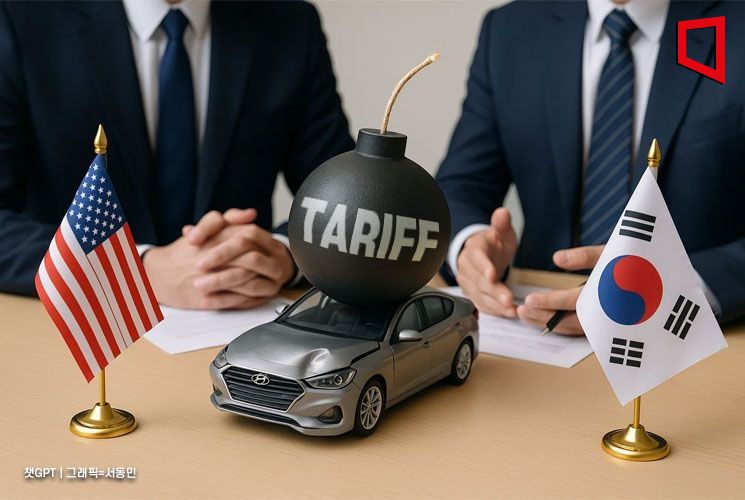
He reiterated Hyundai’s commitment to overcoming the crisis through U.S. sales growth and increased local production, despite the worsening business environment caused by tariff hikes and the elimination of electric vehicle subsidies under the Donald Trump administration.
President Munoz emphasized, “The United States is Hyundai Motor Company’s most important market and still holds significant growth potential,” adding, “We will pursue additional growth by launching new models such as large SUVs and pickup trucks.”
Hyundai Motor Company plans to double the proportion of local production in the U.S. from the current 40% to 80% by 2030. He stated, “Regardless of tariffs, Hyundai has always localized in markets where it has succeeded globally. Vehicles sold in the U.S. should be produced in the U.S.-localization is absolutely necessary.”
To this end, Hyundai is also increasing its investment in the U.S. Of the 77.3 trillion won Hyundai plans to invest globally over the next five years, its U.S. investment will rise from the previous 11.6 trillion won to 15.3 trillion won. This is part of the expanded U.S. investment plan announced by Hyundai Motor Group last month.
Addressing concerns about a potential decrease in domestic production due to expanded U.S. production, he clarified, “This should be viewed from the perspective of U.S. market growth, not as a shift in production. It should not be seen as moving Korean production to the U.S.”
Regarding potential price increases due to tariff burdens, he stated that Hyundai would respond flexibly according to market conditions. After the reciprocal tariffs took effect in April, Hyundai mitigated the impact with stockpiled inventory, but as inventories are depleted in the second half of the year, the tariff burden will intensify, and an even greater impact is expected next year.
President Munoz explained, “With our customer-centric approach, we have not raised prices so far. We are seizing opportunities to expand sales and improving our sales financing. However, we will comprehensively assess future market conditions, including new model launches and logistics costs, before making any decisions.”
He also made clear Hyundai’s strategy of market diversification. The company will pursue balanced growth not only in the U.S., but also in major global markets such as Europe, India, Southeast Asia, Central and South America, and China.
He stated, “In Europe, we will enhance profitability by expanding our electric and hybrid vehicle portfolio,” and regarding China, “We will strengthen cooperation with local partners and accelerate localization with a ‘for China, in China’ strategy.” He emphasized, “We will continue stable and sustainable growth through diversification across global markets, without relying on any specific region.”
© The Asia Business Daily(www.asiae.co.kr). All rights reserved.


















