Opposition to the Separation of the Financial Consumer Agency from the Financial Supervisory Service
First Large-Scale Outdoor Rally in 17 Years Since 2008
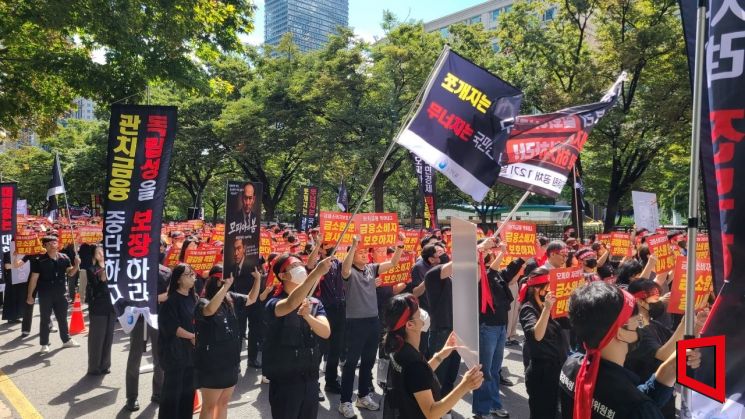 Around noon on the 18th, about 1,000 employees of the Financial Supervisory Service held an outdoor rally near the National Assembly in Yeouido, Seoul, claiming that "the separation and establishment of the Financial Consumer Agency is a harmful reform that goes against the protection of financial consumers." This is the first large-scale outdoor rally by Financial Supervisory Service employees in 17 years since the 2008 protest against the revision of the financial supervisory organization.
Employees of the Financial Supervisory Service held a large-scale outdoor rally, arguing that separating the Financial Consumer Agency from the Financial Supervisory Service would actually undermine the protection of financial consumers. They predicted that the separation of the Financial Consumer Agency would lead to various issues, including both institutions shirking responsibility and overlapping regulations. They also pointed out that the government's designation of the Financial Supervisory Service as a public institution would weaken the independence of the supervisory body, ultimately harming the public.
Over 1,000 Financial Supervisory Service Employees Gather, "Oppose Separation of the Financial Supervisory Service"
Around noon on September 18, more than 1,000 employees of the Financial Supervisory Service held an outdoor rally near the National Assembly in Yeouido, Seoul, declaring that "the separation and establishment of the Financial Consumer Agency is a harmful reform that goes against the protection of financial consumers." This is the first large-scale outdoor rally by Financial Supervisory Service employees in 17 years since the 2008 protest against the revision of the financial supervisory organization.
The Emergency Response Committee of the Financial Supervisory Service emphasized, "The prudential supervision of financial companies, business conduct supervision, and the protection of financial consumers carried out by the Financial Supervisory Service are not isolated tasks but are inseparably and organically connected." The committee warned, "The current plan to reorganize the financial supervisory system artificially fragments these three areas of work, which will actually weaken the protection of financial consumers and only result in unnecessary social and economic costs."
In particular, the committee stated, "The side effects of separating the institutions, such as shirking responsibility between organizations, supervisory blind spots, increased costs due to separation, overlapping regulations, and even contradictory regulations by both institutions, can already be seen in the cases of the United Kingdom and Australia, which have introduced a twin peaks supervisory system." They cited, "The bankruptcy of Australia's largest insurance company HIH and the massive financial fraud case involving the largest pension fund operator Trio Capital are examples of supervisory failures caused by unclear responsibility and poor information sharing between the two supervisory agencies."
Furthermore, the committee dismissed the designation of the Financial Supervisory Service as a public institution as an attempt to revert the financial supervisory system to the pre-1997 Asian financial crisis era, aiming to revive government-controlled finance. According to the committee, in 1997, the International Monetary Fund identified the lack of independence from political influence as a key cause of Korea's financial crisis and demanded the establishment of an integrated supervisory body with operational and budgetary autonomy, which led to the founding of the Financial Supervisory Service.
"Designation as a Public Institution Raises Concerns Over Undermining Supervisory Independence"
The committee stressed, "If the government pushes ahead with designating the Financial Supervisory Service as a public institution, placing it under the control of the newly established Ministry of Economy and Finance, financial supervision-which should protect financial consumers and ensure the soundness of financial companies-will be reduced to a mere tool for economic stimulus and financial industry promotion by the Ministry of Economy and Finance." They added, "This would mean returning to the failed financial supervisory system that led to the worst economic crisis in Korea's constitutional history in the 1990s."
The committee continued, "There are persistent suspicions in the media that this reorganization of the financial supervisory system is being carried out to create positions for certain individuals." They added, "Financial Supervisory Service employees do not want to believe such claims, but the hasty and poorly prepared legislative process without rational discussion only serves to amplify these suspicions."
Meanwhile, the committee also called for the suspension of the task force (TF) reviewing the legislative response to the government’s organizational restructuring plan within the Financial Supervisory Service, criticizing the process as rushed, given that the TF had only about two days to review the proposed bills.
The committee argued, "It is said that more than 50 laws, including the Act on the Establishment of the Financial Supervisory Commission and the Banking Act, and over 9,000 articles need to be amended for the reorganization of the financial supervisory system, but reviewing all of this in just two days is unrealistic." They further criticized, "Although the reorganization is being promoted under the pretext of strengthening financial consumer protection, in reality, it amounts to a hasty legislative process for harmful financial reform."
© The Asia Business Daily(www.asiae.co.kr). All rights reserved.
![Clutching a Stolen Dior Bag, Saying "I Hate Being Poor but Real"... The Grotesque Con of a "Human Knockoff" [Slate]](https://cwcontent.asiae.co.kr/asiaresize/183/2026021902243444107_1771435474.jpg)















