Meta Unveils AI Glasses with Display at Annual Conference
Global Big Tech Firms Compete for Next-Generation Device Leadership
Rivalry Heats Up Over "Wearable AI Assistants" Beyond Traditional Wearables
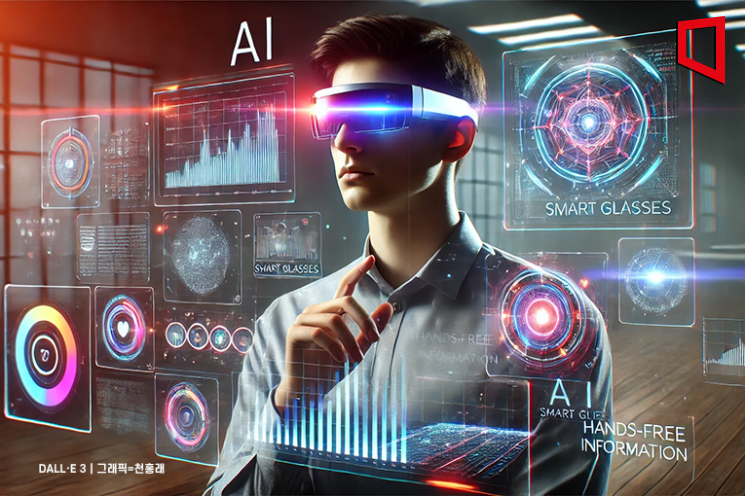
Global big tech companies have officially entered the "smart glasses war," competing to develop next-generation computing devices that go beyond smartphones. Following Meta's unveiling of a new artificial intelligence (AI) eyewear equipped with a display, Amazon, Google, and major Chinese tech firms have also announced their entry into the market. As a result, augmented reality (AR) glasses are emerging as a key battleground for dominance over future devices.
On September 17 (local time), Meta, the parent company of Facebook, introduced the "Meta-Ray-Ban Display" at its Menlo Park headquarters in California during "Meta Connect 2025." The device features a high-resolution display on one lens, allowing users to instantly check messages and notifications, utilize video and translation functions, and maintain outdoor readability thanks to its high resolution and brightness. Notably, the wrist-worn "Meta Neural Band" enables text input and music control through subtle finger movements, presenting for the first time an alternative input method to replace smartphones. The price is set at $799 (approximately 1.1 million KRW), and sales will begin in the United States and other countries at the end of this month. Meta CEO Mark Zuckerberg emphasized, "Smart glasses are devices that connect directly to a user's sight and hearing, enabling the most natural communication with AI," adding, "They will become an interface like a personal assistant that is always on."
The industry believes Apple is also developing next-generation smart glasses following its "Vision Pro." Ming-Chi Kuo, an analyst at TF International, recently reported that "Apple is preparing a total of seven XR devices by 2027, four of which are expected to be in the form of glasses." It is widely anticipated that these devices will feature built-in cameras, microphones, speakers, and support vision-based AI functions.
Amazon is developing two models: "Jayhawk" and "Amelia." Jayhawk is aimed at consumers, equipped with a full-color display, camera, microphone, and speakers, while Amelia is designed for delivery drivers, offering route guidance and sorting assistance in logistics environments. Amazon is targeting a consumer product launch between late 2026 and early 2027.
Google, in partnership with Samsung, is preparing smart glasses through the "Moohan" project. An early prototype was unveiled at Google's developer conference in May, and fashion brand Gentle Monster has joined as a partner to differentiate the design.
Major Chinese tech companies are also moving quickly. Alibaba plans to launch "Quark Vision," priced at 1,999 yuan (approximately 380,000 KRW), within this year. The device focuses on practical features such as navigation and mobile payments, ensuring price competitiveness. Xiaomi, Baidu, and ByteDance are also racing to develop similar products, aiming to expand both in the Chinese domestic market and globally.
The industry views the smart glasses competition as more than just a battle over wearable devices; it is seen as a decisive contest for dominance in the "post-smartphone" era. An IT industry insider commented, "Smart glasses are not just simple wearables; they can become the next-generation interface where AI, platforms, and content converge. Market leadership will depend on which company completes this ecosystem first."
© The Asia Business Daily(www.asiae.co.kr). All rights reserved.

















