Strengthening Imaging Capabilities and Verifying Constellation Operations
with the Launch of the Verification Model in December
The Space Agency will launch a total of 10 ultra-small satellite constellations (Neonsat) in production units-five each-through the fifth launch of the Nuri rocket in 2026 and the sixth launch in 2027, marking the start of a full-scale satellite constellation system.
On September 18, at the Maison Glad Hotel in Jeju, the Space Agency announced this plan during the 4th Ultra-Small Satellite Constellation Utilization Workshop, which was held to discuss ways to promote the use of satellite information.
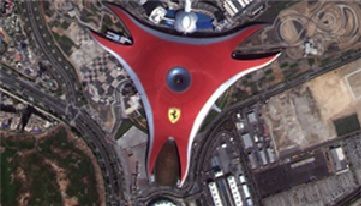 The ultra-small satellite constellation 'Neonsat' captured Ferrari World in Abu Dhabi, UAE, on December 14, 2024. Provided by the Space Agency.
The ultra-small satellite constellation 'Neonsat' is an Earth observation satellite developed by the Korea Advanced Institute of Science and Technology (KAIST) with support from the Space Agency. Its purpose is to provide high-frequency, precise monitoring of the Korean Peninsula and surrounding waters, enabling rapid response to national security, disaster, and emergency situations.
The first prototype of the ultra-small satellite constellation was successfully launched on April 24, 2024 (Korea Standard Time), and is currently being operated stably by the National Satellite Operations Center. As of August 2025, it has captured over 1,700 images of domestic and international regions, producing approximately 20,000 high-resolution images.
The Space Agency plans to launch a verification model in December using Rocket Lab USA's Electron launch vehicle, in order to verify core technologies of the satellite constellation system identified by the prototype, while in orbit.
This verification model will be placed in an afternoon orbit, which allows for ground imaging at a fixed time each day to maximize observation efficiency. It will precisely check in-orbit thrust performance, satellite altitude maintenance and equidistant deployment capability, as well as image quality.
At this workshop, the Space Agency shared the results of a pilot research support program in which it provided domestic experts with free access to more than 1,100 high-resolution optical images of overseas regions captured by the prototype, as well as approximately 900 analysis products such as surface reflectance and spectral indices produced by the Korea Aerospace Research Institute's utilization support system.
This is the first time in the history of domestic satellite development that high-resolution images from a national satellite have been provided free of charge to experts for research support, and it is being recognized as a highly innovative initiative.
In addition, the workshop discussed national use of ultra-small satellite constellations for national security and disaster response, as well as strategies to promote public demand and industrialization.
Kim Jinhee, Director of the Satellite Division at the Space Agency, stated, "The images captured by the ultra-small satellite constellation are among the highest quality in the world for satellites weighing less than 100 kg," adding, "Providing such high-quality data free of charge to support domestic research is a highly innovative and challenging initiative."
© The Asia Business Daily(www.asiae.co.kr). All rights reserved.

















