Introduction of Schneider Electric's "Power of 2" Strategy
Emphasis on Digital Transformation and Comprehensive AI Application
Murad Tamud, Vice President and Chief Supply Chain Officer at Schneider Electric, one of the world's top three energy management companies, advised that Korean companies should pursue localization, diversification, and digital transformation in parallel to secure supply chain resilience. Schneider Electric has ranked first for three consecutive years in Gartner's "Top 25 Supply Chain Leaders" list, and Vice President Tamud participated as a panelist at the SK Group Icheon Forum last month, where he discussed strategies for strengthening core competitiveness.
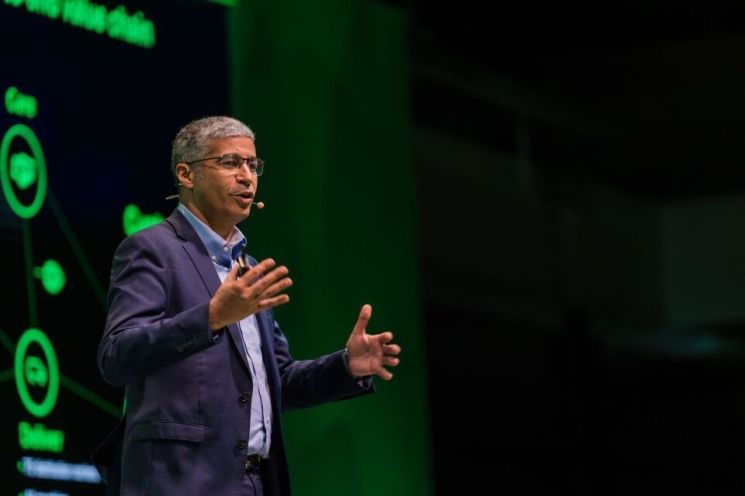 Murad Tamud, Vice President and Chief Supply Chain Officer at Schneider Electric. Schneider Electric
On September 18, in a recent written interview with Asia Economy, Vice President Tamud emphasized the importance of "localization" in supply chains. He assessed that Korean companies' localization efforts are still largely limited to establishing and operating factories. Even when battery and semiconductor companies localize their factories, they tend to remain heavily dependent on specific regions for key components and materials.
Vice President Tamud advised that companies should respond with a "localization" strategy, which balances the strengths of global corporations with agile local responsiveness. He stressed that this approach allows companies to efficiently manage various global business risks, such as trade barriers and tariffs.
He stated, "Schneider Electric has accelerated the 'multi-hub supply chain model,' relocating production bases closer to demand centers, and has localized over 83% of its operations, with a target of 90%." Through this, Schneider Electric has reduced lead times from order to final delivery, decreased transportation-related carbon emissions, and improved service levels.
He added, "Initially, we focused on simplifying production bases and integrating operations, but the real transformation began with the shift to a 'Tailored, Sustainable, Connected (TSC) supply chain.' The core of this transformation is differentiated responses for each customer, digitalization of factories and logistics centers, and ensuring transparency across the entire supply chain through EcoStruxure."
◆The Era of Expanding Protectionism... Supply Chain Diversification Is Essential
Korean companies still rely heavily on specific regions for raw material procurement. Lithium is mainly sourced from Chile or Australia, while dependence on China remains high for graphite and rare earth elements. Whenever the Chinese government imposes export restrictions on rare earths, Korean companies have repeatedly faced emergency situations.
In response to these changes, Schneider Electric has introduced the "Power of 2" strategy. Vice President Tamud explained, "We operate with at least two suppliers and two production bases to reduce dependence on single-source risks. This enables rapid responses to trade regulations, natural disasters, and sudden shifts in demand."
◆Digital Transformation and Comprehensive Application of Artificial Intelligence (AI) Are No Longer Optional
Vice President Tamud stated, "One of the most important areas of innovation is digital transformation (DT). By investing heavily in AI, the Internet of Things (IoT), and advanced analytics, we have made our supply chain intelligent, predictable, and agile." Digital transformation is an area especially emphasized by SK among domestic companies. Last month, SK held the Icheon Forum under the theme "AI and Digital Transformation." Vice President Tamud commented, "It is impressive that Korean companies, including SK Group, are not only responding to these changes but are actually leading them."
Schneider Electric applies AI across all stages, from business planning to field operations. AI-driven unmanned systems manage inventory and predict demand automatically, while on-site, AI assists managers with real-time diagnostics and asset optimization, reducing the probability of sudden downtime.
Vice President Tamud said, "AI-based control towers monitor global issues in real time and enable rapid responses across the entire network. I recommend that Korean companies invest in digital transformation to enable dual sourcing systems, strengthen local manufacturing capabilities, and make scenario-based decisions."
Vice President Tamud joined Schneider Electric in 1997 as a supply chain and logistics manager. Over the past 20 years, he has held key positions in various fields, including industrial strategy, production, and logistics. Since 2019, as Chief Supply Chain Officer, he has overseen the operation, innovation, logistics, network design, and strategic agenda of Schneider Electric's entire supply chain organization.
© The Asia Business Daily(www.asiae.co.kr). All rights reserved.
![Clutching a Stolen Dior Bag, Saying "I Hate Being Poor but Real"... The Grotesque Con of a "Human Knockoff" [Slate]](https://cwcontent.asiae.co.kr/asiaresize/183/2026021902243444107_1771435474.jpg)















