Additional Explanation on the September 7 Real Estate Policy Package
The government has announced that construction could begin in 2027 for the Seongdae Baseball Stadium site in Dobong-gu and the Wirye business site in Songpa-gu, which were presented as part of Seoul’s supply plans in the September 7 real estate policy package. Although these sites had previously been considered as potential locations for housing supply, development had stalled due to various issues and disagreements with local governments during the process.
On September 16, the Ministry of Land, Infrastructure and Transport released a "Q&A on Additional Explanations for Housing Supply Expansion Measures," stating that "significant progress has been made in consultations with local governments and related agencies to quickly supply housing at these sites." The ministry also explained, "Taking into account the characteristics and locations of each site, we plan to include for-sale housing in the supply." While these sites were previously mentioned as part of the supply plan through 2030, the government has now specified a more concrete timeline.
Regarding how the public housing at these sites will be divided between for-sale and rental units, the ministry stated that it will gather opinions from local governments and other stakeholders before making a decision. To address potential opposition from local residents, the government is also considering including cultural and leisure facilities, such as libraries, as well as amenities for residents. For other idle sites in Seoul, such as the Korea Educational Development Institute site in Seocho-gu and the public office building in Gangseo-gu, the goal is to begin construction in 2028, which is the year after next.
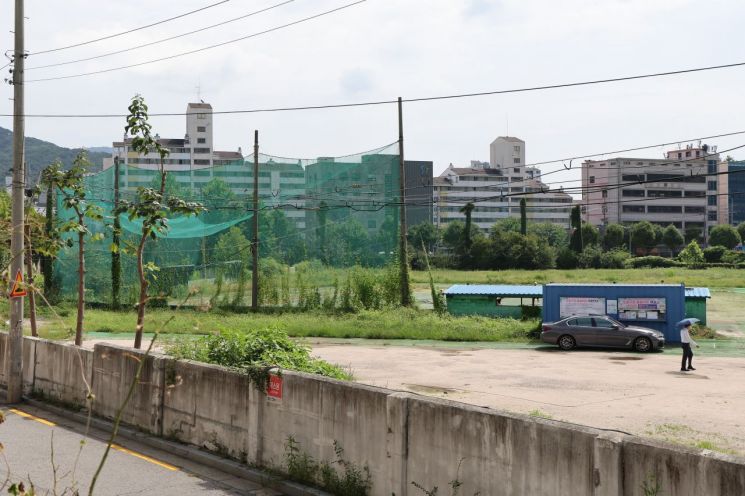
The plan is to build 1,800 housing units at the Seongdae Baseball Stadium site and 1,000 units at the Wirye business site. The Korea Educational Development Institute site will provide 700 units, and the Gangseo-gu public office building will provide 558 units. The Korea Land and Housing Corporation (LH) will be responsible for the projects after acquiring the land through negotiations with the landowners-Sungkyunkwan University, the Ministry of National Defense, and the Gangseo-gu Office, respectively. For the Korea Educational Development Institute site, the land will be acquired through expropriation.
The materials distributed by the Ministry of Land, Infrastructure and Transport on this day are largely intended to address negative feedback that emerged after the announcement of the policy on September 7. In response to concerns that LH’s direct involvement in the projects might mean they are only targeting unsold land due to fears of unsold units, the ministry clarified, "As of the end of last month, LH held 53 unsold housing land plots, totaling 22,000 units. Of the 53,000 units planned for the Seoul metropolitan area, only about 5% of the land is currently held by LH due to unsold or canceled contracts."
Regarding concerns that the quality of housing may decline because LH is pursuing these projects as contract-based private participation projects with lower construction costs, the ministry stated, "Since private companies will be using their own brands and managing quality, it will be possible to ensure a quality level comparable to privately sold housing." The ministry also addressed concerns about low participation from major construction companies by noting that, of the 17 construction companies selected in the past two years, 11 were among the top 30 in construction capability evaluations. The ministry also announced plans to introduce incentives to encourage participation from construction companies.
© The Asia Business Daily(www.asiae.co.kr). All rights reserved.
![Clutching a Stolen Dior Bag, Saying "I Hate Being Poor but Real"... The Grotesque Con of a "Human Knockoff" [Slate]](https://cwcontent.asiae.co.kr/asiaresize/183/2026021902243444107_1771435474.jpg)















