On September 16, the National Assembly continues its second day of government questioning in the fields of foreign affairs, unification, and national security. The ruling and opposition parties are expected to engage in heated debates over issues such as the South Korea-US tariff negotiations and the detention of Korean nationals in Georgia by US immigration authorities. Prime Minister Kim Minseok, Minister of Foreign Affairs Cho Hyun, Minister of Unification Chung Dongyoung, and Minister of National Defense Ahn Kyubaek are attending the session.
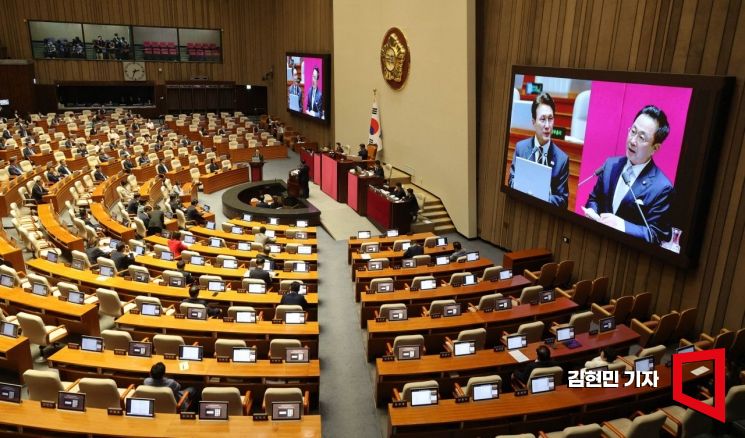 Prime Minister Kim Minseok is responding to a question from Park Seongjun, a member of the Democratic Party of Korea, during the government questioning session held at the National Assembly plenary hall on the 15th. Photo by Kim Hyunmin
The Democratic Party of Korea is expected to emphasize that, since the inauguration of the Lee Jaemyung administration, it has overcome the turmoil caused by the 12·3 Martial Law and restored the normal operation of the diplomatic and security response system. In contrast, the People Power Party is likely to press the administration on its failure to reach a final agreement in the South Korea-US tariff negotiations. The party is also expected to label the detention of Korean nationals as a "diplomatic disaster" and launch a broad offensive against the administration's overall foreign policy.
The ruling and opposition parties also engaged in fierce exchanges during the government questioning on political affairs held the previous day. The ruling party raised issues regarding the unconstitutionality of the 12·3 Martial Law and the stance of the People Power Party. The People Power Party, in turn, accused the Democratic Party of inciting a psychological civil war through allegations of insurrection and characterized the ruling party's prosecution and judicial reforms as "dictatorship."
Park Seongjun, a Democratic Party lawmaker who was the first to speak during the government questioning, stated, "December 3 (last year) was an attempt to pursue permanent sovereignty and totalitarian fascism through insurrection." He added, "Far-right YouTubers were mobilized, and the prosecution, acting like the Nazi secret police, manipulated indictments to violently control the state." In response, Prime Minister Kim Minseok said, "Although the terminology may differ, I fundamentally view it that way," referring to the characterization of the Yoon Sukyeol administration as fascist.
© The Asia Business Daily(www.asiae.co.kr). All rights reserved.