Second Anniversary of Gaya Tumuli's UNESCO World Heritage Designation in 2023
Commemorative Exhibition at the National Gimhae Museum
35 Years of Daeseongdong Tumuli Artifacts Brought Together
First Public Display of Restored Leather Shield
To commemorate the second anniversary of the Gaya Tumuli's designation as a UNESCO World Heritage Site, the National Gimhae Museum is hosting the exhibition "Coexistence of Time: Daeseong-dong Tumuli in Gimhae." Archaeological materials unearthed from the Daeseong-dong Tumuli over the past 35 years will be showcased in one place.
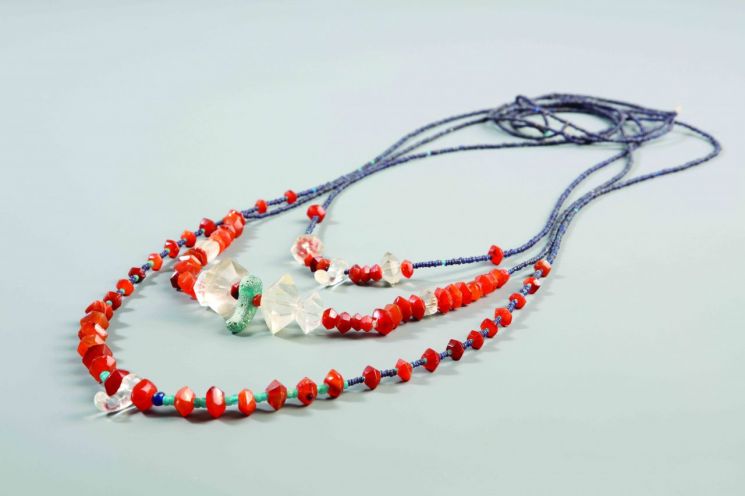
This special exhibition brings together more than 1,000 representative artifacts of Gaya, including pottery, ironware, items from foreign trade, cylindrical bronze objects, plant and animal remains, organic materials, and human bones. Various prestige items excavated from the tombs of Gaya kings, who once played a leading role in East Asian trade through iron, will be on display.
For the first time in Korea, the original forms of leather shields excavated from Daeseong-dong Tomb No. 11 and a quiver from Tomb No. 14 have been restored and will be unveiled. The leather shield measures 169 cm in height and 62 cm in width, featuring patterns such as the triangular line motif (a design formed by densely gathering fine lines into a triangle), as well as striking black lacquer and vivid red lacquer decorations. Unlike the typical waist-worn quiver engraved with the owner's surname or inscription, the quiver is designed to be carried on the back like a backpack, with the arrowheads facing upward. Scale armor excavated from Daeseong-dong Tomb No. 8 has also been restored and will be presented to the public.
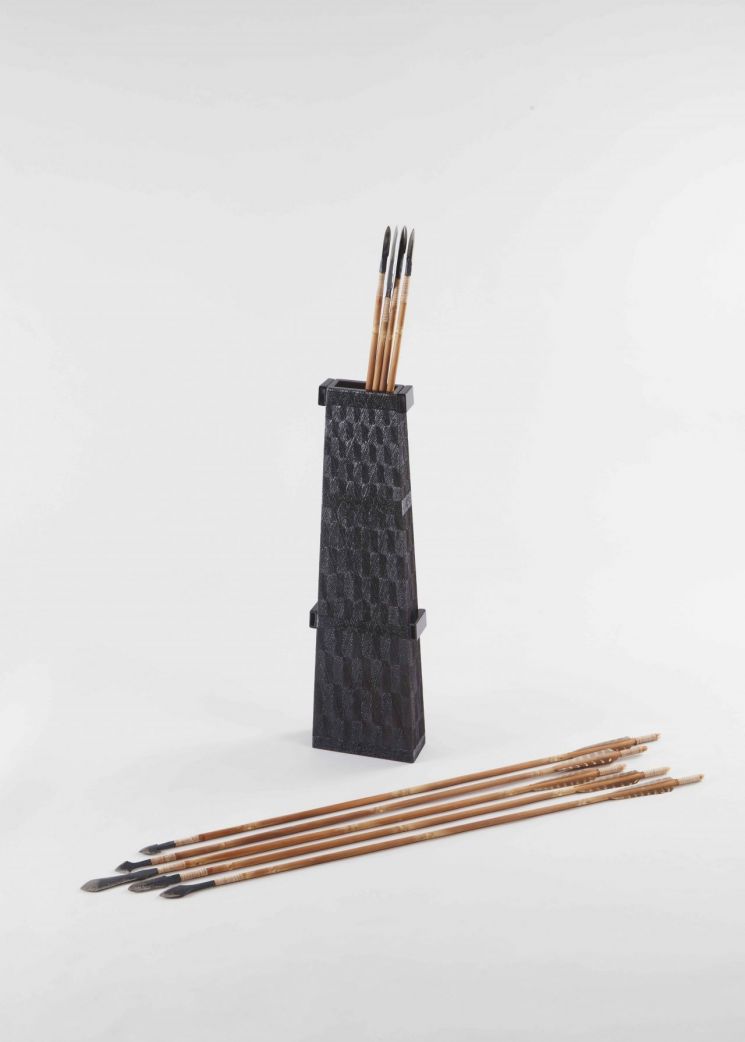 A quiver excavated from Daeseong-dong Tomb No. 14. It is characterized by a backpack style worn on the back rather than around the waist. Provided by the National Gimhae Museum
More than 70 cylindrical bronze objects, considered symbols of Gaya rulers, have been gathered in one place. For the first time, a cylindrical bronze artifact from the Leeum Museum of Art, previously unknown to the public, will be revealed. Some excavated items feature geometric patterns and traces of red lacquer, and while they are presumed to be ritual vessels, their exact purpose remains unknown.
The remains of human sacrifices offered in rituals have also been restored. A dedicated section, created in collaboration with specialized researchers, reconstructs the natural environment of the Gaya people by analyzing various organic materials, including peaches, melons, millet, a variety of animals, and fish.
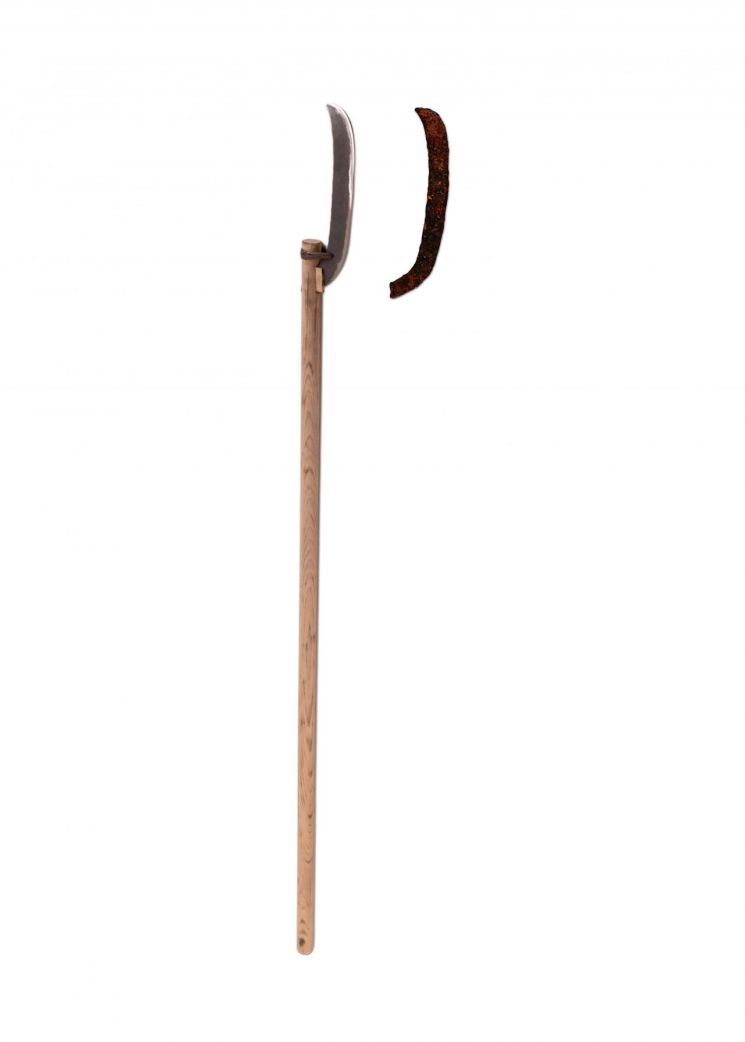 The curved sword called "Gokdo" (曲刀), which inspired the bent blade used by Mira, the protagonist of "K-Pop Demon Hunters." Courtesy of the National Gimhae Museum
Additionally, the exhibition will unveil iron ingots that served as currency, necklaces made from gilt-bronze, crystal, and various types of glass, as well as a gilt-bronze belt ornament-a symbol of authority among ancient East Asian leaders. The curved sword known as "Gokdo," which inspired the bent blade used by Mira, the protagonist of "K-Pop Demon Hunters," will also be on display.
The tomb of Gaya's first king, Tomb No. 29, has been recreated through an immersive video projection on an 18-meter-wide screen. The exhibition explores the founding of Gaya by King Suro of Garakguk, who was buried on Aeguji Hill, and the aspirations of the Gaya people, focusing on Gujibong, the origin of Gaya, and Bonghwangdae Hill, the royal fortress.
A museum official explained, "Gimhae is where the Nakdong River meets the sea, connecting China and the northern regions to the northwest and Japan to the south. Thanks to this geographical advantage, Gaya engaged in exchanges with various regions of ancient East Asia in the third century. Beads, which were as highly valued as iron in ancient times, symbolize the brilliance of Gaya civilization."
A variety of academic events will also take place. On September 24, a curator who planned the exhibition will give a lecture, and on October 24, an academic conference will be jointly hosted by the National Gimhae Museum, the Daeseong-dong Tumuli Museum, the Inje University Gaya Culture Research Institute, the Yeungnam Archaeological Society, and the Gaya History Society.
© The Asia Business Daily(www.asiae.co.kr). All rights reserved.



















