"30 Million Tourism Era! Tourism Innovation Forum" Held at the National Assembly
As the number of inbound tourists is expected to reach an all-time high this year, there is a growing call to ease regulations on home-sharing accommodations to address the shortage of lodging infrastructure.
On September 15, the "30 Million Tourism Era! Tourism Innovation Forum" was held at the National Assembly Library Auditorium, hosted by Kim Kyohung, Chairman of the National Assembly's Culture, Sports and Tourism Committee, and organized by the Korea Tourism Association. The forum focused on "Institutional Innovation Measures for Home-Sharing to Promote Qualitative Growth in the Tourism Industry," discussing ways to relax regulations on home-sharing accommodations to support the growth of the tourism sector.
Han Juhyung, Professor of Tourism Management at Kangwon National University, who delivered the keynote presentation, argued, "Home-sharing can provide a new growth engine for Korea's tourism industry and is expected to revitalize regional tourism as well."
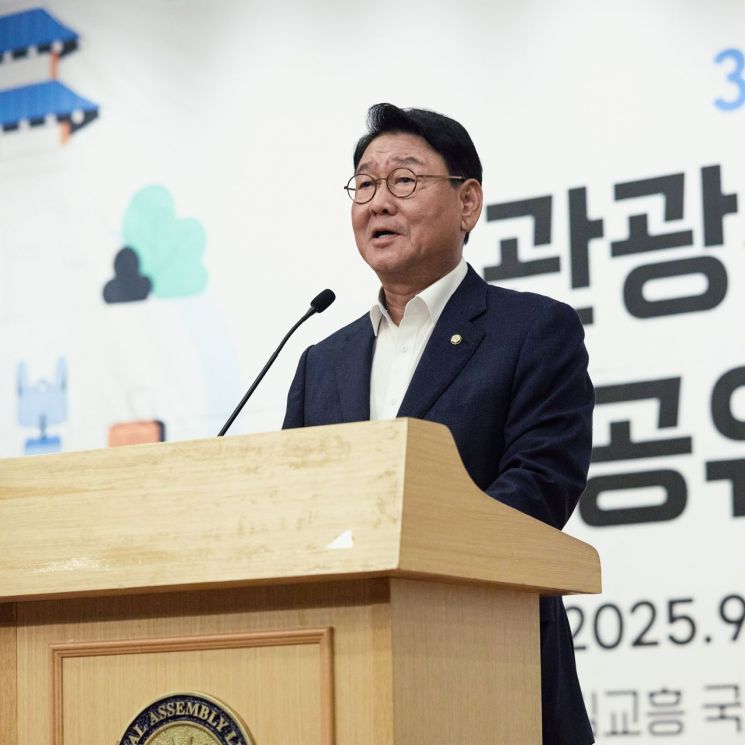 Kim Kyoheung, Chairman of the National Assembly Culture, Sports and Tourism Committee, is delivering a greeting at the "30 Million Tourism Era! Tourism Innovation Forum" held on the 15th at the National Assembly Library Auditorium.
 Photo by Office of Kim Kyoheung
As of July this year, the number of inbound tourists reached 10,559,166. There is growing anticipation that the annual total will surpass the previous record set in 2019 (17,502,756), and even reach the milestone of 20 million for the first time. The government plans to attract 30 million inbound tourists, aiming to make the tourism industry a new driver of economic growth. However, concerns have been raised that the shortage of domestic lodging facilities could hinder these plans, as many accommodations closed during the COVID-19 pandemic.
Professor Han pointed out, "Many hotels went out of business during the pandemic, and the supply of new rooms has not yet made up for the reduction." He explained that around 4,000 rooms in four- and five-star hotels disappeared during COVID-19, but only about 1,000 new rooms were supplied by last year. He further noted that the shortage of rooms has caused hotel prices to surge, negatively impacting the competitiveness of Korea's tourism industry. In addition, he emphasized that in regional areas, the lack of lodging facilities means there are few factors to encourage tourists to stay, making it a barrier to revitalizing local tourism. Professor Han stressed that home-sharing could be an excellent alternative.
Home-sharing refers to the practice of renting out unused residential spaces to others for lodging purposes. In Korea, this concept has long existed in the form of "minbak" (private lodging).
Home-sharing is regulated under the Foreign Tourist Urban Minbak Business Act (commonly referred to as "Oedomin Business"), enacted in 2012. The problem is that, unlike other lodging businesses, home-sharing faces several unique restrictions. To avoid conflict with the existing lodging industry, Oedomin Business limits home-sharing to foreign guests only and requires hosts to reside on the premises.
Professor Han stated, "We need to fundamentally consider whether it is necessary to distinguish between domestic and foreign guests, and whether the host residency requirement reflects current tourism trends," adding, "It is time to review and improve the system."
Suh Wonseok, President of the Korea Tourism Association, emphasized, "Tourism trends have changed dramatically over the past decade, but as we try to fit the latest home-sharing trends into outdated laws like the Oedomin Business Act, various problems are emerging. Establishing an appropriate institutional framework for home-sharing is essential for Korea to achieve qualitative growth in tourism."
© The Asia Business Daily(www.asiae.co.kr). All rights reserved.

















