In Japan, where 3 out of every 10 people are aged 65 or older and the number of centenarians is nearing 100,000, the congratulatory cash gifts traditionally given to the elderly for longevity are being reduced or abolished.
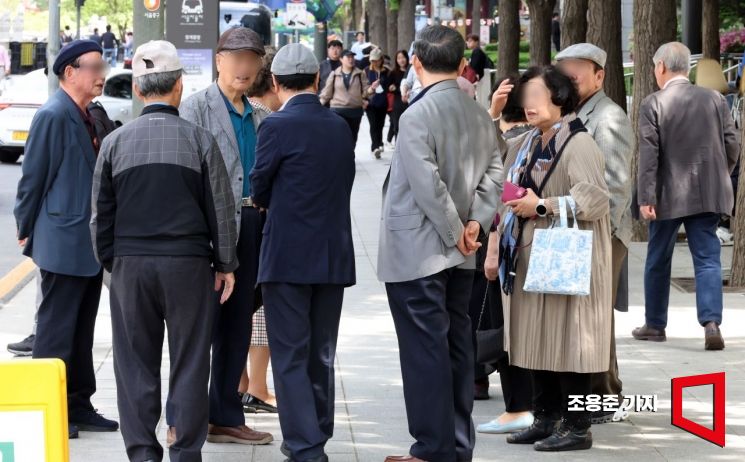 Elderly people are gathered near Cheonggyecheon in Seoul, having a conversation. This is a stock photo unrelated to the article content.
On September 15, Asahi Shimbun reported that Miyagi Prefecture and several local governments in Japan are facing significant financial burdens due to the increasing elderly population and the resulting costs of longevity cash gifts. September 15 is "Respect for the Aged Day" in Japan. Every year, the third Monday of September is designated as a national holiday to honor and celebrate the elderly. According to Asahi Shimbun, in the past, local governments independently operated and spread systems that provided cash gifts ranging from several thousand yen to hundreds of thousands of yen under names such as "Respect for the Aged Gift" or "Longevity Gift" to seniors reaching certain ages, such as 77 (Kiju), 88 (Beiju), and 100 (Hyakuju). These systems have been in place nationwide since around the 1960s.
From tens of thousands of yen each time to "growing fiscal risk" concerns
Recently, however, many local governments are reconsidering these programs. For example, Natori City in southeastern Miyagi Prefecture had been providing 5,000 yen (about 47,000 won) each at ages 77, 80, and 85; 10,000 yen (about 94,000 won) at age 88; 20,000 yen (about 188,000 won) at age 90; 30,000 yen (about 282,000 won) at age 95; 50,000 yen (about 470,000 won) at age 99; 200,000 yen (about 1.88 million won) at age 100; and 20,000 yen (about 188,000 won) annually for those aged 101 and above. Starting this year, while the amounts remain the same, the number of payouts has been reduced to three occasions: ages 77, 88, and 100. As a result, those who live to 100 years old could previously receive a cumulative total of 325,000 yen (about 3.06 million won), but under the new system, this is reduced to 215,000 yen (about 2.02 million won).
Tagajo City also reduced its program this year. The gift at age 88 was cut from 10,000 yen (about 94,000 won) to 5,000 yen (about 47,000 won), and at age 100 from a maximum of 200,000 yen (about 1.88 million won) to 50,000 yen (about 470,000 won). In Iwanuma City, starting last year, the gift at age 99 was reduced from 50,000 yen (about 470,000 won) to 10,000 yen (about 94,000 won), and for those aged 101 and above, the annual maximum of 100,000 yen (about 940,000 won) was replaced with only a bouquet of flowers and congratulatory words.
 Elderly people are engaging in crafting activities at a social welfare center located in Seoul. This is unrelated to the main article.
"From 940,000 won annually for those over 101 to just congratulations"
These changes are occurring not only in Miyagi Prefecture but across Japan. Some local governments are abolishing the longevity cash gift altogether. A Natori City official explained, "Given the city's growing burden in the long-term care insurance program, we would like to focus on policies that directly support seniors in need or prevent the need for nursing care, rather than distributing cash to all elderly residents." The funds saved will be used for emergency notification systems for seniors living alone, subsidies for hearing aids, dental checkup programs, and more. Natori City spent a total of 30.06 million yen (about 2.83 billion won) on longevity gifts last year, but with the program revision, this year’s expenditure is expected to be about 16 million yen (about 1.5 billion won).
Many elderly people eagerly anticipate receiving these cash gifts. As direct payments have been reduced, opposition has arisen in various local assemblies. In Natori City, lawmakers submitted and passed a revised proposal that reduced the scale of cuts compared to the original plan. In the Daiwa area, a revision to the "Respect for the Aged Gift Ordinance" was attempted last year, but some assembly members protested that it was too hasty, leading to its withdrawal. A revised proposal with a smaller reduction was later submitted and passed.
According to a survey by Asahi Shimbun of 14 cities in Miyagi Prefecture, Osaki City is the only one without a longevity cash gift program. Osaki City abolished its program in 2005, when it was still Furukawa City, and now provides wooden tableware at age 88 and a commemorative plaque and bouquet at age 100. On the other hand, Tomiya City offers the most generous support, providing 5,000 yen (about 47,000 won) at age 80 and up to a combined total of 335,000 yen (about 3.15 million won) at ages 88, 90, and 100. Tomiya City has maintained its current system since a partial reduction in 2018.
 On the 30th, elderly people were walking on the streets near Tapgol Park in Jongno-gu, Seoul. This is unrelated to the article content.
3 out of 10 are over 65... 53.6% of those aged 65-69 are employed
According to Kyodo News and NHK, data released by Japan's Ministry of Internal Affairs and Communications on the eve of Respect for the Aged Day (September 15) shows the population aged 65 and older at 36.19 million, a decrease of 50,000 from last year. This is only the second time since 1950, when comparable statistics became available, that the elderly population has declined, the first being in 2023. The proportion of elderly people in the total population reached a record high of 29.4%, up 0.1 percentage point from a year earlier. Kyodo News reported, "Japan has the highest percentage of elderly people among countries with populations over 40 million."
As more people continue working into old age, the employment rate among elderly people last year was 25.7%, up 0.5 percentage point from the previous year. The number of employed elderly people reached 9.3 million, marking a record high for the 21st consecutive year. In particular, the employment rate for those aged 65 to 69 was 53.6%, up 1.6 percentage points from the previous year. Among those aged 70 to 74, the employment rate was 35.1%, and for those aged 75 and older, it was 12.0%.
 Residents of the shantytown in Yeongdeungpo-gu, Seoul, are cooling off with cooling fog. This is unrelated to the article content.
Number of centenarians nears 100,000... 55 consecutive years of increase
According to the Ministry of Health, Labour and Welfare, as of September 1, the number of people aged 100 or older was 99,736, an increase of 4,644 from a year earlier. This marks the 55th consecutive year of increase in the centenarian population. The number of centenarians, tallied annually by the Ministry of Health, Labour and Welfare ahead of Respect for the Aged Day since 1963, surpassed 1,000 in 1981, 10,000 in 1998, and 50,000 in 2012.
By gender, there are 87,784 women and 11,979 men among the centenarians, a ratio of 7.3 to 1. There are 80.58 centenarians per 100,000 people. The oldest person is Shigeko Kagawa, a 114-year-old woman living in Nara Prefecture. Among men, the oldest is Kiyotaka Mizuno, age 111, in Shizuoka Prefecture. Yomiuri Shimbun reported that "with advances in medicine and increased health awareness, the number of people living to 100 or beyond continues to rise," and projected that in fiscal year 2025 (April 2025 to March 2026), the number of people reaching or surpassing 100 years of age will be 52,310, an increase of 4,422 from fiscal year 2024.
© The Asia Business Daily(www.asiae.co.kr). All rights reserved.



















