34 Years After Groundbreaking, Saemangeum Embraces the Era of Energy Transition
"Renewable Energy Hub... Addressing Both Balanced Development and Major Energy Transformation"
Saemangeum, which began its first phase of construction in 1991, is undergoing a transformation after 34 years, aligning itself with the era's shift toward energy transition. The government is pushing for the establishment of a national industrial complex based on RE100 (100% renewable energy) as a national policy objective, and with the Saemangeum Development Authority placing this initiative at the forefront, the unfinished reclaimed land is being re-evaluated as a hub for both balanced national development and a major energy transition. The Saemangeum Development Authority has encapsulated this strategy in the slogan "REal Korea, RE100 Saemangeum," positioning Saemangeum as the optimal location to simultaneously achieve balanced development and energy transformation.
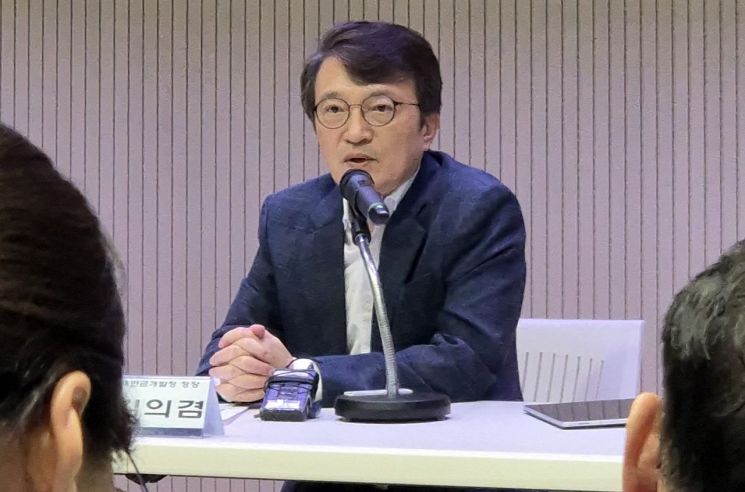 Kim Eui-gyeom, Administrator of the Saemangeum Development Authority, is responding during a press briefing held on the 11th at the Saemangeum Reclamation Museum in Buan County, Jeonbuk. Saemangeum Development Authority
At a press conference held on the 11th at the Saemangeum Reclamation Museum in Buan County, Jeonbuk, Kim Euigyeom, head of the Saemangeum Development Authority, stated, "Saemangeum is the only place where we can simultaneously address the long-standing challenge of balanced national development and the urgent task of energy transition. We will establish Saemangeum as a renewable energy hub based on its abundant sunlight and wind."
Kim went on to say, "We have received government designation for Saemangeum's first and second industrial complexes as Korea's first RE100 industrial complexes. By attracting advanced industries such as secondary battery and artificial intelligence (AI) companies, we aim to make this a global success story. Following the entry of electrolyte and precursor companies, we will also attract secondary battery manufacturers in cell and pack formats, as well as a diverse range of energy companies."
The government has made the creation of the RE100 industrial complex its top policy priority. It plans to enact the "RE100 Industrial Complex Special Act" within the year, which will include significant electricity rate discounts for tenant companies. National policy tasks also include fostering Saemangeum as a renewable energy hub and the southern industrial belt as growth centers, with plans to develop Saemangeum into an RE100 industrial complex and a center for renewable energy. During the presidential election in April, President Lee Jaemyung visited the Saemangeum 33 Center in Gimje City and said, "The future of Jeonbuk lies in Saemangeum," adding, "Since we must rapidly transition to a renewable energy society, we will thoroughly review ways to revitalize the Saemangeum project."
The Saemangeum National Industrial Complex was designated as an Investment Promotion Zone in 2023, granting it exemptions from corporate and income taxes. In the same year, it was also designated as a specialized cluster for the national advanced strategic industry of secondary batteries, receiving tax credits and expedited permit processing. A Saemangeum Development Authority official stated, "Saemangeum has well-developed port and road networks and offers low lease rates. With these tax benefits, it is the optimal location for companies. Once designated as an RE100 site, global RE100 member companies such as Samsung Electronics, SK Hynix, and Naver will have no choice but to invest boldly."
"Without RE100, It's Only Half Complete"... Saemangeum Industrial Complex Companies Also Urge Designation
 Saemangeum National Industrial Complex. Among the nine sections marked on the map, sections 1, 2, 5, and 6 have completed land reclamation, while sections 3, 7, and 8 have finished reclamation but are undergoing development work such as soil compaction, water supply installation, and road construction. Section 4 has not yet been reclaimed. Saemangeum Development Agency
On the ground, there is a strong call for the urgent designation of Saemangeum as a national RE100 industrial complex. Currently, most of the solar power generated within the complex has already been contracted to other sites, making it difficult for tenant companies to use it directly. An executive from a company located in the Saemangeum Industrial Complex commented, "The location is excellent, but to receive RE100 certification, we must use renewable energy to reduce carbon dioxide emissions. Under the current system, it is difficult to receive these benefits." They explained that designation as a national RE100 industrial complex would lead to expanded renewable energy facilities such as solar and wind power, direct power supply to tenant companies, electricity discounts, and certification.
Currently, 300MW of onshore solar power has been in operation for three years in Saemangeum. The first phase of floating solar power (1.2GW) has completed operator selection and cost-sharing agreements and is being promoted in conjunction with Korea Electric Power Corporation's West Coast HVDC project. The second phase (0.95GW) is also planned. About 67MW of reservoir solar power is preparing to break ground this year. Additional solar installations using the entire embankment are under review, and the total renewable energy capacity could exceed 6GW. Offshore wind power, however, is facing delays due to permit cancellations and legal disputes.
In response, the Saemangeum Development Authority has decided to significantly expand its initial goal of 6GW of renewable energy production, which was reported to the National Policy Planning Committee. The plan is to complete both phases of floating solar power by 2030 and to pursue new tidal power projects, aiming for a "three birds with one stone" effect: improving water quality, preventing floods, and expanding renewable energy. The electricity produced will be supplied directly to companies within the RE100 industrial complex, providing the essential condition of "100% renewable energy use" for business operations. The Saemangeum Development Authority plans to calculate industrial complex power demand by industry sector and prioritize supplying renewable energy within the complex. Kim stated, "This will be the decisive factor in attracting investment from advanced companies."
Ports, Roads, Waterfront City... Accelerating Infrastructure Expansion
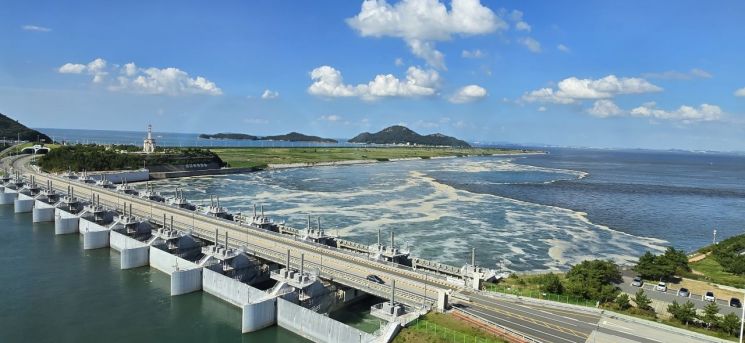 The world's longest Saemangeum seawall (33 km) road. Photo by Ministry of Land, Infrastructure and Transport press corps
The establishment of logistics networks to support business activities is also accelerating. The new Saemangeum port is being expanded in phases, aiming for a priority opening in 2026. Regional connecting roads totaling 20.76 km are preparing for groundbreaking, with completion targeted for 2030. The new Saemangeum airport is scheduled to open in 2029, and the smart waterfront city is set for completion in 2028. The first single-family housing lots will begin sales at the end of this year.
However, the future of the airport project has become uncertain following a recent court ruling canceling the basic plan for the new Saemangeum airport. Kim stated, "We will seek adjustment measures in consultation with the Ministry of Land, Infrastructure and Transport, which is the responsible authority."
The 2026 budget for the Saemangeum Development Authority is set at 213.3 billion won, a 74% increase from the previous year, with focused allocations for the creation of the RE100 industrial complex and early completion of social overhead capital projects. The integrated control center will receive 12 billion won, the secondary battery cluster's power infrastructure will receive 4.4 billion won, and regional connecting road construction will receive 163 billion won. The integrated control center is an essential infrastructure facility for the integrated operation of renewable energy supply, safety, and energy management within the industrial complex.
Kim stated, "We will establish strategies for each initiative, coordinate with relevant agencies such as the Ministry of Environment and the Ministry of Agriculture, Food and Rural Affairs, and systematically implement them by reflecting them in the Saemangeum master plan (MP)."
© The Asia Business Daily(www.asiae.co.kr). All rights reserved.



















