Strengthening the Public Nature of Wholesale Markets
Reducing Distribution Costs by 10% by 2030
Stabilizing Perceived Prices with Price Comparison Apps and More
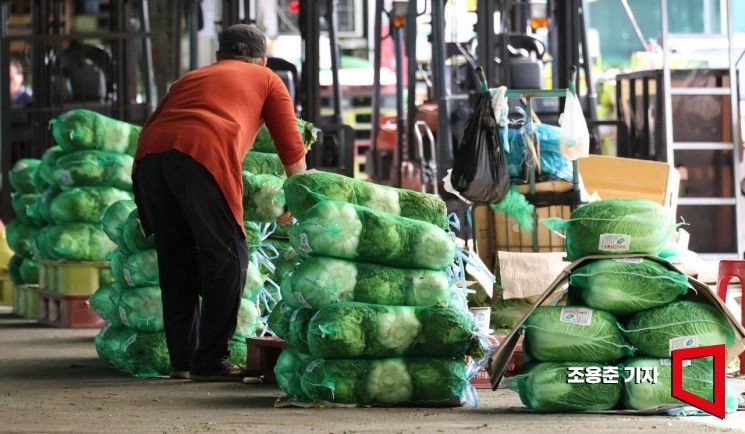 On the 27th, when the initial shipment of 16 tons of Chinese-imported cabbage arrived to stabilize the soaring cabbage prices, the Garak Market in Songpa-gu, Seoul, showed a sparse scene due to the low supply of domestically produced cabbage. Photo by Jo Yongjun jun21@
The government will completely overhaul the agricultural product distribution structure, which has been criticized for its complex distribution stages and high price volatility, by transitioning to a digital-based system. Additionally, it will promote price stability and logistics efficiency that can be felt by both producers and consumers by expanding online wholesale markets, strengthening the public nature of wholesale markets, and improving supply and demand management systems.
On September 15, the government announced these measures under the "Plan to Improve the Agricultural Product Distribution Structure" during an inter-ministerial economic policy meeting.
Online Wholesale Market Share to Expand to 50% by 2030
The government plans to increase the share of online wholesale markets, which currently accounts for only 6% of total wholesale distribution, to 50% by 2030. By enabling anyone to trade via platforms and deliver directly to consumers, the government aims to reduce distribution stages and lower logistics costs. It will ease seller registration requirements and provide customized vouchers to support logistics and promotional expenses.
Various transaction methods will also be introduced, including auctions, reverse auctions, and small-quantity transactions involving multiple items, in addition to the current fixed-price and reservation-based transactions. A logistics chain dedicated to online transactions will be established and gradually expanded to include joint delivery, cold chain logistics, and AI-based integrated logistics management.
The wholesale market system will also undergo major reforms. The government will mandate the cancellation of designations for wholesale corporations and introduce a new corporation recruitment system to promote competition. An evaluation committee involving both producers and consumers will be established to enhance transparency, and intermediate wholesalers will be evaluated based on their transaction volume and financial soundness.
Additionally, a "shipment price compensation system" will be introduced to support shippers in the event of a sharp price drop, and a public interest fund will be created to guarantee a minimum payment price for farmers. To curb excessive profits by wholesale corporations, the government will adjust and lower consignment commission rates. From 2027, electronic shipping documents will be mandatory and used to predict shipments and stabilize prices.
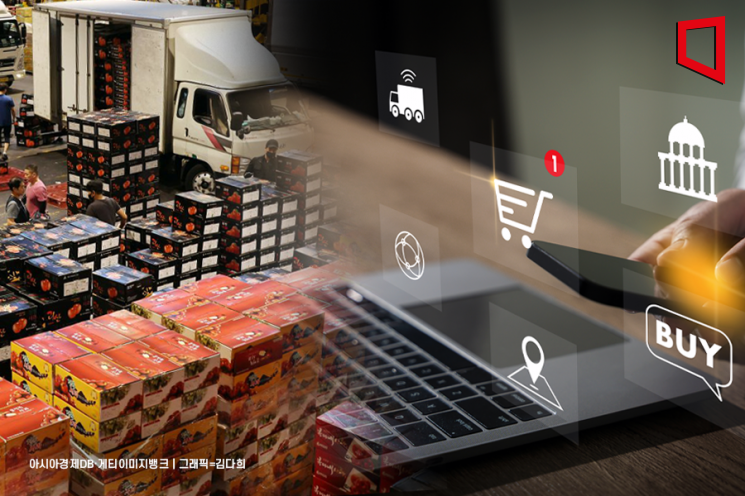
Consumers Can Make Rational Choices Using Price Comparison Apps
The government will also strengthen information provision so that consumers can make informed purchases of agricultural products. By 2026, it will develop a nationwide mobile app that allows users to compare prices by retailer and check information on seasonal agricultural products. In 2028, an integrated platform will be established to provide production, crop conditions, wholesale and retail prices, and discount information, offering AI-based personalized information.
Alternative distribution channels that reduce distribution stages will also be expanded. By activating local food initiatives at the municipal level, operating urban-rural mutual benefit markets, and establishing direct sales stores, the government aims to lower perceived prices. The National Agricultural Cooperative Federation will also launch pilot projects to directly produce and sell leafy vegetables by linking with smart farms.
Responding to the climate crisis, stabilizing production and supply, and securing the production base are also major pillars. The government, local governments, and farmers will jointly develop supply and demand management plans to pre-adjust and manage the cultivation area of major items. New suitable cultivation sites, such as summer cabbage in semi-highland areas, will be identified, and by 2030, 100 smart production complexes for fruit and 20 for greenhouse vegetables will be established.
Public-private collaboration in pest and abnormal climate control will be strengthened, and disaster prevention facilities will be expanded. The government will also expand contract farming and purchase reserves to prepare for supply instability, and address rural labor shortages by organizing local work teams.
Producer organization will also be promoted. By 2030, more than 3,000 basic producer organizations will be fostered and linked to integrated organizations, and a five-year plan will be established to promote contract farming and the economic activities of the National Agricultural Cooperative Federation. For some items, the government is considering allowing producer organizations to participate in the import (TRQ) policy and share sales profits.
Through these measures, the government aims to reduce the wholesale and retail price volatility of key items such as cabbage and apples by half by 2030, and to cut agricultural product distribution costs by 10%. The size of the online wholesale market is expected to grow from 1 trillion won in 2025 to 7 trillion won in 2030.
© The Asia Business Daily(www.asiae.co.kr). All rights reserved.
![Clutching a Stolen Dior Bag, Saying "I Hate Being Poor but Real"... The Grotesque Con of a "Human Knockoff" [Slate]](https://cwcontent.asiae.co.kr/asiaresize/183/2026021902243444107_1771435474.jpg)
















