Company A illicitly received approximately 500 million won in government subsidies over three years while carrying out six research and development (R&D) projects. The company created a shell company under an employee's name and issued fake tax invoices by pretending to purchase goods from this entity.
Company B manipulated documents to make it appear as if it had purchased new products from another company, while in reality, it reused products for its R&D projects. Through this method, it obtained 140 million won in government subsidies over two years.
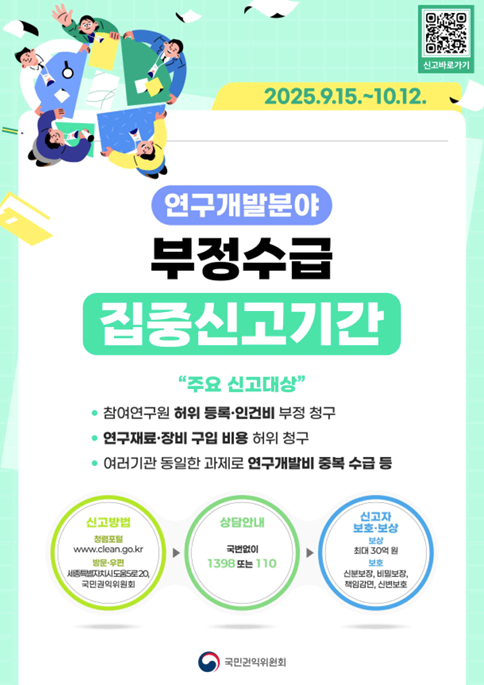
The Anti-Corruption and Civil Rights Commission announced that it will operate a focused reporting period for fraudulent receipt of government subsidies in the R&D sector from September 15 to October 12. The maximum reward for reporting is 3 billion won.
Methods of fraudulent receipt include: ▲ inflating labor costs by falsely registering R&D personnel, ▲ receiving duplicate funding for the same or similar R&D projects, ▲ making false purchases of goods using shell companies, ▲ manipulating settlement documents, and ▲ fabricating research results to make it appear as if already completed developments are new achievements.
The commission plans to conduct a comprehensive investigation not only into the reported cases but also into whether there has been fraudulent receipt of R&D funds provided by other agencies.
Reports of fraudulent receipt can be submitted through the Clean Portal, in person, or by mail, and the personal information of whistleblowers will be thoroughly protected.
Lee Myungsoon, Vice Chairperson of the commission, stated, "Government subsidies invested in the R&D sector are an investment to secure the nation’s future growth engines. The commission will thoroughly investigate any fraudulent receipt of funds and strive to create a transparent R&D environment."
© The Asia Business Daily(www.asiae.co.kr). All rights reserved.
![Clutching a Stolen Dior Bag, Saying "I Hate Being Poor but Real"... The Grotesque Con of a "Human Knockoff" [Slate]](https://cwcontent.asiae.co.kr/asiaresize/183/2026021902243444107_1771435474.jpg)















