"Russia Presents a New Challenge to Black Sea Security"
Romania has stated that a Russian suicide drone, intended for attacks on Ukraine, violated its airspace.
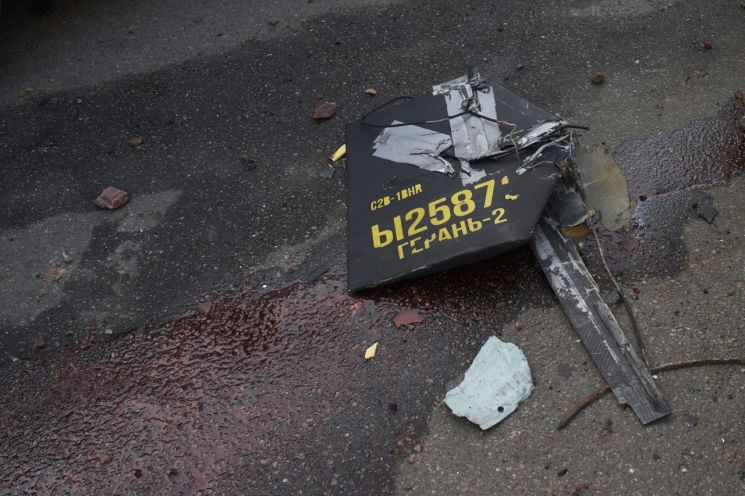 In June (local time), fragments of a Russian drone labeled "Geran-2" fell in a residential area of Kyiv, Ukraine. Photo by AP News Agency
According to AFP and other sources on September 14 (local time), the Romanian Ministry of Defense announced in a statement the previous day that a drone appearing in its airspace was identified as a "Geran"-type drone. The Geran is a Russian-modified version of the Iranian Shahed-136 drone, equipped with explosives and designed to approach targets and self-detonate. The drone flew for about 50 minutes from northeast to southwest along the Kilia branch of the Danube River near the Romania-Ukraine border, then turned back toward Ukraine near the village of Pardina and exited Romanian territory.
The Romanian Ministry of Defense pointed out, "This incident demonstrates Russia's disregard for international law and endangers not only the safety of Romanian citizens but also the collective security of the North Atlantic Treaty Organization (NATO)." The ministry strongly condemned Russia's irresponsible actions and emphasized that this incident poses a new challenge to security and stability in the Black Sea region.
The Romanian Ministry of Defense reported that one F-16 fighter jet and two Eurofighter Typhoon jets monitored the drone. The ministry explained that the drone did not fly over residential areas and did not pose a threat, and although the fighter pilots were authorized to shoot it down, they refrained from doing so to avoid collateral risks.
In response to this Russian provocation, the Romanian Ministry of Foreign Affairs summoned Vladimir Lipaev, the Russian Ambassador to Romania, to lodge a protest.
Earlier, on September 10, a Russian drone also violated Polish airspace. At that time, the Russian drone was mostly a "Gerbera" model, which is an unmanned decoy drone launched without explosives to disrupt enemy air defenses.
Poland has proposed reconsidering the closure of Ukrainian airspace as a measure to block Russian aerial threats. Polish Foreign Minister Radoslaw Sikorski said in an interview with the German daily Frankfurter Allgemeine Zeitung (FAZ) that while closing the airspace is technically possible at the NATO and European Union (EU) level, it is not a decision Poland can make alone and must be pursued together with its allies.
Immediately after the outbreak of war in February 2022, Ukraine strongly urged NATO, the United States, and other Western countries to declare its airspace a no-fly zone (NFZ). However, Western nations refused, expressing concerns that military intervention, such as attempts to shoot down Russian aircraft violating the NFZ, would be inevitable and could escalate the war.
© The Asia Business Daily(www.asiae.co.kr). All rights reserved.
![Clutching a Stolen Dior Bag, Saying "I Hate Being Poor but Real"... The Grotesque Con of a "Human Knockoff" [Slate]](https://cwcontent.asiae.co.kr/asiaresize/183/2026021902243444107_1771435474.jpg)















