UNIST Achieves High-Resolution Daily Monitoring of Ammonia Concentrations
Up to 1.8 Times More Accurate Than Previous Models
Demonstrates Spatial Scalability, Published in Journal of Hazardous Materials
An AI technology capable of filling the observation gaps in ammonia concentration, a major cause of fine particulate matter, has been developed.
On September 15, the research team led by Professor Jeongho Lim from the Department of Urban and Environmental Engineering at Ulsan National Institute of Science and Technology (UNIST) announced that they have developed an artificial intelligence model that can accurately estimate atmospheric ammonia (NH₃) concentrations on a daily basis.
 Research team, (from left) Professor Jeongho Lim, Researcher Saman Malik, Researcher Eunjin Kang. Provided by Ulsan National Institute of Science and Technology (UNIST)
Ammonia is emitted as a gas from sources such as agricultural fertilizers, livestock manure, and fire sites. While it is harmless by itself, it reacts with acidic substances like sulfuric acid or nitric acid in the atmosphere to form fine particulate matter (PM2.5), making accurate monitoring essential for air quality forecasting and environmental policy development.
However, ammonia has a short atmospheric residence time, resulting in significant fluctuations in concentration, and ground observation stations are scarce, so data has only been provided every two weeks. Although there are climate models that estimate ammonia concentrations through calculations, these models cover broad areas, leading to large regional prediction errors.
The research team developed an AI model based on deep neural networks to enhance the frequency and accuracy of ammonia monitoring. They used ERA5 climate data from the European Centre for Medium-Range Weather Forecasts and ammonia column concentrations from the IASI satellite as input data, and ground observation data from the US AMoN network as target values to train the model.
This AI model recorded a prediction error up to 1.8 times lower than CAMS, the European climate model. Although the AI model was trained using US data as the target values, it successfully captured high-concentration events caused by a major fire in Manchester, UK, in 2019. This demonstrates the model’s spatial scalability and potential for field application.
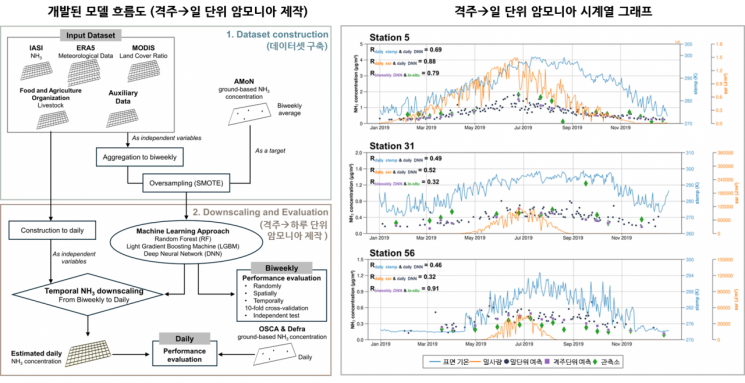
This research was co-led by researchers Saman Malik and Eunjin Kang as first authors. The research team stated, "Climate models like CAMS, which estimate ground-level ammonia concentrations through calculations, have limitations in accuracy, while direct measurements from ground observation stations are limited by long data provision intervals. This new model can compensate for the shortcomings of existing monitoring methods."
Professor Jeongho Lim emphasized, "This technology can be directly applied to nitrogen-based pollutant air quality forecasting and the development of environmental management policies. In particular, in Korea, ammonia concentration monitoring is only conducted at limited locations, but applying this technology will enable the establishment of a high-resolution monitoring system."
The research findings were published on September 15 in the Journal of Hazardous Materials (Impact Factor: 11.3), a prestigious journal in the field of environmental science.
The research was supported by the National Institute of Environmental Research under the Ministry of Environment and the National Research Foundation of Korea under the Ministry of Science and ICT.
© The Asia Business Daily(www.asiae.co.kr). All rights reserved.
![Clutching a Stolen Dior Bag, Saying "I Hate Being Poor but Real"... The Grotesque Con of a "Human Knockoff" [Slate]](https://cwcontent.asiae.co.kr/asiaresize/183/2026021902243444107_1771435474.jpg)
















