The Fourth Town Hall Meeting Following Gwangju, Daejeon, and Busan
"Side Effects of the Metropolitan Area-Centered System: Focus Must Shift to Regional Development"
"Special Consideration So That Living in Border Areas Is Not Seen as a 'Malignant Fate'"
Minister Ahn Gyubaek: "We Will Take a Forward-Looking Approach to Address the Inconveniences of Border Area Residents"
President Lee: "Lifting Regulations Is Too Slow, Let's Speed Up the Process"
On September 12, President Lee Jaemyung emphasized during a town hall meeting themed "Listening to the Heart of Gangwon" that while the Seoul metropolitan area-centered system was once a useful strategy for rapid growth, its side effects have begun to surface. He stressed that it is now time to shift the focus to regional development for balanced growth. President Lee also pledged to provide special consideration so that living in Gangwon Province would not be regarded as a "malignant fate," and urged relevant ministers to accelerate the lifting of military protection zones.
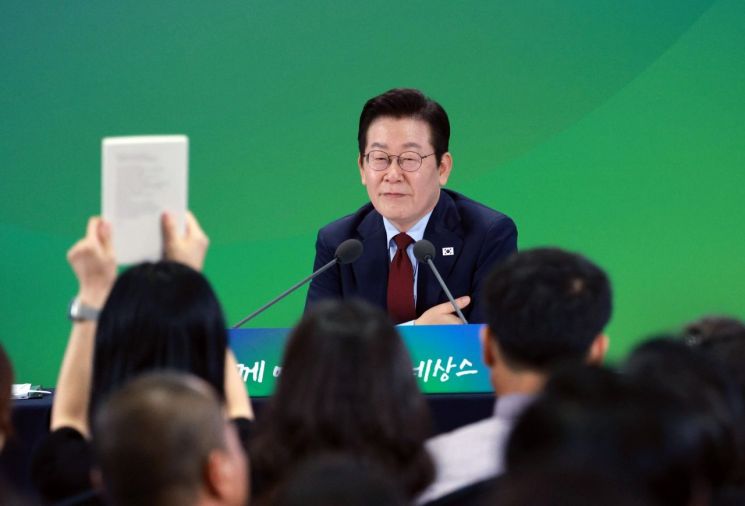
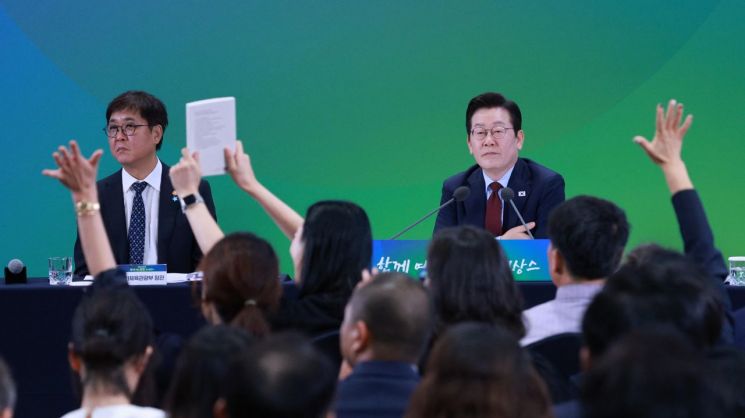
President Lee made these remarks during his opening statement at the town hall meeting held at the Gangwon Creative Development Center in Chuncheon, Gangwon Province. This was the fourth town hall meeting, following those in Gwangju, Daejeon, and Busan. President Lee stated, "One of the key challenges is to overcome the Seoul metropolitan area-centered system," adding, "At a time when resources and capital were scarce, distributing them evenly across the country was seen as inefficient, so the so-called 'all-in strategy' of concentrated investment in Seoul greatly contributed to rapid growth."
He pointed out that this strategy of concentrating resources in the metropolitan area is now revealing its limitations. President Lee said, "The side effects of the metropolitan area-centered system have begun to emerge," noting, "The inefficiencies resulting from this concentration have become so severe that now everything is being drawn into Seoul and the metropolitan area, causing Seoul to become overcrowded. It has become standard for a single square meter of land to cost 100 million or 200 million won, and in some cases, an apartment costs 280 million won per square meter."
President Lee continued, "Even building factories has become difficult due to the high cost of land, and we have become less competitive internationally," emphasizing, "If this concentration continues, the marginal utility will turn negative, making it difficult for us to grow and develop." He added, "On the other hand, people are disappearing from the provinces. In one area, the problem is too many people; in another, it is too few."
He also addressed the issue of unfairness between regions following the metropolitan area-centered system. President Lee cited as a representative example the practice of selecting regions with relatively less resistance for undesirable facilities, making unilateral decisions behind closed doors, and then labeling local opposition as collective selfishness, thereby forcing local communities to make sacrifices. He diagnosed, "Because our society has lived without much leeway, fairness has become rare and unfairness has become the norm," adding, "Our national policies have often reflected the idea that the powerless minority must endure for the benefit of the majority, without consideration for the minority."
President Lee also pointed out the need to provide appropriate compensation for the strict regulations imposed on areas near the Demilitarized Zone. He said, "These areas are designated as military protection zones, with restrictions such as prohibiting people from going out at night, yet no compensation is provided," adding, "Living in the border areas of Gangwon Province is treated as a crime. How unfair must that feel? If it has been this way because life was hard, now it is time to change."
President Lee stressed, "There are benefits that our community gains from regions or groups of people who make special sacrifices for the good of the whole community," adding, "A portion of those benefits should be returned to them. The principle that special sacrifices require special compensation is one I established when I began my political and social activism." As President Lee said with a smile, "I started my political career to create a world where no one and no region feels especially wronged. Now, haven't I become the most powerful person in Korea?" the audience responded with applause.
Minister Ahn Gyu-baek: "We Will Take a Forward-Looking Approach to Address the Inconveniences of Border Area Residents"
At the town hall meeting, Minister of National Defense Ahn Gyu-baek also pledged to take a proactive approach to address the inconveniences faced by residents of border areas. Minister Ahn stated, "We are deeply aware that Gangwon Province, as the forefront of Korea's national security, faces many restrictions on regional development." He added, "The Ministry of National Defense has already eased regulations and lifted security measures over an area about 88 times the size of Yeouido, and we will take even bolder steps to relax regulations in line with the times."
He also responded positively to requests to ease regulations north of the Civilian Control Line. Minister Ahn said, "We will work to ease restrictions from the current 10 kilometers in a way that fits the current era," adding, "We will allow local governments to utilize idle land and provide financial support related to local water shortages." He also promised, "We will lift all possible regulations except for essential elements and make Gangwon Province the leading province."
President Lee responded positively to Minister Ahn's remarks, saying, "Lifting military facility protection zones is key to deregulating Gangwon Province," and "It would be best to lift all restrictions except those that are absolutely necessary." President Lee then suggested, "But the process is too slow. Let's speed things up."
In addition, Minister of Land, Infrastructure and Transport Kim Yoon-duk announced plans to further develop Gangwon Province's tourism by expanding transportation networks, revitalizing national high-tech industrial complexes, and improving living conditions in areas threatened by population decline. He stated, "Within this year, we will definitely increase the number of Seoul-Gangneung KTX trains by four and improve the speed of the Donghae Line between Samcheok and Gangneung," adding, "We will also complete the preliminary feasibility study for the metropolitan railway connecting to the Seoul metropolitan area this year." He further explained that there are plans to create a cluster in Chuncheon that combines water resources, information technology, and biotechnology, and to more actively promote corporate innovation parks in Wonju and Chuncheon.
Meanwhile, about 300 people attended the Gangwon town hall meeting, including 200 Gangwon residents who applied online in advance, as well as Gangwon Governor Kim Jin-tae, Chuncheon Mayor Yuk Dong-han, Minister of Culture, Sports and Tourism Choi Hwi-young, Minister of National Defense Ahn Gyu-baek, and other government and local officials.
© The Asia Business Daily(www.asiae.co.kr). All rights reserved.
![Clutching a Stolen Dior Bag, Saying "I Hate Being Poor but Real"... The Grotesque Con of a "Human Knockoff" [Slate]](https://cwcontent.asiae.co.kr/asiaresize/183/2026021902243444107_1771435474.jpg)
















