Recently, the scale of indirect exports has surged. This is attributed to an increase in cases where related items are disguised as domestic (Korean) products and exported in order to evade high U.S. tariffs. The government believes such cases will continue and plans to strengthen crackdowns on domestic product counterfeiting and circumvention exports, aiming to eradicate the practice.
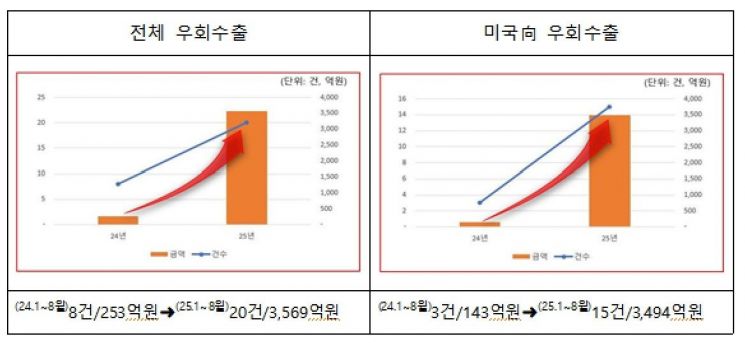 Comparison data of detected cases of indirect exports from January to August this year and the same period last year. Provided by Korea Customs Service
According to the Korea Customs Service on September 12, the number of detected cases of indirect exports from January to August this year reached 20, amounting to 356.9 billion won. Compared to the same period last year (8 cases and 25.3 billion won), the number of cases increased by 150% and the amount by 1,313%.
In particular, over the past five years, the detected scale of domestic product counterfeiting and circumvention exports was 15 cases and 43.6 billion won in 2021, 43 cases and 240.8 billion won in 2022, 49 cases and 118.8 billion won in 2023, and 10 cases and 34.8 billion won in 2024. This shows that the amount of indirect exports detected from January to August this year is nearly half of the five-year cumulative total of 794.9 billion won.
The sudden increase in detected cases this year appears to be influenced by U.S. tariff policies. With the United States imposing reciprocal tariffs by country, concerns that Korea could be used as a route for indirect exports of goods from third countries with relatively high tariffs to the U.S. have become a reality.
This trend can also be seen in the changing share of indirect exports to the U.S. within the overall scale of circumvention exports. The proportion of indirect exports to the U.S. was: 20% of cases and 15% of value in 2021; 23% of cases and 35% of value in 2022; 12% of cases and 3% of value in 2023; 40% of cases and 62% of value in 2024; and for this year (January to August), 75% of cases and 98% of value. The shares for last year and this year show an unprecedented vertical increase in indirect exports to the U.S.
The problem is that if Korea is used as a transit country for indirect exports, it cannot avoid a decline in the credibility of its country of origin and increased U.S. regulations, which could cause serious harm to domestic industries.
In fact, on August 7, the United States announced sanctions in an executive order on reciprocal tariffs, stating that it would disclose the companies and countries involved in detected cases of circumvention exports to the U.S. every six months, and impose a 40% tariff and fines on those goods.
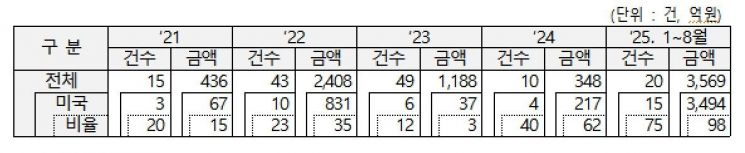 Statistics on the Detection of Domestic Product Counterfeiting and Circumvention Exports from 2021 to 2025 (January to August). Provided by the Korea Customs Service
In response, the Korea Customs Service is strengthening monitoring and crackdowns on circumvention exports aimed at avoiding high U.S. tariffs and import regulations, as well as seeking domestic premium margins. A representative example is the establishment of the "Special Trade Security Investigation Team" in April, dedicated to blocking indirect exports.
The investigation team has focused on circumvention exports of sensitive items in industries with intense international competition, especially those for which the U.S. has raised tariffs against other countries, such as solar cells, electric vehicle battery components, graphite, steel, and aluminum.
During this process, the team detected a sharp increase in intermediary trade of gold processed products, selected and analyzed companies with large export volumes, and identified seven companies suspected of disguising gold processed products as Korean-made and exporting them to the U.S.
In addition, through joint investigations with the U.S. Homeland Security Investigations (HSI), it was revealed that the detected companies declared the goods as foreign-made to Korean customs, but submitted false certificates of origin to U.S. customs, claiming them as Korean-made, thereby engaging in circumvention exports. The total amount of illegal indirect exports to the U.S. by the seven detected companies reached 283.9 billion won.
Beyond operating the investigation team, the Korea Customs Service plans to concentrate its resources on blocking illegal circumvention exports at the source by strengthening export and cargo monitoring based on artificial intelligence (AI) and big data, and by enhancing cooperation with the National Intelligence Service, Ministry of Trade, Industry and Energy, Ministry of Foreign Affairs, as well as U.S. Customs and Border Protection (CBP) and Homeland Security Investigations (HSI).
Lee Myunggu, Commissioner of the Korea Customs Service, stated, "Domestic product counterfeiting and circumvention exports are serious acts that can cause significant harm to Korean exporters and industries," adding, "The Korea Customs Service will strengthen cooperation and monitoring with domestic and international intelligence and enforcement agencies to ensure Korea is not exploited as a route for circumvention exports of foreign goods."
© The Asia Business Daily(www.asiae.co.kr). All rights reserved.
![Clutching a Stolen Dior Bag, Saying "I Hate Being Poor but Real"... The Grotesque Con of a "Human Knockoff" [Slate]](https://cwcontent.asiae.co.kr/asiaresize/183/2026021902243444107_1771435474.jpg)

















