Korea Pharmaceutical and Bio Association to Launch SDL Training Program in November
Pyo Junhee, Deputy Director of the AI New Drug Convergence Research Institute
"SDL Will Overcome the Challenges of Limited Manpower and Resources"
The paradigm of the pharmaceutical and bio industry is rapidly changing. With artificial intelligence (AI) and robots taking center stage in new drug development and clinical trials, the industry is overcoming the traditional constraints of time and cost. In this context, the 'SDL (Self-Driving Laboratory)' training program offered by the Korea Pharmaceutical and Bio-Pharma Manufacturers Association is expected to serve as a catalyst for a paradigm shift in the domestic pharmaceutical and bio industry.
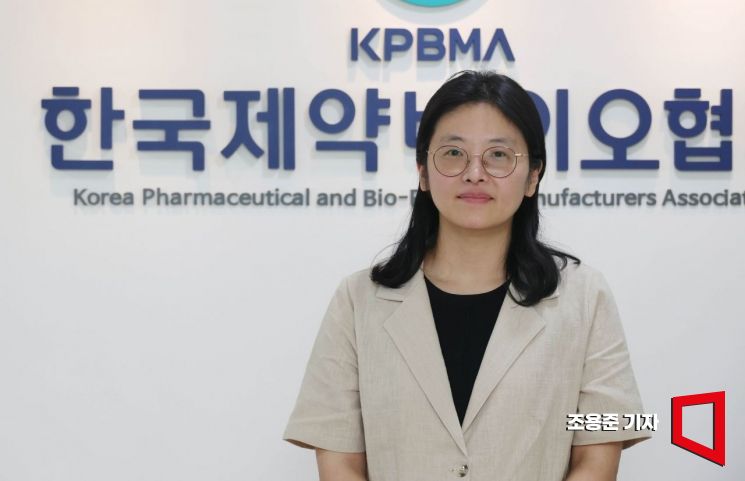 Pyo Junhee, Vice President of AI New Drug Convergence Research Institute, is being interviewed by Asia Economy at the Korea Pharmaceutical and Bio-Pharma Manufacturers Association in Seocho-gu, Seoul. Photo by Jo Yongjun
On September 12, Pyo Junhee, Vice President of the AI New Drug Convergence Research Institute at the Korea Pharmaceutical and Bio-Pharma Manufacturers Association, said in an interview at the association's office in Bangbae, Seocho-gu, Seoul, "SDL is a self-driving laboratory. It is a closed-loop system in which AI designs the experiment, robots execute the experiment, and the results are evaluated and fed back to the AI." He added, "Through iterative learning, AI can quickly identify optimal synthesis conditions and maximize research efficiency."
While conventional AI training has focused on data analysis and algorithm principles, SDL distinguishes itself by integrating physical experiment automation. As experimental data is continuously generated and accumulated, the models become more sophisticated and the speed of exploration increases dramatically.
The AI New Drug Convergence Research Institute has secured a project from the Ministry of Health and Welfare for the 'AI-Based New Drug Development Training and Promotion Program,' making it the first in Korea to introduce SDL training infrastructure. The association is currently building a training center and plans to begin training in November this year. The SDL training program emphasizes the creation of an 'educational ecosystem' rather than simply building a laboratory. Pyo explained, "Korea has yet to develop the vast internal ecosystem seen in global big pharma. To facilitate the adoption and spread of new technologies, corporate researchers and graduate students need opportunities to experience and understand AI and robotics technologies."
 Hyunhee Pyo, Deputy Director of the AI New Drug Convergence Research Institute, is being interviewed by Asia Economy at the Korea Pharmaceutical and Bio-Pharma Manufacturers Association in Seocho-gu, Seoul. Photo by Jo Yongjun
SDL is expected to become a key tool for overcoming the limitations faced by the Korean industry in new drug development. Success in drug development requires continuous validation and repeated experimentation, which has put Korea's pharmaceutical and bio industry at a disadvantage due to limited human and capital resources. However, SDL enables 24-hour automated experimentation and systematic data accumulation. Pyo stated, "SDL compensates for the limitations of human-centered research, increases reproducibility, and shortens exploration time. Ultimately, this is essential for Korea to secure competitiveness on the global stage."
The training program is open to both researchers working at pharmaceutical companies and graduate students. Pyo explained, "When students experience SDL, they can immediately apply it in the workplace, and companies can lower the barriers to adopting new technologies. Ultimately, the goal is to lower the barriers to new technology adoption across the entire industry."
The institute is also pursuing global collaboration. Recently, it signed a memorandum of understanding (MOU) with the 'Acceleration Consortium,' which includes the University of Toronto in Canada, to prepare for joint research and training. Plans are also underway to establish a distributed research collaboration system based on cloud technology. Pyo predicted, "By sharing data and conducting joint training with overseas researchers, Korean companies and students will be able to quickly join the global trend."
The SDL training program is more than just a training course. It fosters integrative thinking that encompasses AI, automation, and data strategy. For Korea's pharmaceutical and bio industry to gain leadership on the global stage, new infrastructure and talent are essential. Pyo emphasized, "SDL is a catalyst for increasing the success rate and efficiency of new drug development. As more researchers gain experience with SDL, the fundamental nature of our industry will change."
© The Asia Business Daily(www.asiae.co.kr). All rights reserved.
![Clutching a Stolen Dior Bag, Saying "I Hate Being Poor but Real"... The Grotesque Con of a "Human Knockoff" [Slate]](https://cwcontent.asiae.co.kr/asiaresize/183/2026021902243444107_1771435474.jpg)
















