Future Stock Market Direction Hinges on Policy Implementation
Fueled by policy expectations during the first 100 days of the new administration, the KOSPI reached an all-time high. However, analysts now suggest that the "honeymoon" is effectively over, and short-term profit-taking may dominate. As the market shifts from anticipation to a demand for tangible "results," the future direction of stock prices will depend on factors such as the judicial enforcement and legal effectiveness of unfair trading practices based on revisions to the Commercial Act and Tax Act, as well as corporate earnings driven by the outcomes of industrial policies.
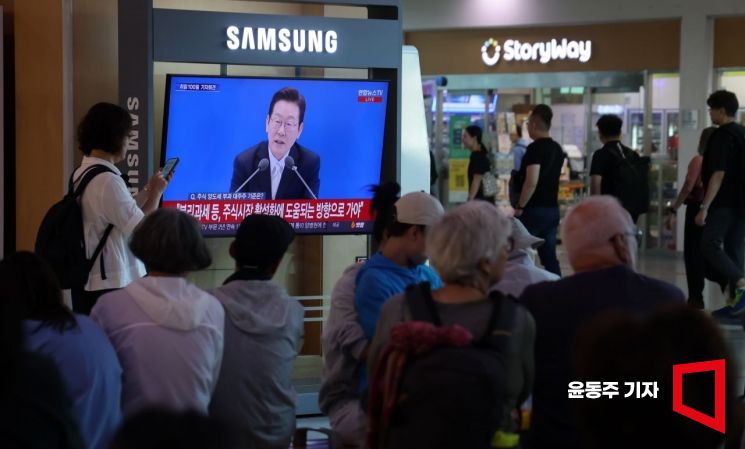 On the 11th, citizens at the Seoul Station waiting room watched the live broadcast of President Lee Jae-myung's 100-day inauguration press conference. 2025.09.11 Photo by Dongju Yoon
Jung Haechang and Lee Kyungmin, strategists at Daishin Securities, stated in their September 12 report, "End of the Honeymoon for the Lee Jaemyung Administration: Will Expectations Become Reality?" that "the first 100 days of a presidential term are the golden time for policy momentum. The initial steps have been set in the right direction." The report continued, "This is also the period when policy expectations are at their highest in the stock market. The KOSPI reached a historic peak, buoyed by global market strength and additional momentum from policies targeting the 'KOSPI 5000' milestone."
Regarding President Lee Jaemyung's 100-day inauguration press conference held the previous day, the report noted, "The event primarily reaffirmed the administration's existing policy stance," and added, "It did not provide any additional momentum from the market's perspective." In the stock market, there has been keen interest in whether the administration would withdraw the tax reform plan to lower the major shareholder capital gains tax threshold to 1 billion won. President Lee indicated a possible withdrawal by emphasizing the need for principled taxation, but also acknowledging investor sentiment, stating, "There is no need to insist on it."
The report also stated, "Industrial policy announcements largely summarized existing details. In the energy sector, the administration reiterated a pragmatic mix, emphasizing that a return to nuclear phase-out is not the direction, while reaffirming the focus on renewable energy and strengthening the power grid as realistic policies." The analysts added, "While maintaining policy consistency, the administration clarified its direction and reaffirmed its commitment, which is meaningful. However, from the market's perspective, no additional upward momentum for stock prices was provided."
If policy expectations have driven the domestic stock market so far, the key going forward will be policy execution and results. The report emphasized, "The honeymoon period for the Lee Jaemyung administration is now effectively over," and "it is now time for actual results to be delivered." Accordingly, they predicted, "In the short term, as expectations peak, profit-taking is likely to prevail."
Regarding the future direction of stock prices, the analysts stated, "It will depend on the judicial enforcement and legal effectiveness of unfair trading practices under the revised Tax Act and Commercial Act; the visibility of corporate earnings following industrial policies; and whether, amid diplomatic issues such as negotiations with the United States (including auto tariffs and skilled worker visas) and North American dialogues, the Korean economy can secure a distinct competitive advantage in the global environment." They added, "Going forward, it is time to focus on tracking the actual performance of industries and companies resulting from institutional changes, rather than just policy events."
On capital market policy, President Lee highlighted the issue of the "Korea Discount" the previous day, again pointing out that governance structures and unfair practices are undermining market trust. He also emphasized that, in cases of unfair trading such as stock price manipulation, not only profits but also principal amounts will be confiscated. He diagnosed that the sluggish domestic investment by the National Pension Service and other pension funds fundamentally stems from the undervaluation and lack of trust in the domestic market.
From a tax perspective, President Lee indicated that revitalizing the market is a priority, suggesting the withdrawal of the tax reform plan that would have lowered the major shareholder threshold for capital gains tax from the current 5 billion won to 1 billion won. He also stated that separate taxation of dividend income should be steered in a way that helps invigorate the stock market, signaling a possible reduction of the maximum tax rate from the current 35%. There have been ongoing calls from within and outside the market to lower the rate to 25% to provide more incentives for companies to increase dividends, as the current system discourages them from doing so.
© The Asia Business Daily(www.asiae.co.kr). All rights reserved.

















