Establishment and Approval of the "2025 National Suicide Prevention Strategy" through Inter-Ministerial Collaboration
Overcoming the Stigma of "OECD's Highest Suicide Rate" by Proactively Addressing Risk Factors
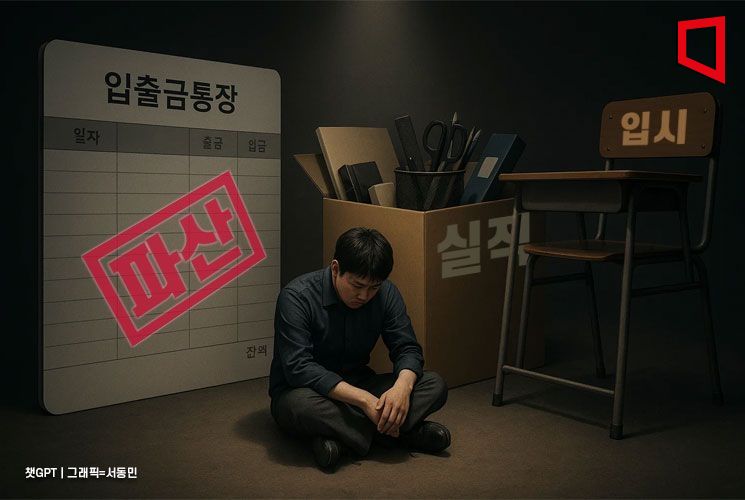
The government will revise related systems to write off long-term debts for small business owners and individuals who lack repayment capacity and to allow people to receive medical benefits even if they have dependents. In response to the severe suicide problem, with an average of 40 people taking their own lives each day, the government has decided to mobilize all inter-ministerial policy tools to address various suicide risk factors, such as bankruptcy, unemployment, academic stress, and crime victimization.
On September 12, the government held the 9th Suicide Prevention Policy Committee at the Government Complex Seoul, chaired by Prime Minister Kim Minseok, and reviewed agenda items including the "2025 National Suicide Prevention Strategy."
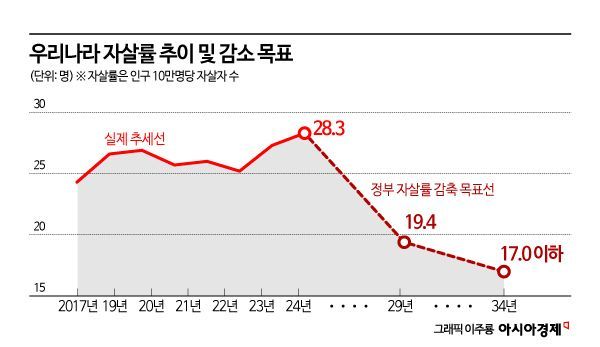
With the vision of "A society where everyone protects everyone, and life protection becomes a daily routine in Korea," this plan aims to reduce the suicide rate-which was 28.3 per 100,000 people last year-to 19.4 by 2029 and to below 17.0 by 2034. The goal is to lower the annual number of suicides, which exceeds 14,400, to below 10,000 within five years, and to overcome the stigma of having the highest suicide rate among OECD countries within ten years.
The plan involves 14 ministries and agencies, including the Ministry of Health and Welfare, Office for Government Policy Coordination, Financial Services Commission, Ministry of Education, Ministry of Gender Equality and Family, Ministry of Employment and Labor, Ministry of Justice, Ministry of the Interior and Safety, Ministry of National Defense, National Police Agency, and National Fire Agency. Together, they will implement 18 initiatives across five key areas.
First, to strengthen management of those at the highest risk-suicide attempters-the plan will enhance immediate and emergency intervention. When an incident occurs, local government suicide prevention centers will be dispatched to the scene to assist with emergency room accompaniment and treatment processes. In addition, nationwide one-stop support for suicide survivors will be expanded to include psychological counseling, temporary housing, specialized cleaning and legal assistance, and educational grants.
Various organizations-including suicide prevention centers, integrated financial support centers for low-income individuals, employment and welfare centers, crime victim support centers, youth counseling and welfare centers, family centers, and Wee Centers-will collaborate to identify high-risk groups early, resolve complex difficulties, and quickly address crises through a systematic network and partnership system.
In particular, to address the diverse, complex, and multiple factors that cause psychological crises-such as debt, illegal debt collection, financial hardship, school violence, workplace bullying, family issues, crime and disaster victimization, and addiction-the government will deploy inter-ministerial policy measures. Under the leadership of the Financial Services Commission, the government will purchase and write off or restructure long-term delinquent loans (over seven years, under 50 million won) held by small business owners and individuals. It will also expand free legal representation for victims of illegal debt collection. To protect "people on the edge," the Ministry of Health and Welfare will promote emergency livelihood support, increase livelihood benefits, and abolish the dependent support requirement for medical benefits.
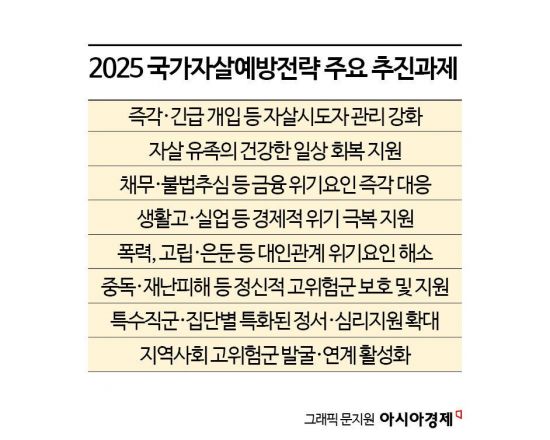
The Ministry of Education will introduce a relationship recovery reflection period to prevent and address school violence and expand support for victimized students, thereby managing relationship crises within schools. For multi-victim crimes such as voice phishing and rental fraud, the Ministry of Justice will lead strict investigations, asset seizure and forfeiture, and enhanced victim protection. Support will be provided for police officers, firefighters, and other high-risk workers to overcome trauma from field responses. The Ministry of National Defense will mandate psychological testing for all officers, establish mobile psychological testing, and expand the deployment of specialized counselors for military life.
The government will establish dedicated suicide prevention and crisis response teams at local government headquarters, designating suicide prevention officers to develop tailored prevention and field-oriented response strategies that reflect regional conditions and specific risk factors. Plans are also underway to use artificial intelligence (AI) technology to analyze suicide prevention hotline conversations in real time and monitor harmful online information.
Lee Hyunghoon, Second Vice Minister of Health and Welfare, emphasized, "Currently, suicide rates among teenagers and people in their 20s continue to worsen, and with the increase in single-person households and social isolation, the risk of a severe suicide situation is likely to persist. The government and local authorities will pool their capabilities to improve social awareness of suicide and proactively address suicide risk factors with our full efforts."
© The Asia Business Daily(www.asiae.co.kr). All rights reserved.
![Clutching a Stolen Dior Bag, Saying "I Hate Being Poor but Real"... The Grotesque Con of a "Human Knockoff" [Slate]](https://cwcontent.asiae.co.kr/asiaresize/183/2026021902243444107_1771435474.jpg)

















